Yes, you can, as long as you understand a couple of fundamental technical details.
Basics
As long as the specific voltage and current requirements of a piece of equipment are met, you can use that equipment anywhere you like. The trick is to meet those requirements, and for that, you’ll need to know:
- The operating voltage of the equipment
- Its power consumption, and
- If it can be reconfigured for different line voltages
If you own 100V Japanese equipment that cannot be reconfigured for other local voltages, and many pieces cannot, you’ll need to select and source a suitable step-down or step-up transformer with the correct power rating and voltage. Such a step-down transformer should be sourced from a quality local manufacturer like Tortech.
A quality step-down transformer should be capable of delivering 1.5x – 3x (or more) the rated maximum power consumption of the equipment drawing power from it. It must also deliver the voltage your equipment requires, within +/- 5%. This will ensure your equipment runs well under the most challenging conditions.
Low-power devices are easiest to use with step-down transformers because their low power consumption means a small, affordable transformer can be used. High-power step-down transformers are expensive, large, heavy, ugly things, and just another box you have to find a place for.
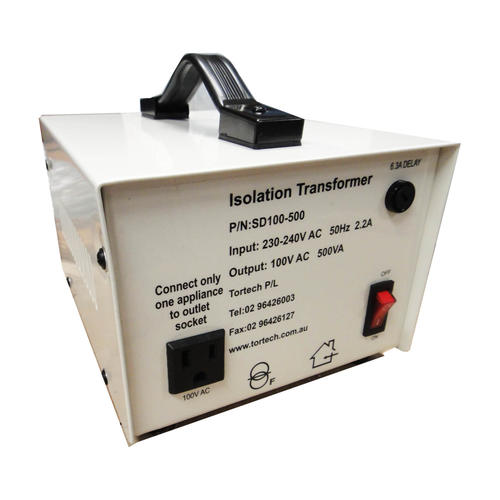
Note that 100V equipment needs a 100V step-down transformer, NOT the 110V or 120V units often found online or in cheap electronics stores. The placard on the rear of your equipment specifies what voltage it needs. Avoid cheap transformers because they often don’t meet their specifications for voltage, power (W or VA), or duty cycle.
Special Cases
If you have an integrated or power amplifier, you’ll need a big step-down transformer. An amplifier rated for 500W maximum power consumption should be matched with a transformer rated for 1- 1.5 kW at a 100% duty cycle, or even more if possible. That’s a hefty transformer, and it won’t be cheap.
The high rating is needed to minimise power supply source impedance and ensure the transformer core does not saturate. This, in turn, will maximise amplifier performance and ensure the transformer does not overheat. Because hefty transformers are heavy and expensive, amplifiers are the least well-suited for use with step-down transformers.
For low-powered equipment like turntables, DACs and preamps, smaller step-down transformers work very well. A moderately sized (say 300W) transformer will safely run several low-power devices. Just make sure that the total continuous power consumption of all the connected equipment is comfortably exceeded (1.5x to 3x, or more) by the continuous maximum rating of the step-down transformer.
Voltage
It is always best to run high-power devices like amplifiers on the highest voltage they can be configured for, ie 240V in most cases. There are two reasons for this. Setting the highest voltage provides the greatest margin for overvoltage conditions, so there is some degree of protection in this configuration. Also, at 240V, the current requirements are less than half of what they are at 100V.
Lower current draw means less voltage sag at the outlet, lower wire losses due to resistive heating and reduced dynamic effects associated with modulation of the power supply rails. Many ‘extreme’ hi-fi systems in countries with 100 or 120V mains will have house wiring configured to deliver 230 or 240V for this reason.
Warnings
Never plug equipment configured for 100V or 120V into a 220V/230V/240V mains outlet unless it has been configured for 240V. Failure to adhere to this warning WILL result in the DEATH of your equipment, and it may be permanent!
Reconfiguring equipment may require internal work such as the adjustment of jumpers, connectors or switches, soldering, and replacement parts such as circuit breakers and/or fuses of a different current rating to suit the higher line voltage. This work cannot be ignored or haphazardly completed because equipment may catastrophically fail if a fault occurs when correctly rated current limit devices (fuses, circuit breakers) are not in place.
I’ve seen a recent influx of 100V equipment that has failed because people have not had it reconfigured or have forgotten to use a step-down transformer. I’ve also seen Japanese equipment incorrectly reconfigured, and some where the correctly rated circuit breakers or fuses have not been installed, exposing that equipment to the risk of catastrophic failure. It is imperative to have equipment professionally inspected and reconfigured, and to make sure any 100V equipment and zones are clearly marked.
PS
If you found this information helpful, there is a donate button in the footer and 150 other FAQs you might enjoy, plus hundreds of other full-length articles, all for free.
Discover more from LiQUiD AUDiO
Subscribe to get the latest posts sent to your email.