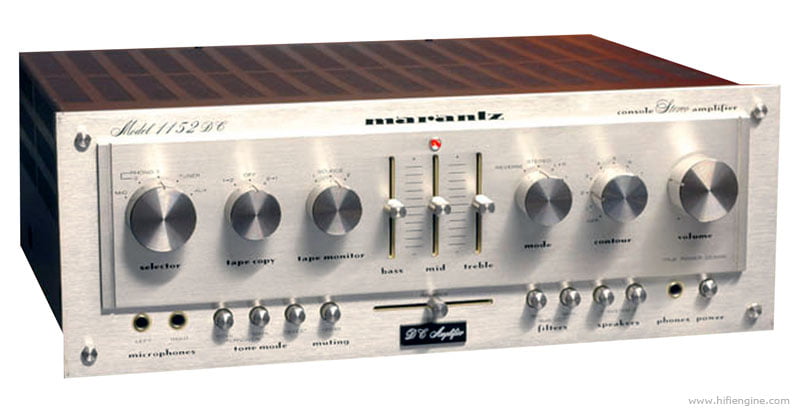
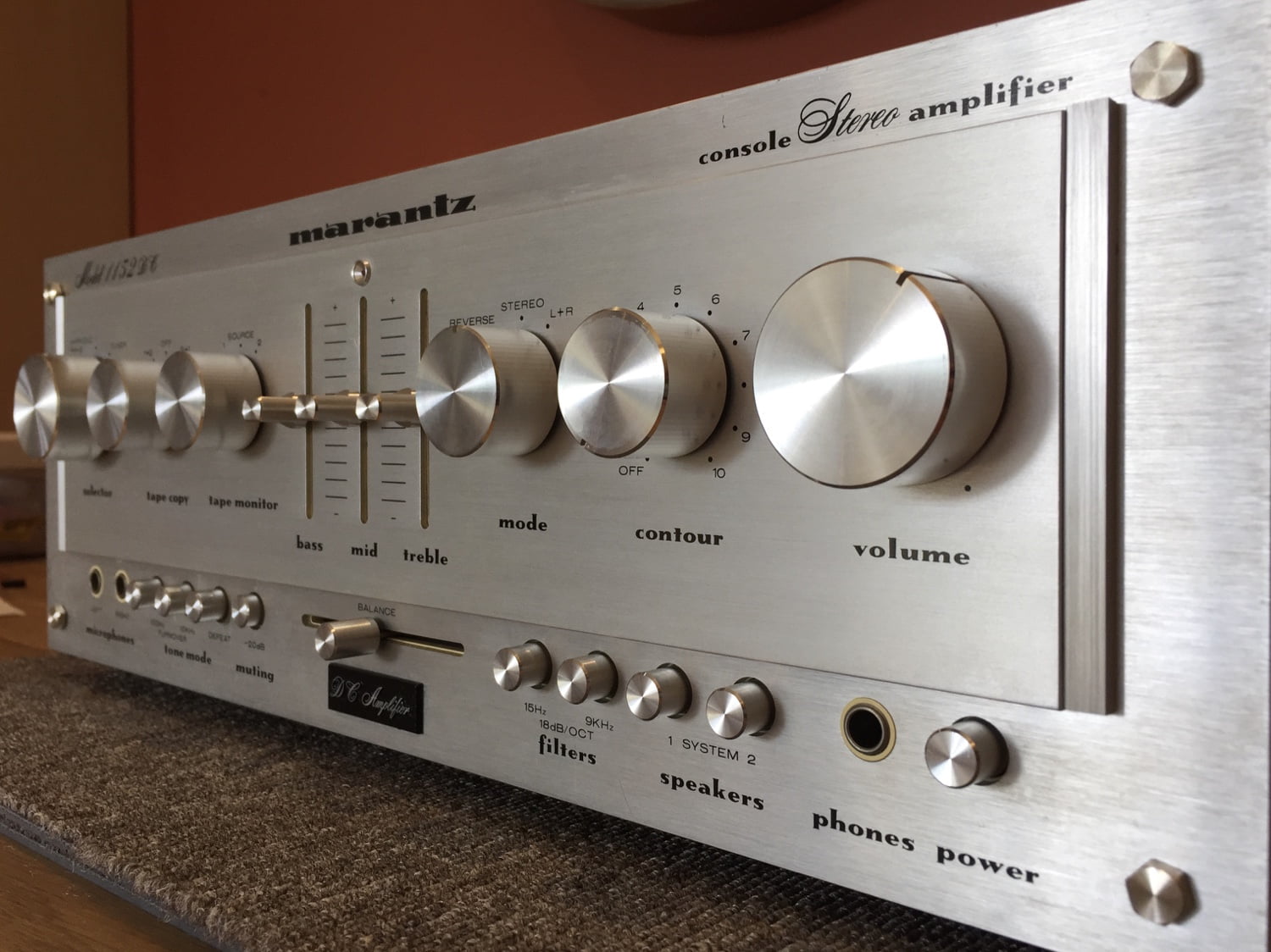
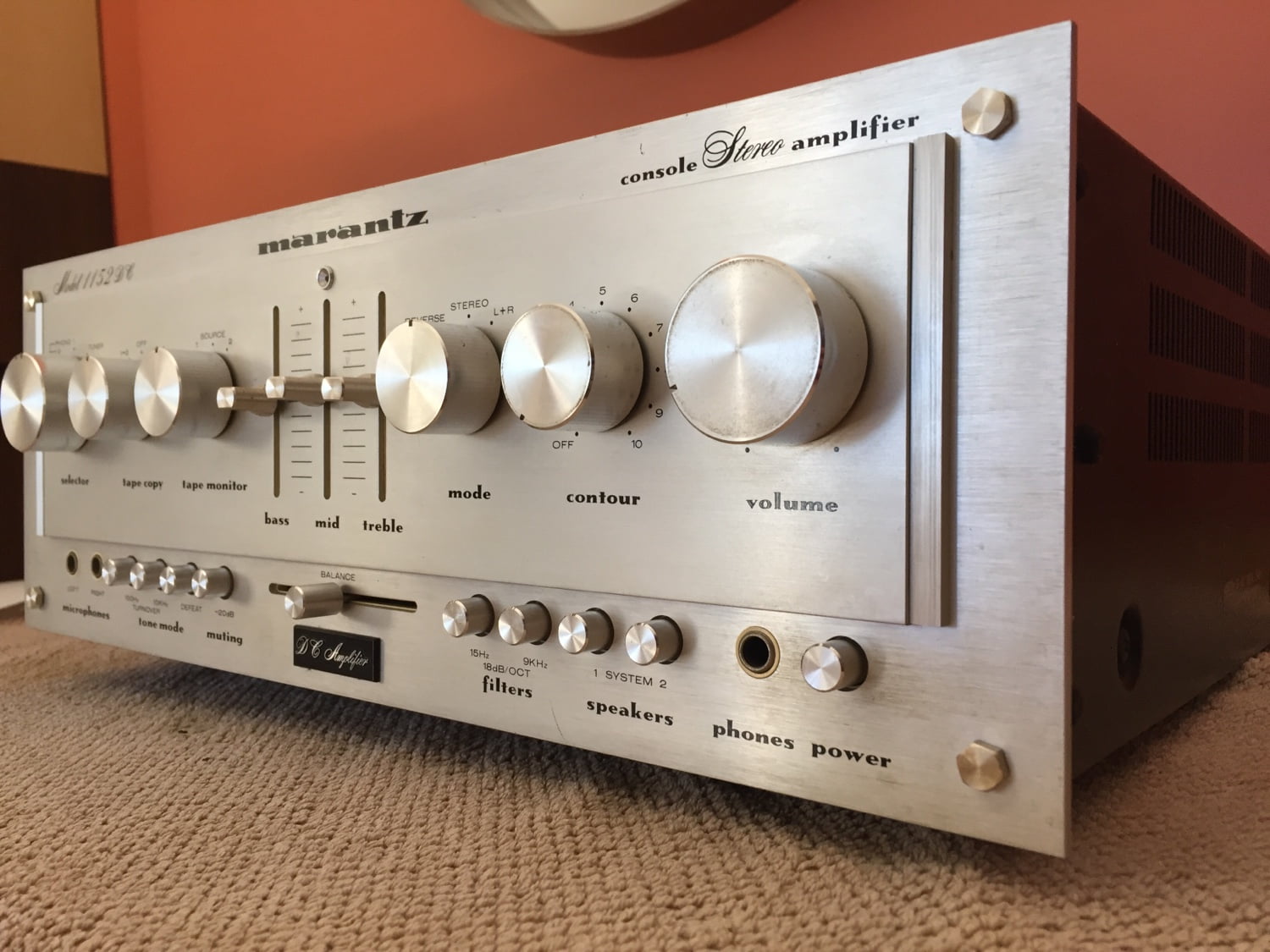
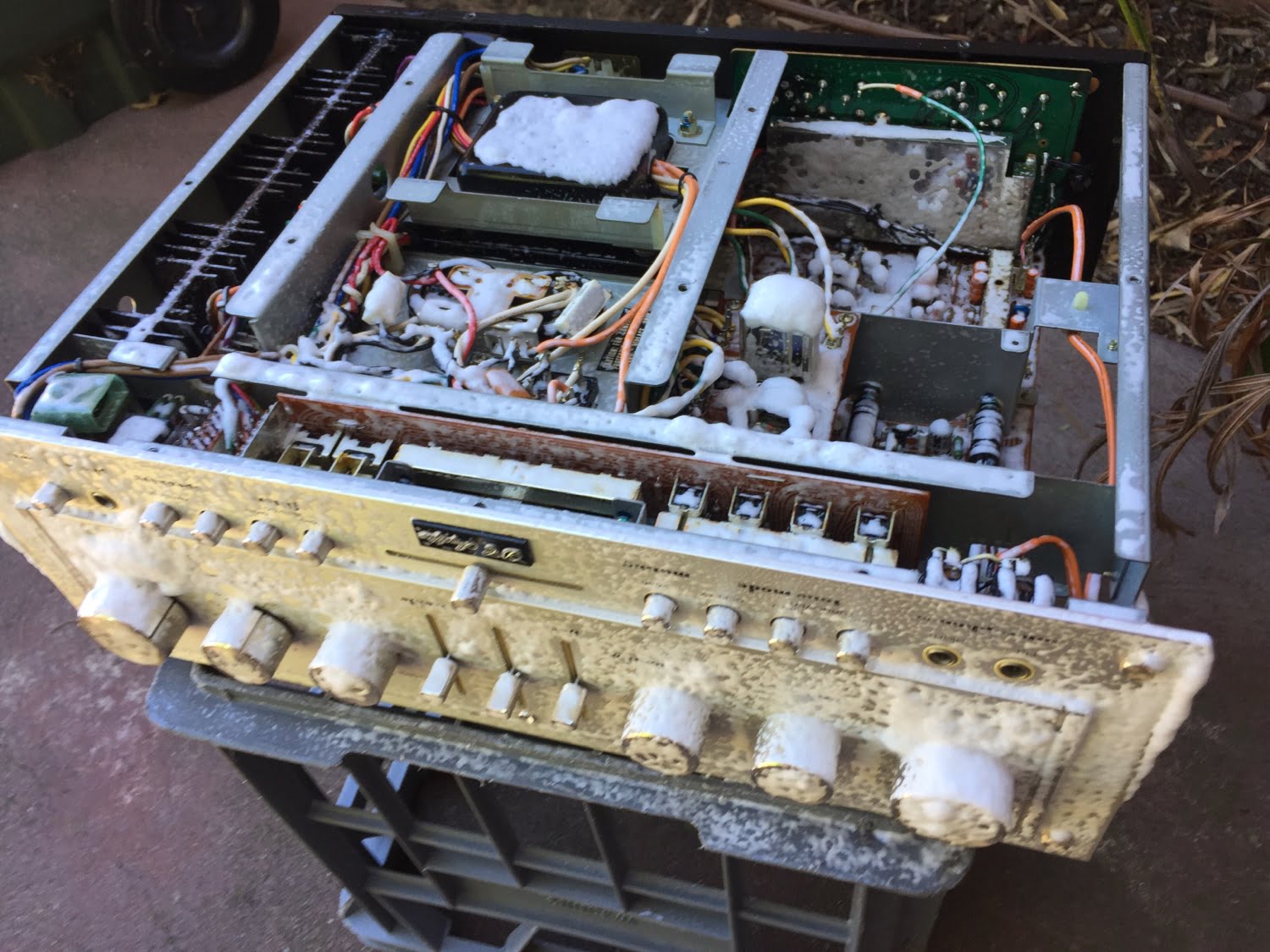
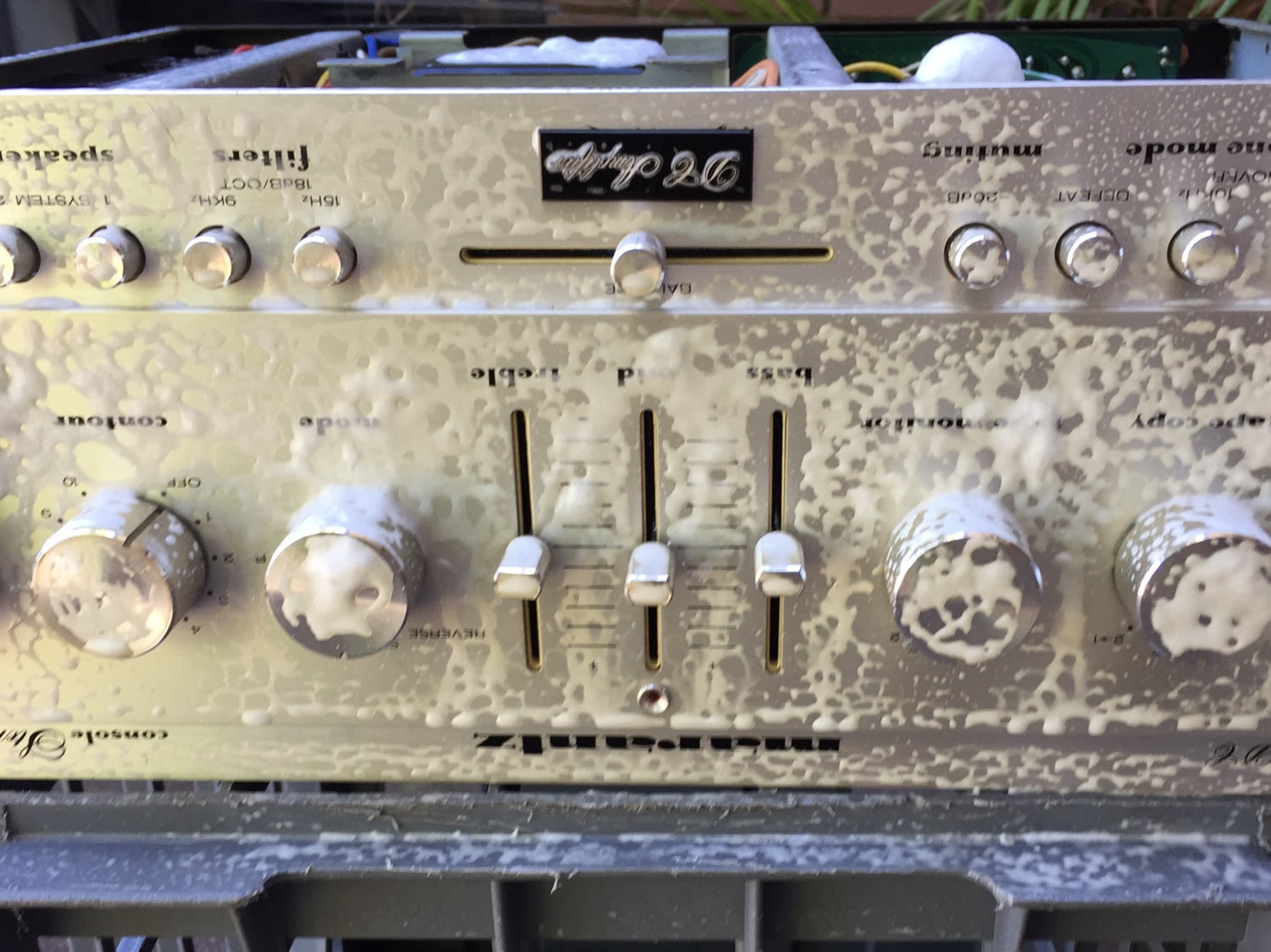
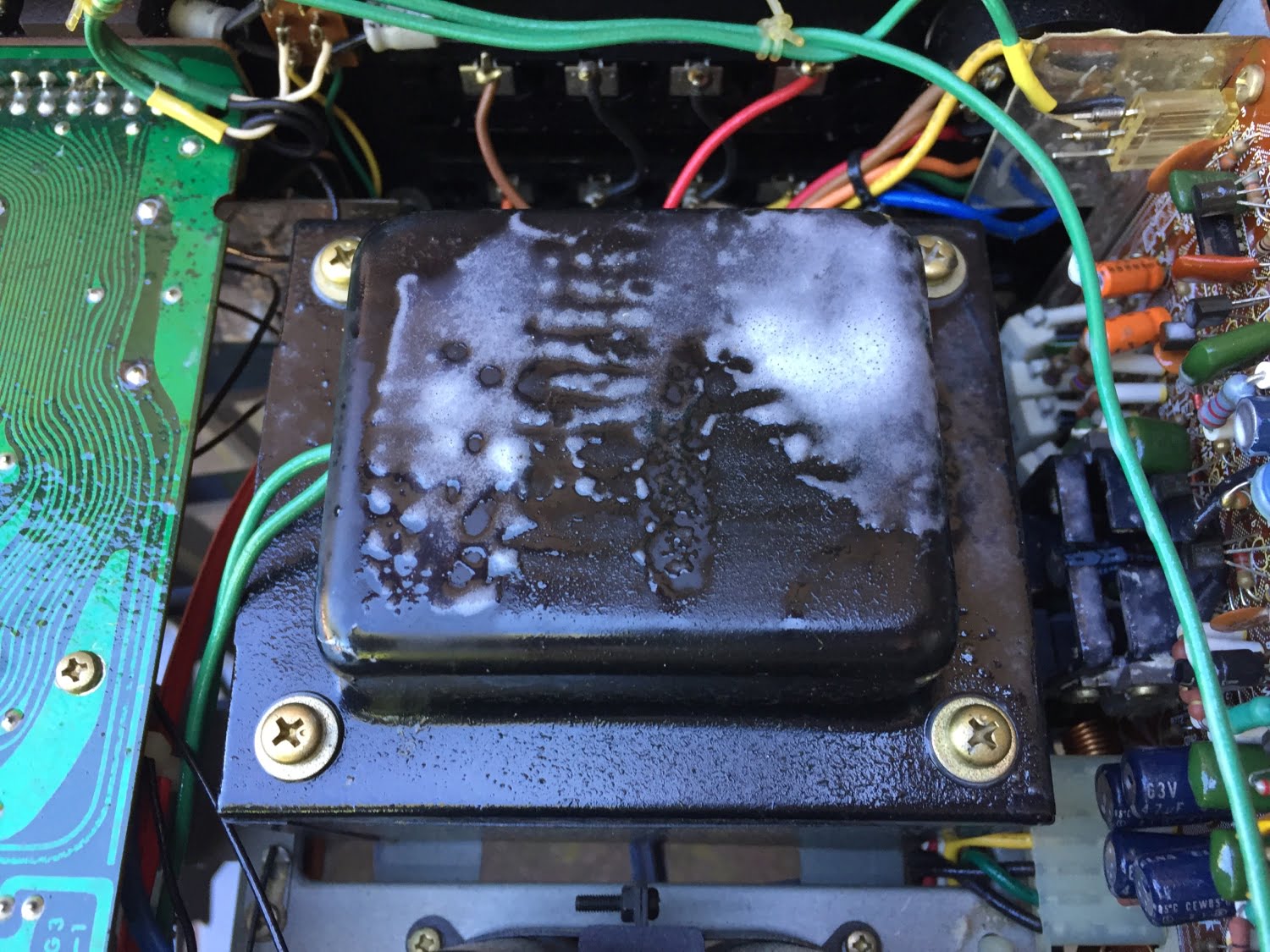
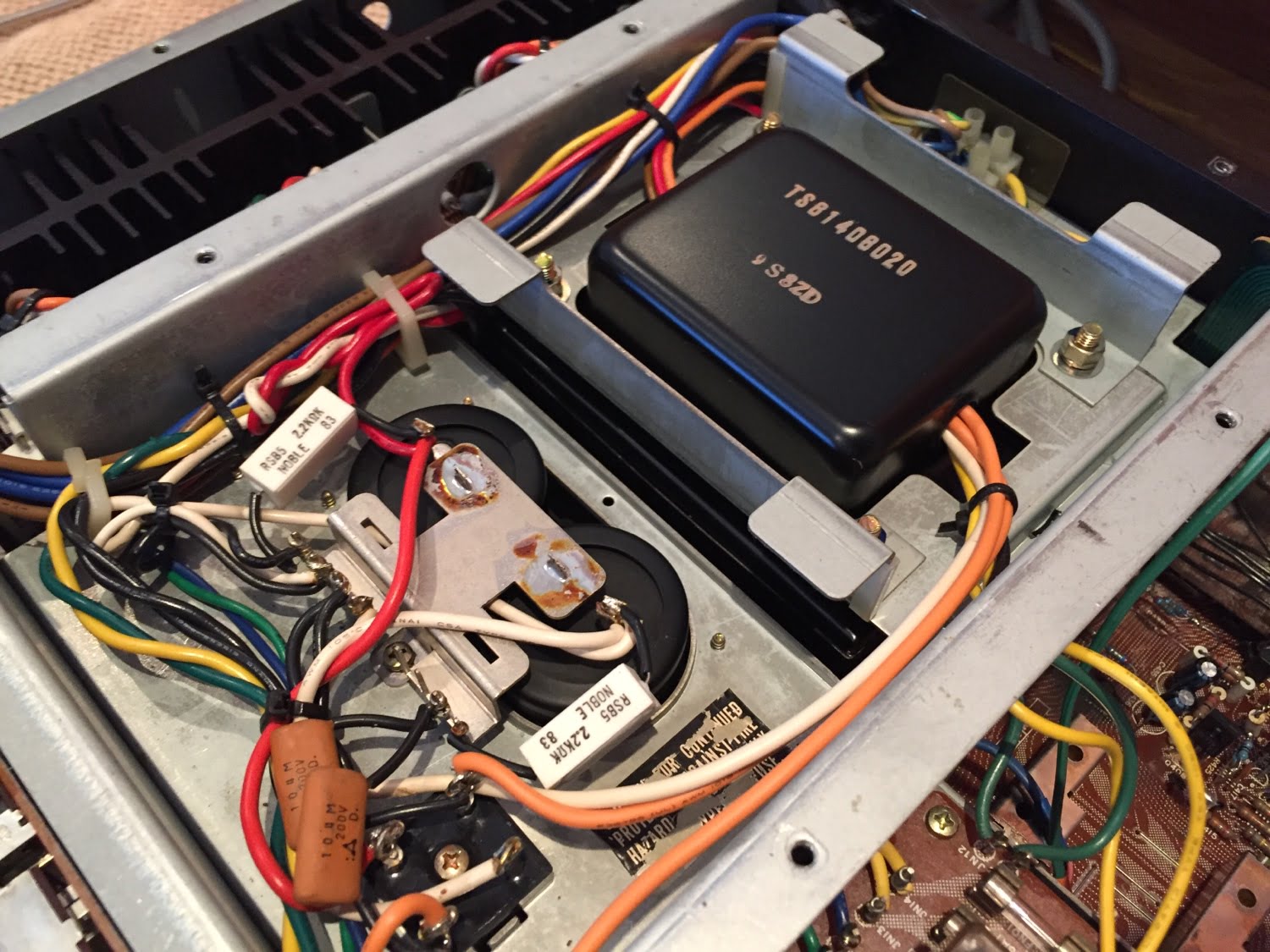
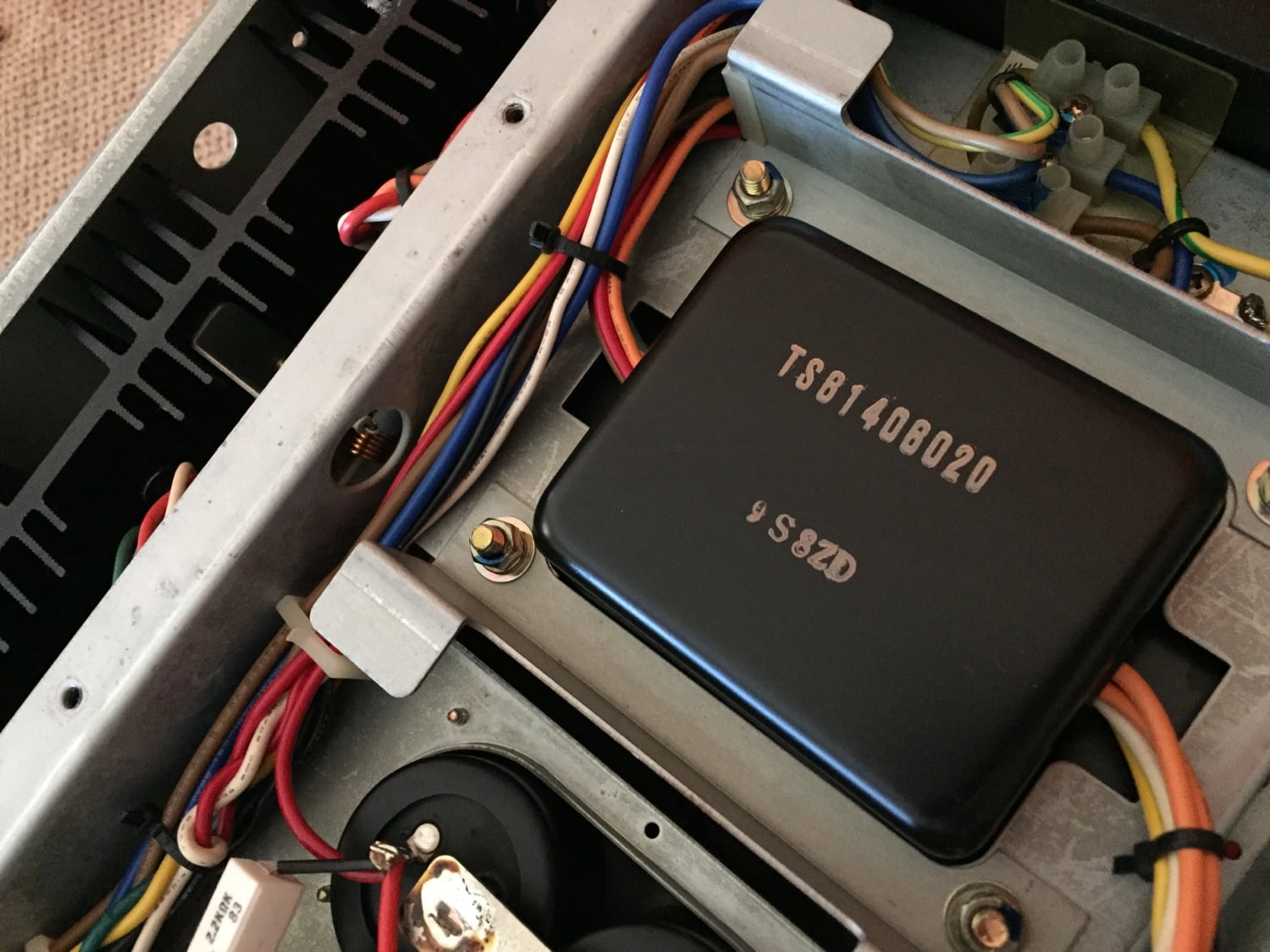
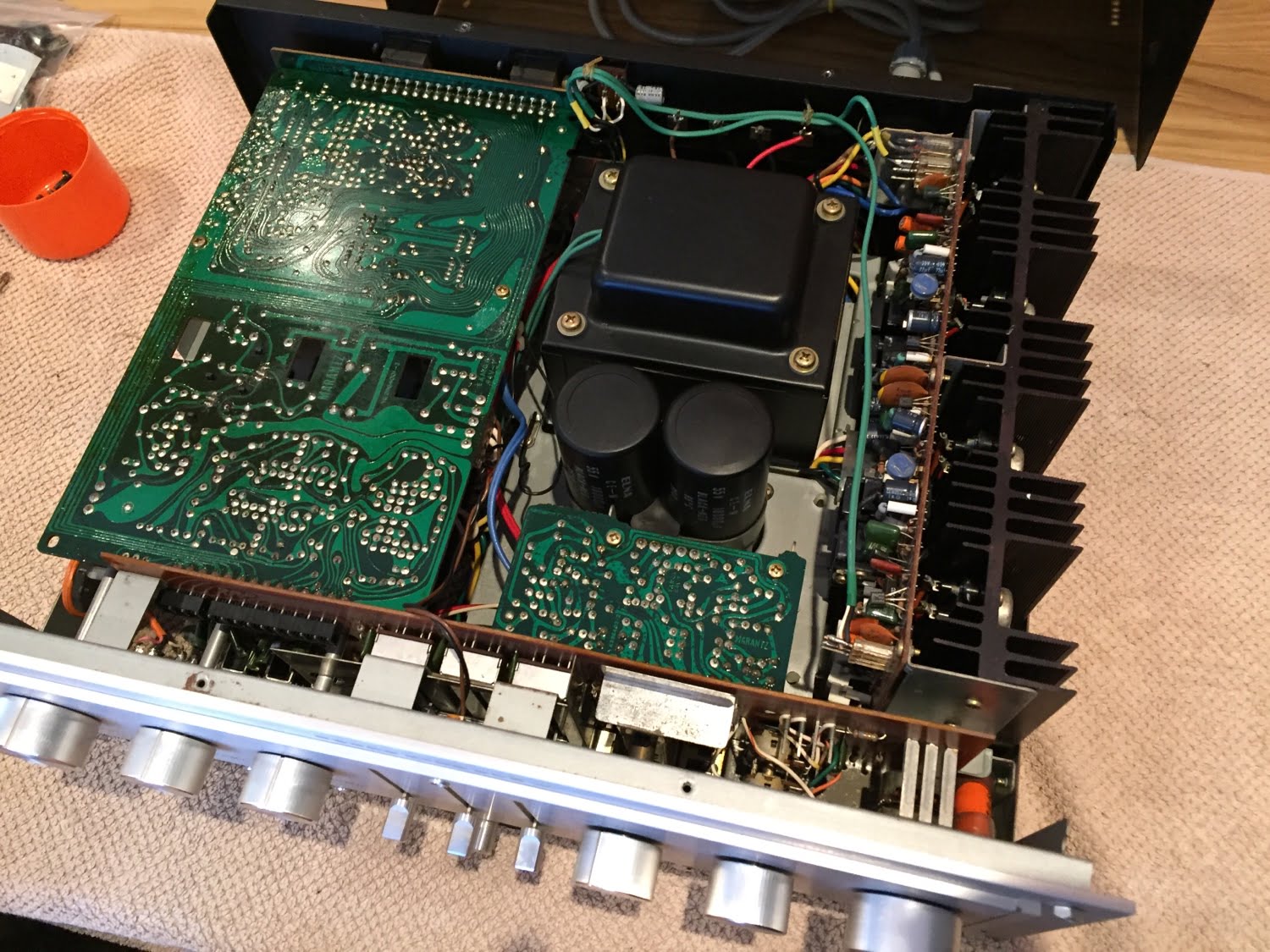
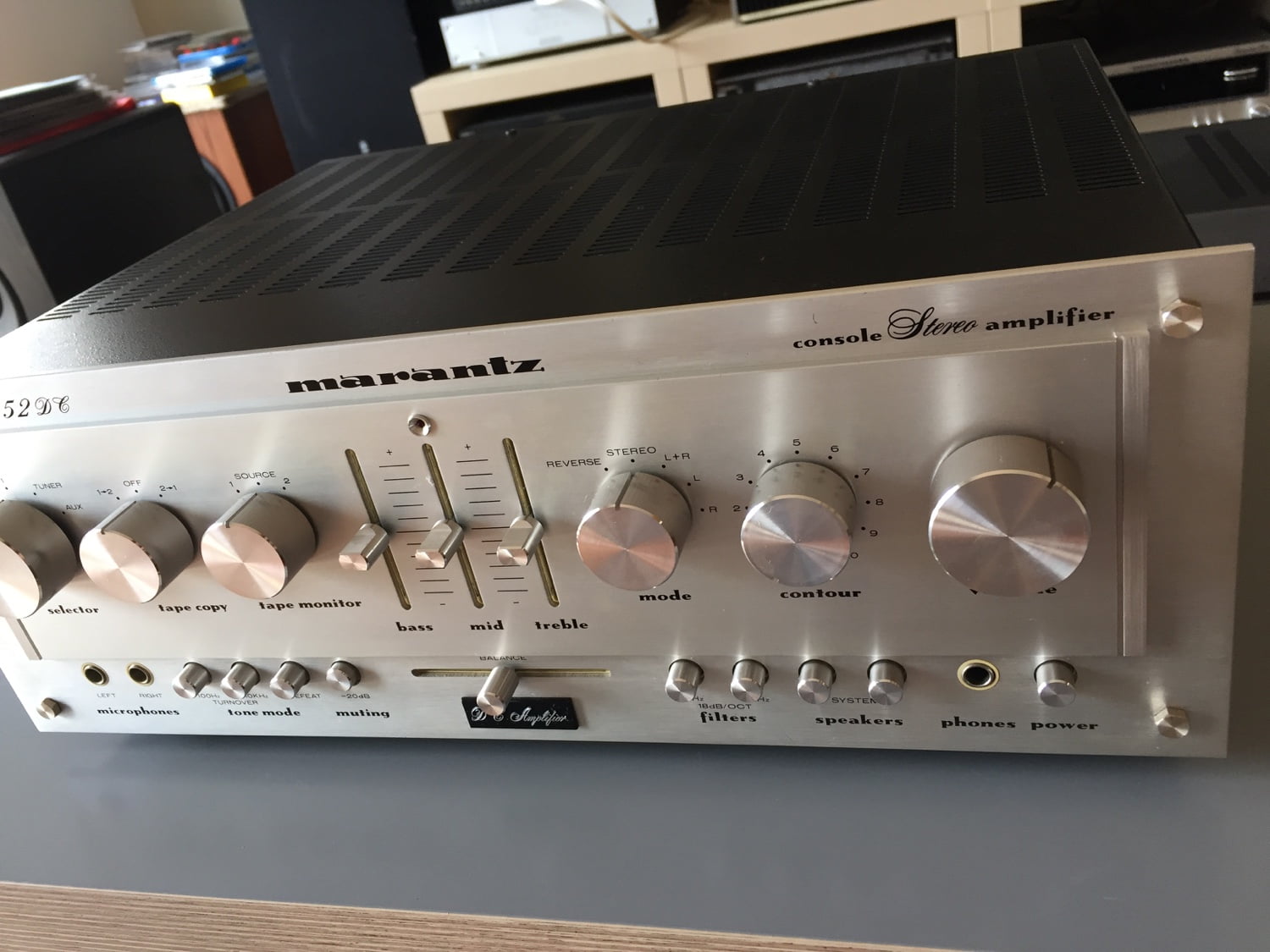
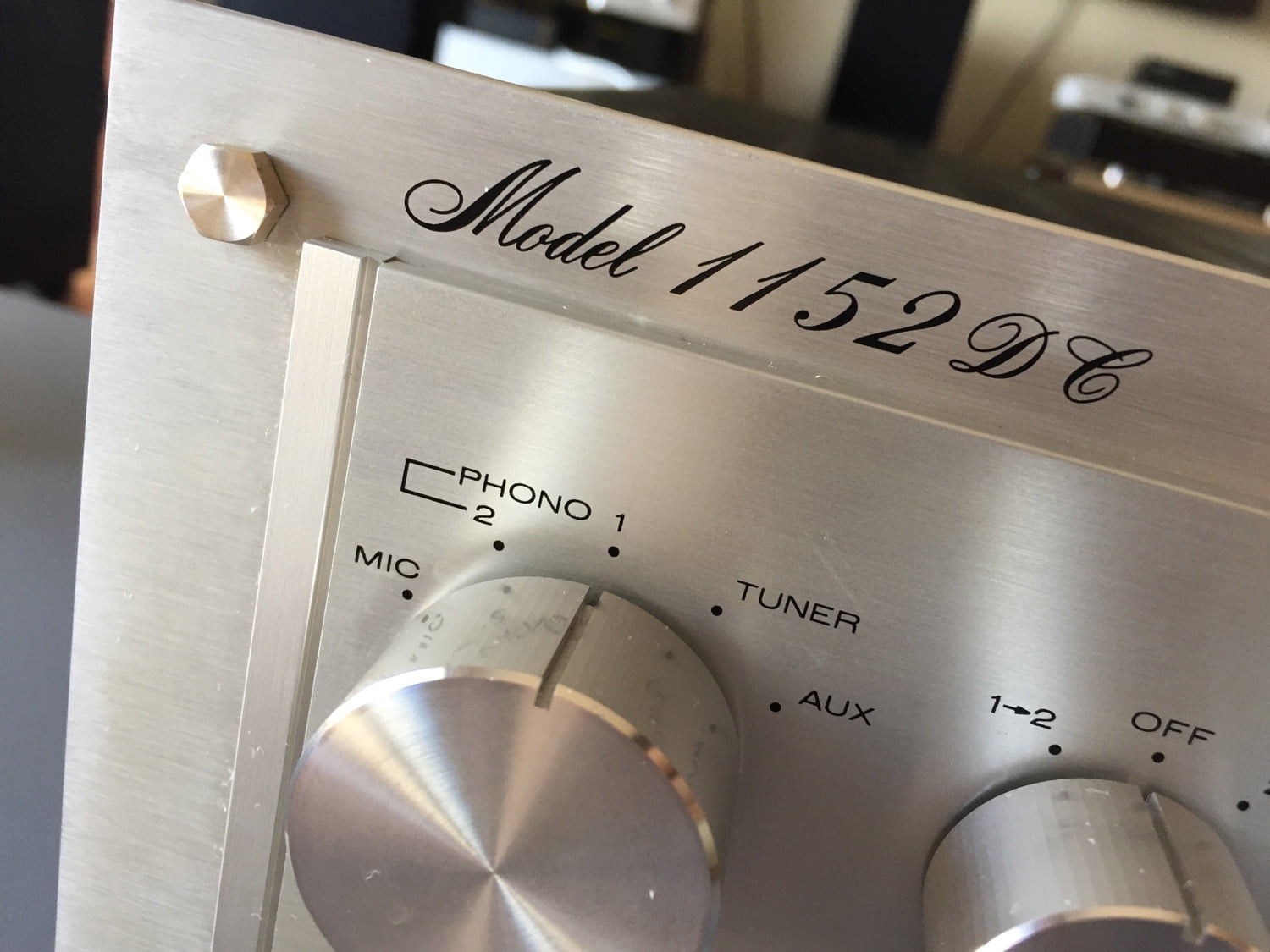
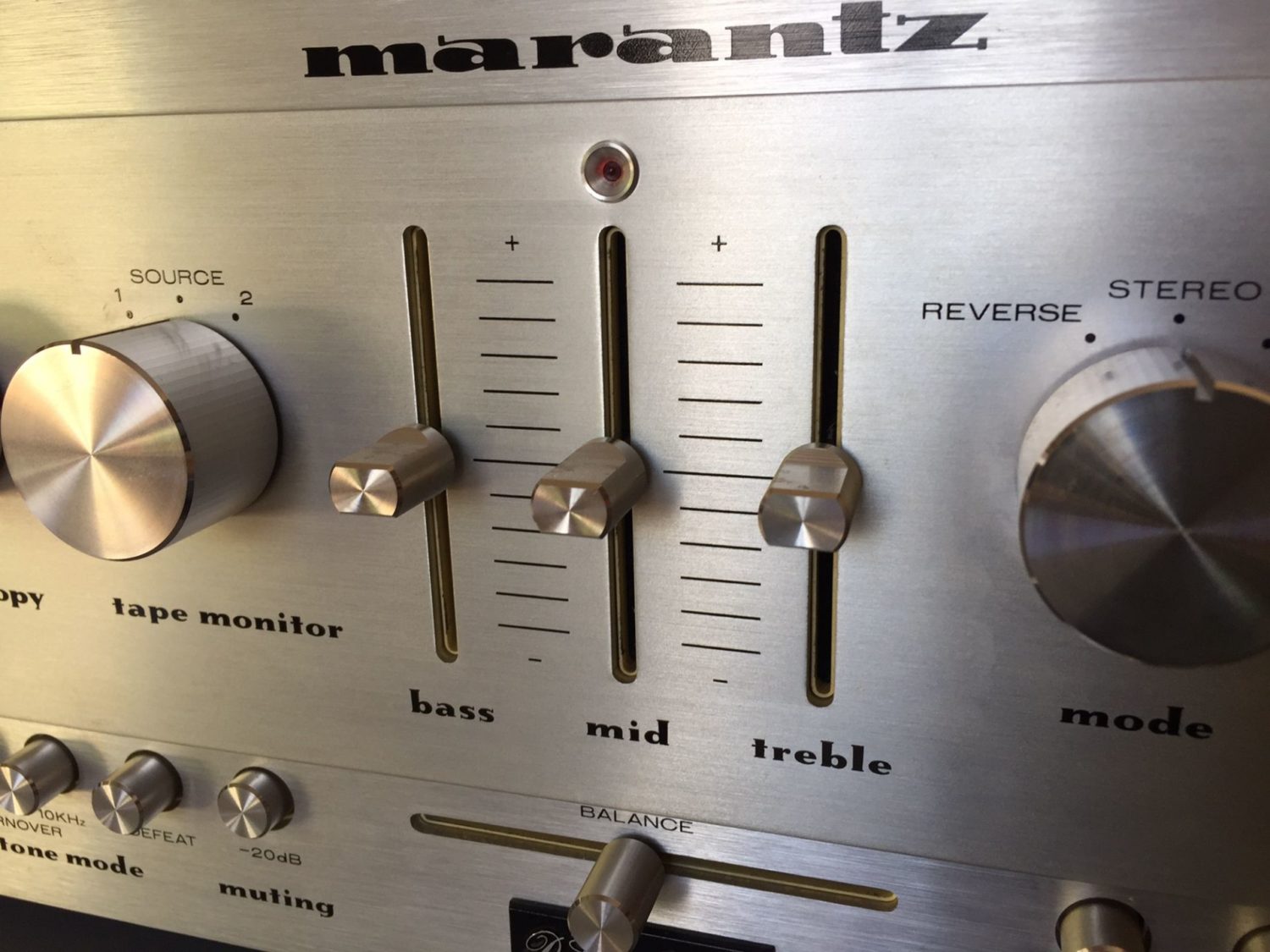
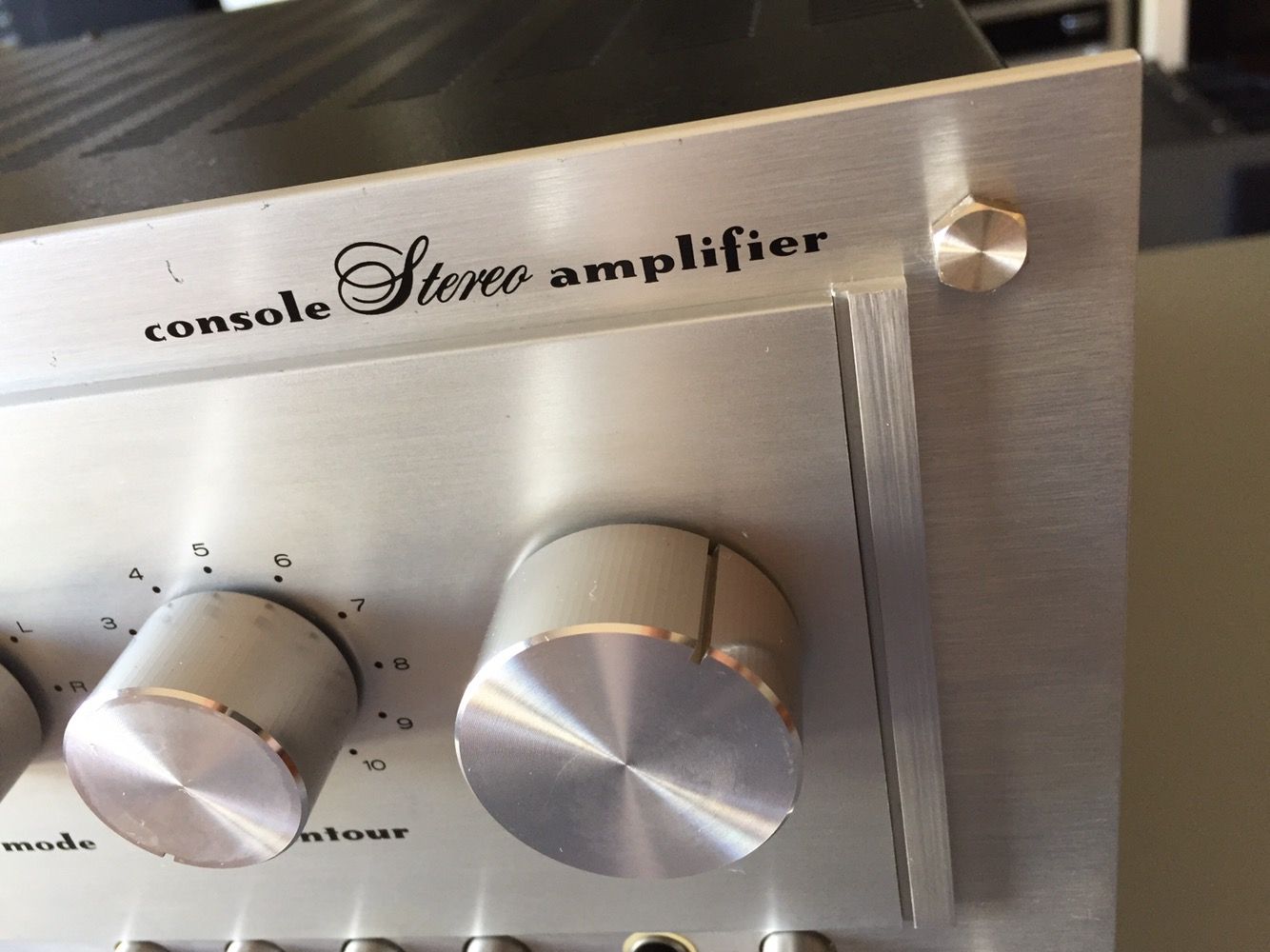
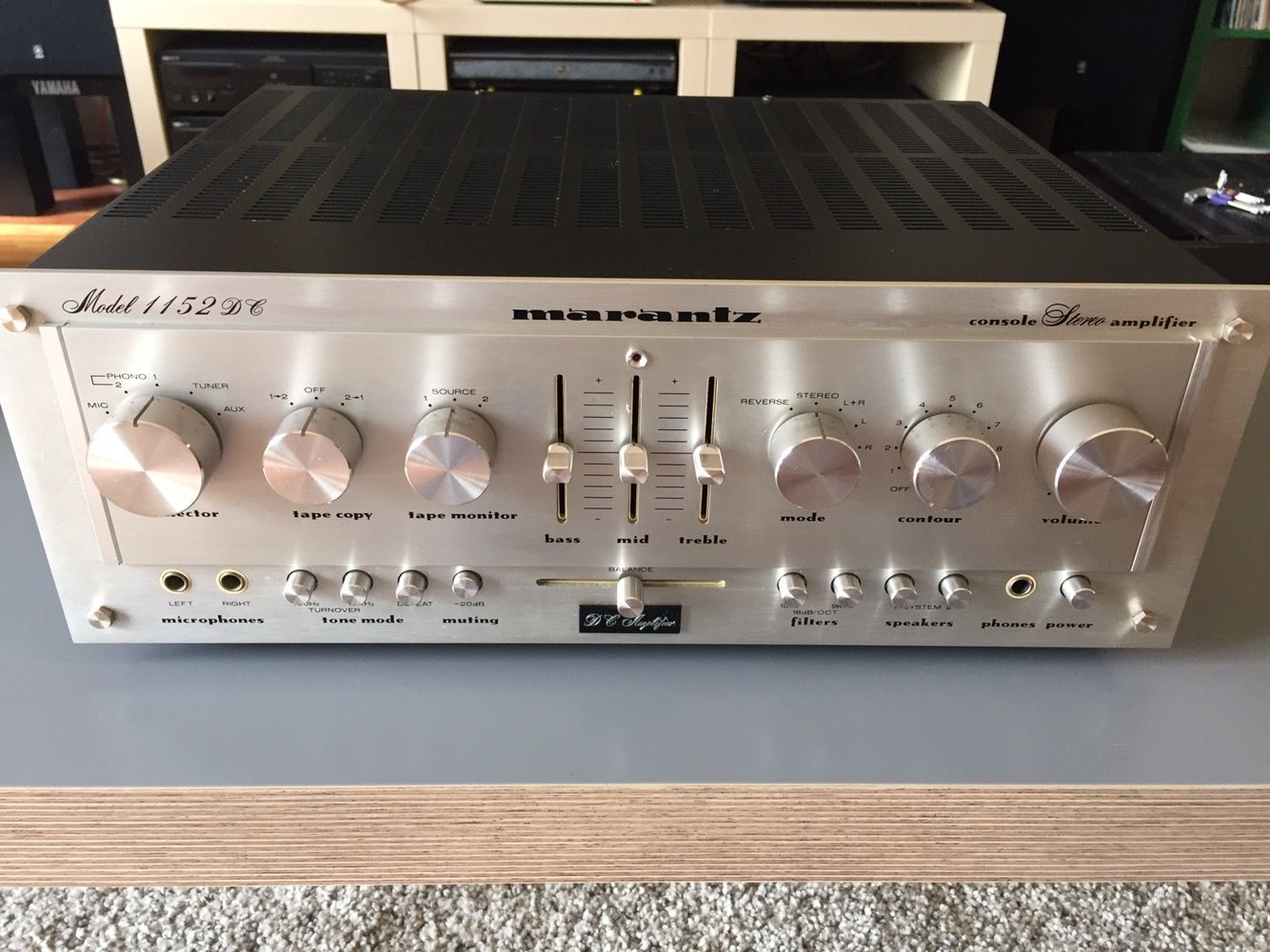
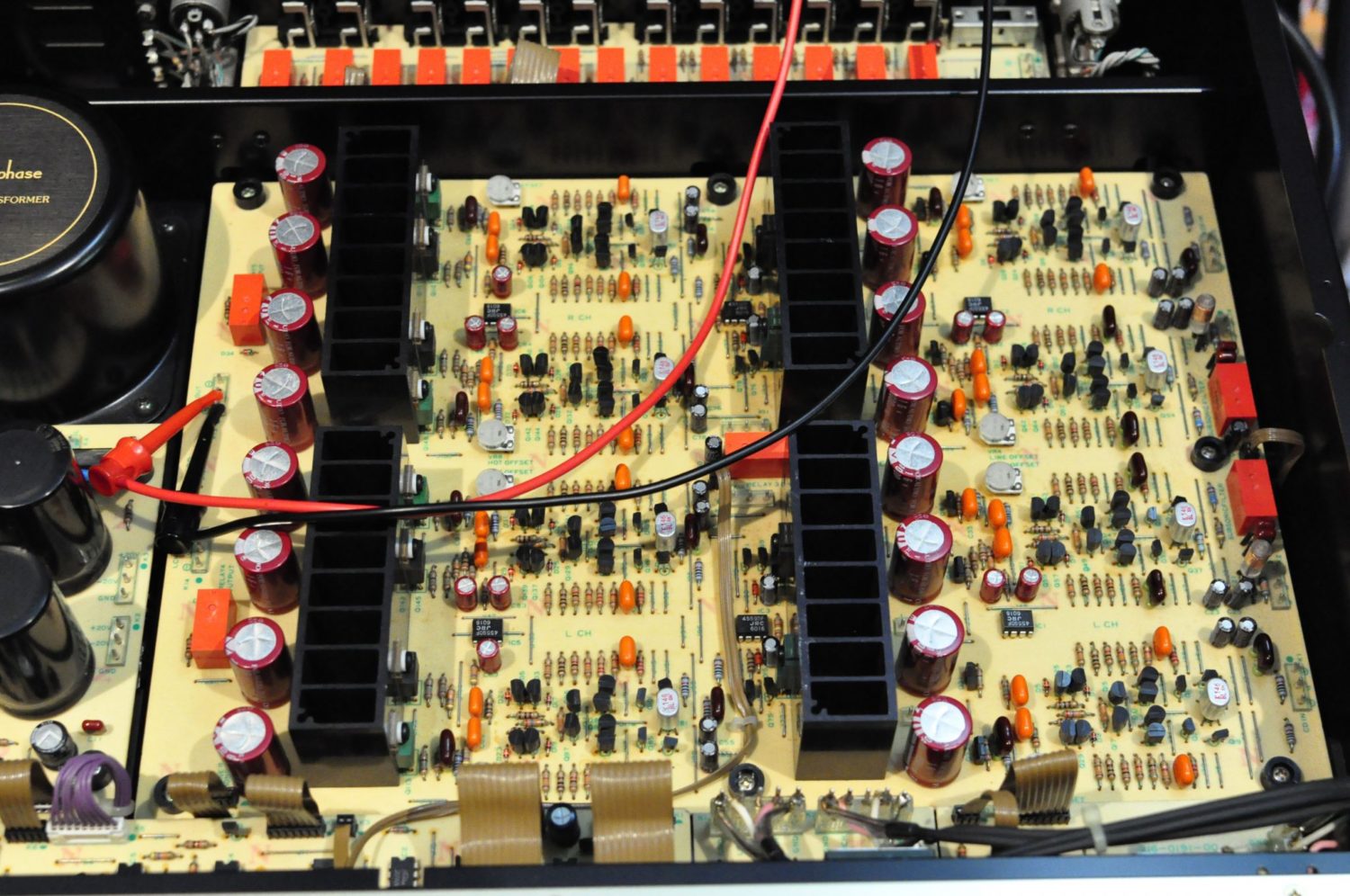
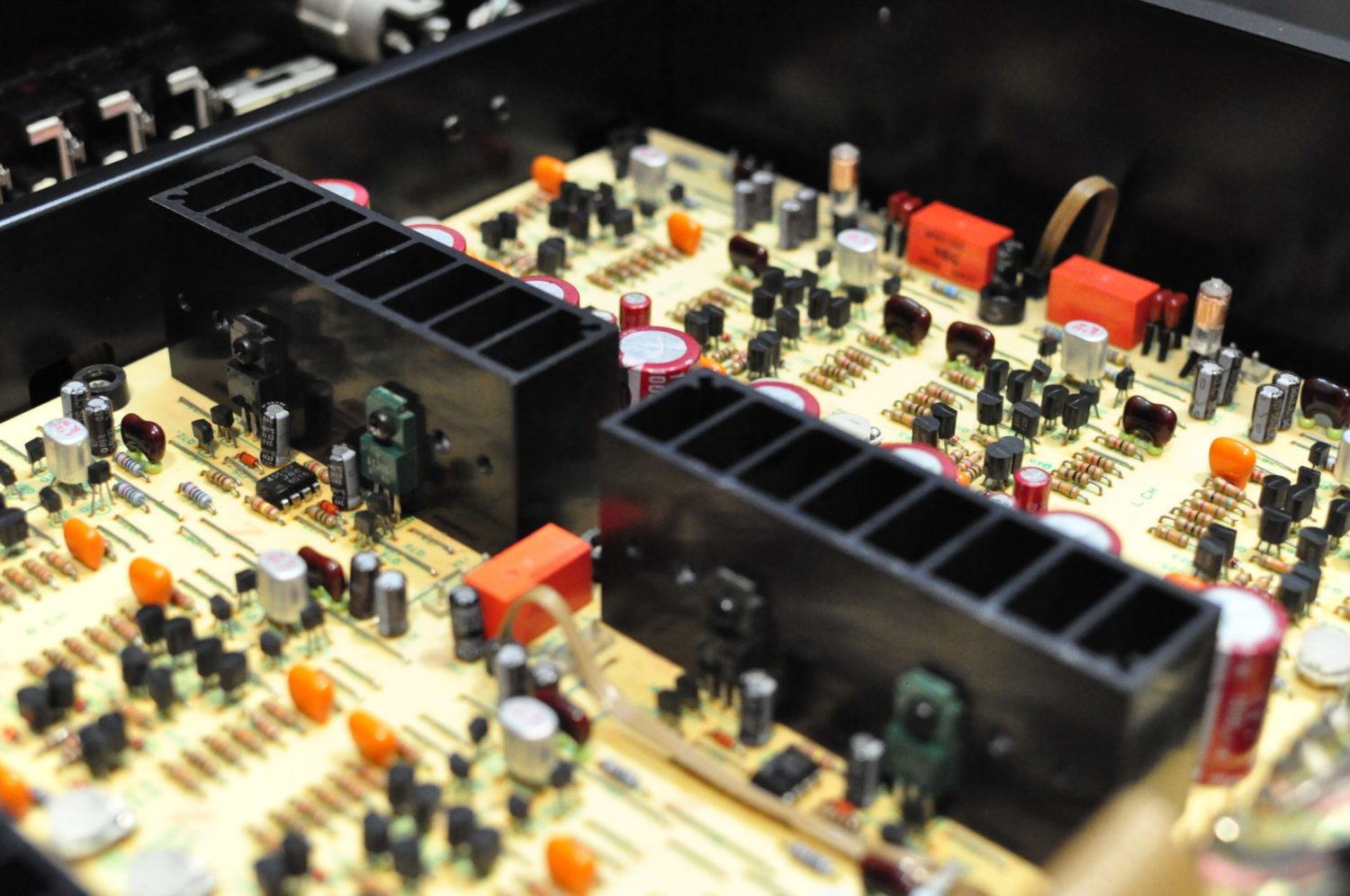
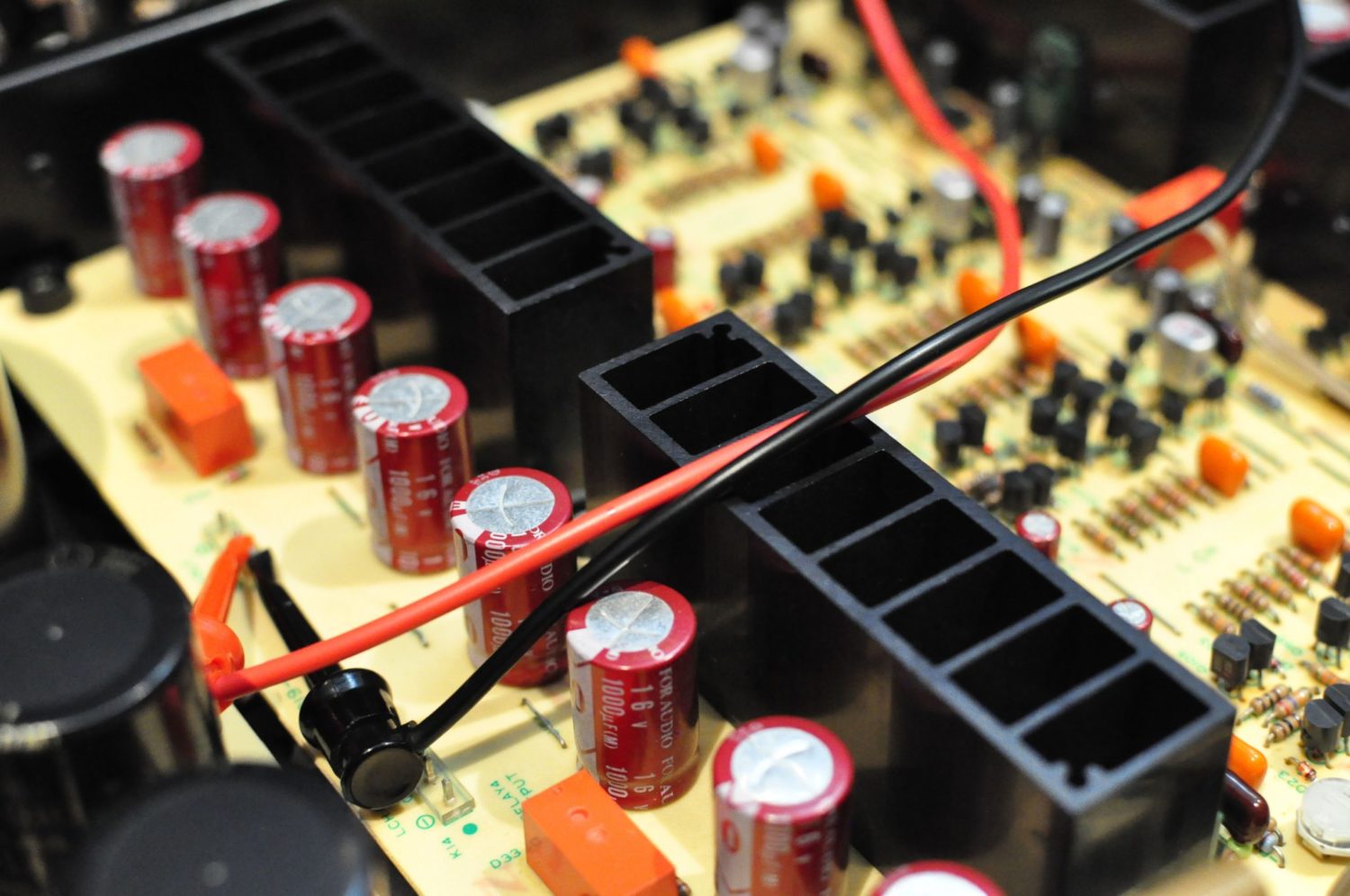
How’s this for a beautiful amplifier?! I recently repaired and restored this absolutely stunning Marantz 1152DC integrated amplifier, let’s take a look.
The Marantz 1152DC is an integrated amplifier from the upper middle of Marantz’s range in the late 1970’s. The 1152DC and others from this series are very collectible now, thanks to their unique looks, great sound and Marantz’s famous build quality. They were quite expensive but came with lots of great features and an excellent phono preamplifier.
This 1152DC was in almost perfect physical condition, but electrically it was a different story. She was donated to me by her generous original owner, in non-working condition. The unit had visited a well-known Perth electronics repairer at some point, and sadly, was worse off for it.
Power output: 76 watts per channel into 8Ω Frequency response: 7Hz to 70kHz Damping factor: 45 Input sensitivity: 1.8mV (MM), 180mV (line) Signal-to-noise ratio: 78dB (MM), 91dB (line) Output: 180mV (line), 1.5V (Pre out) Semiconductors: 73 x transistors, 44 x diodes, 4 x FETs Dimensions: 416 x 146 x 316mm Weight: 14kg
You’ll find more about the Marantz 1152DC at Classic Audio.
Problems
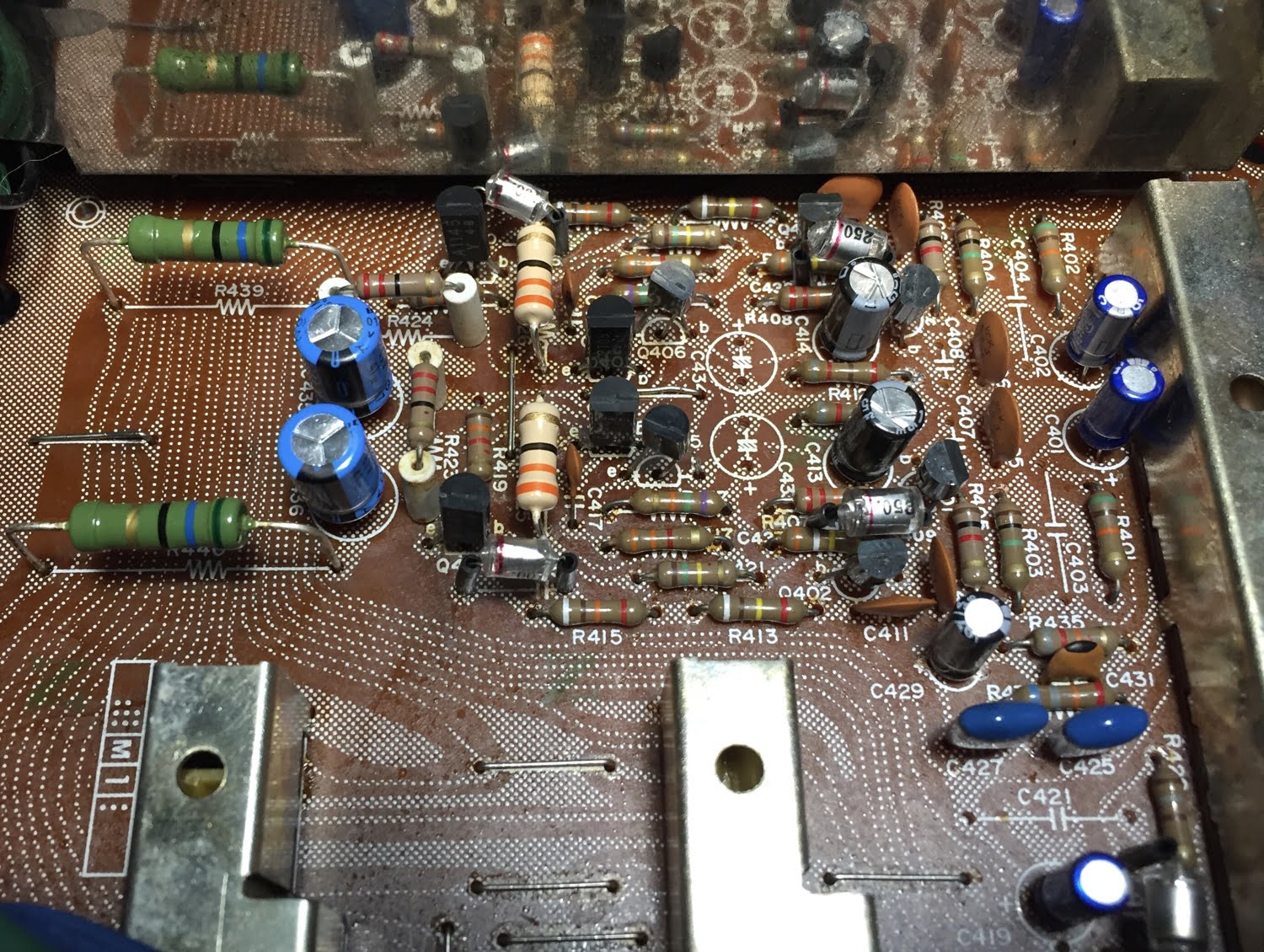
The repairer who worked previously on this Marantz 1152DC is well-known for taking shortcuts. Rather than take the time to clean boards, replace transistors as matched pairs, find parts that actually match those originally installed etc, this guy replaced just the bare minimum with poor substitutes, ‘made’ resistors, left charcoal on boards etc. Sound familiar..?
This Marantz 1152DC wouldn’t power on and showed some obvious signs of damage. Rather than risk more damage, I decided to completely overhaul her, before selling her to a lucky new owner.
Initial Condition
I would describe this 1152DC as cosmetically very good, but electrically needing work.
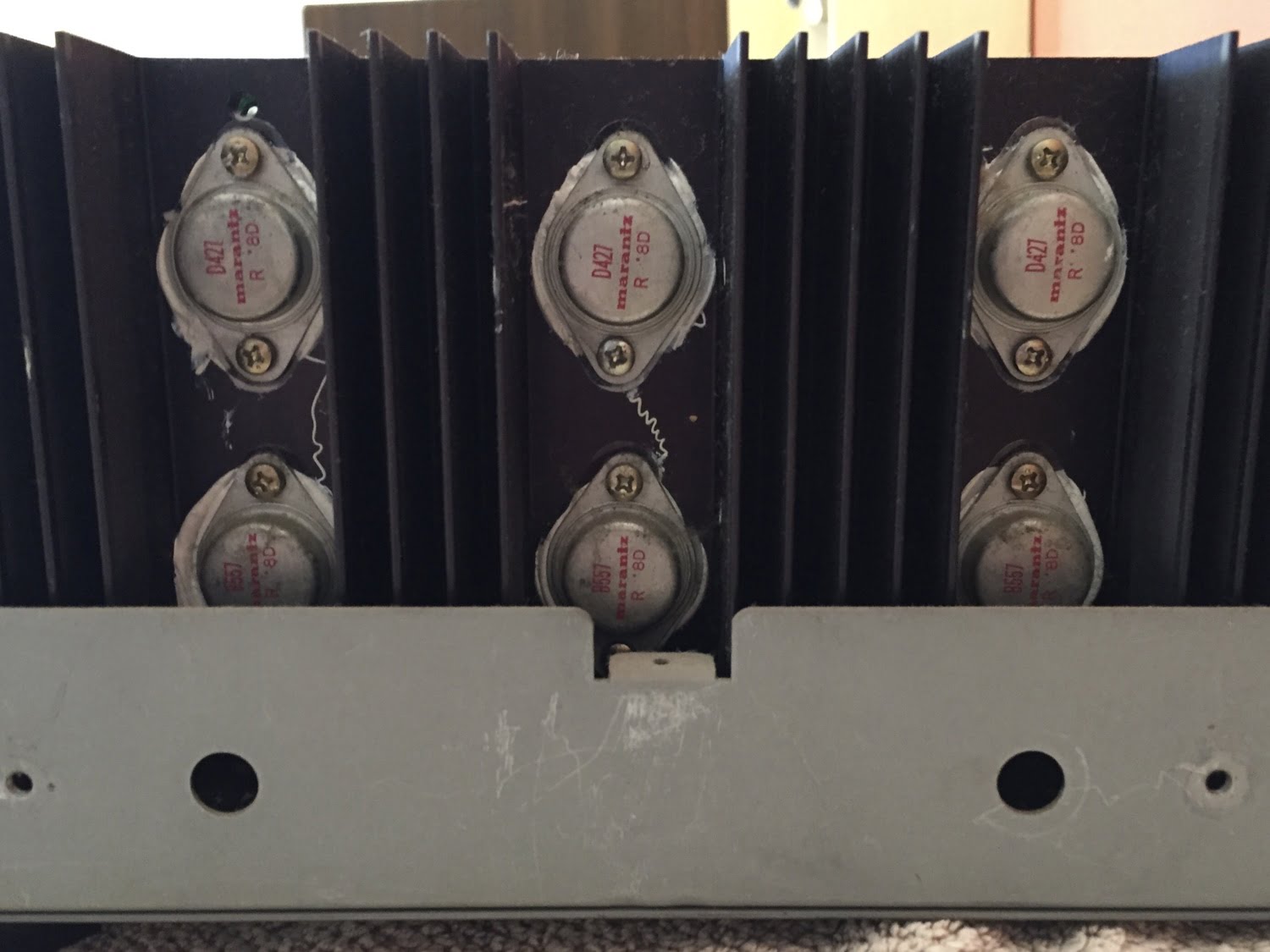
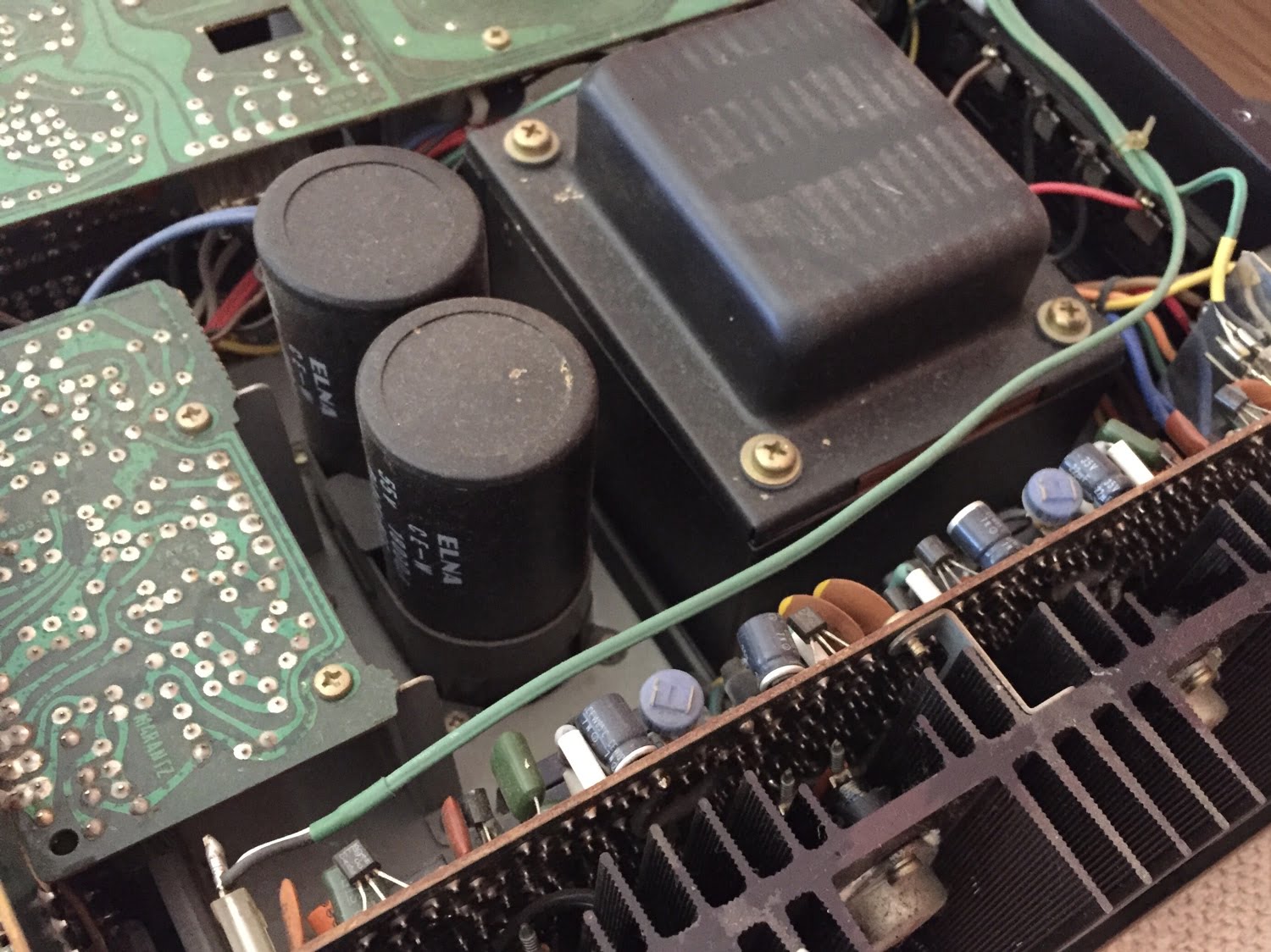
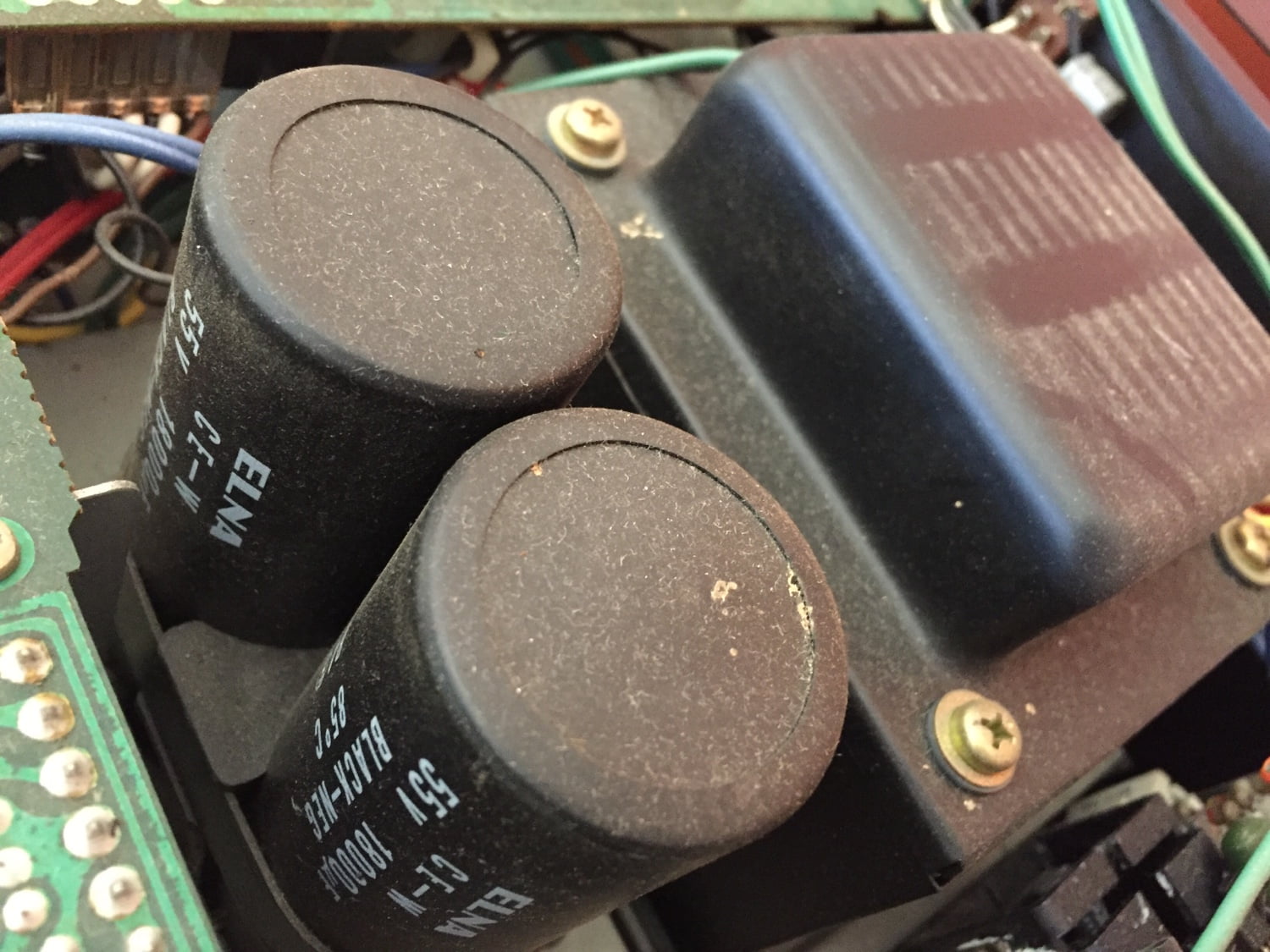
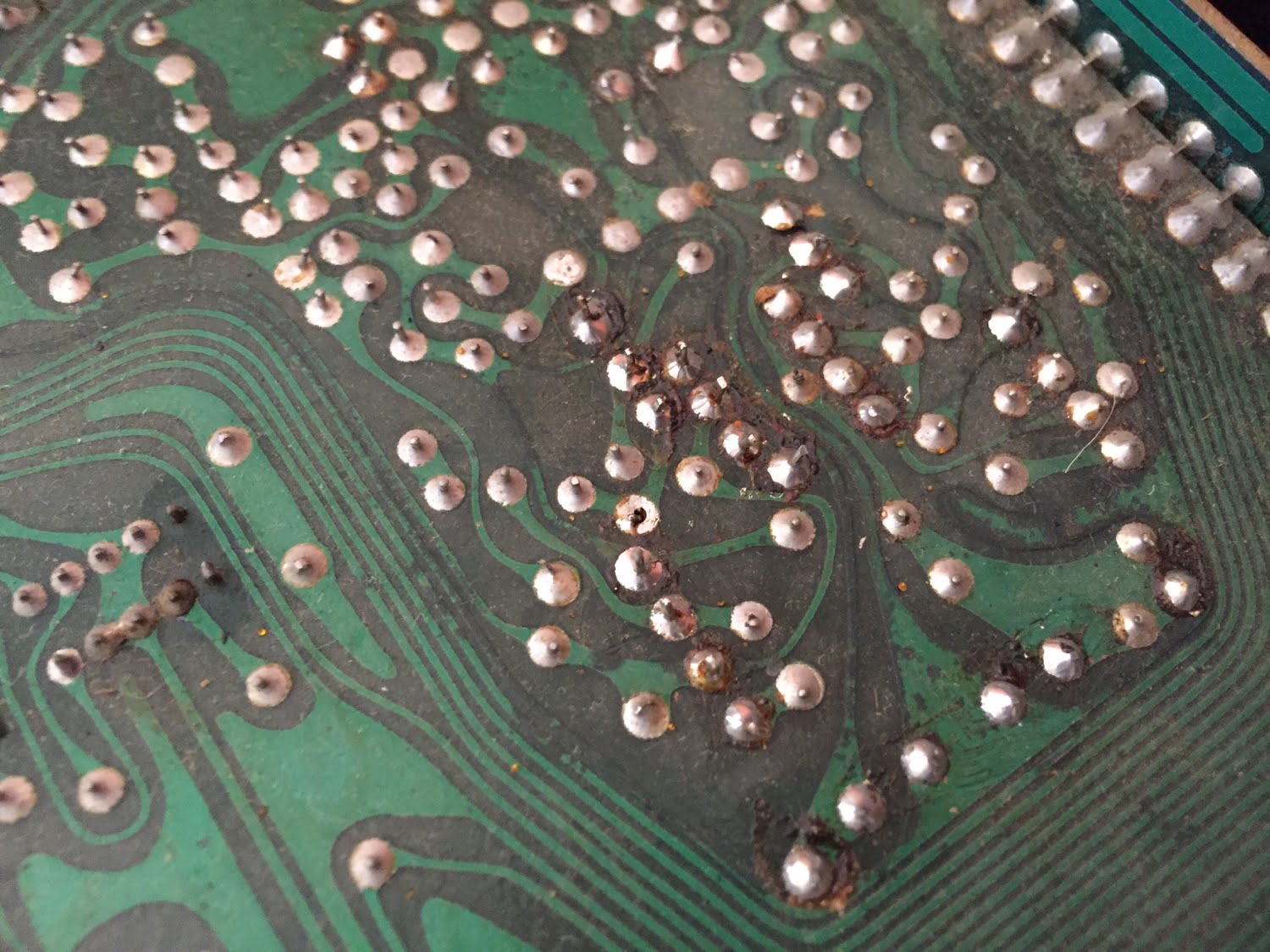
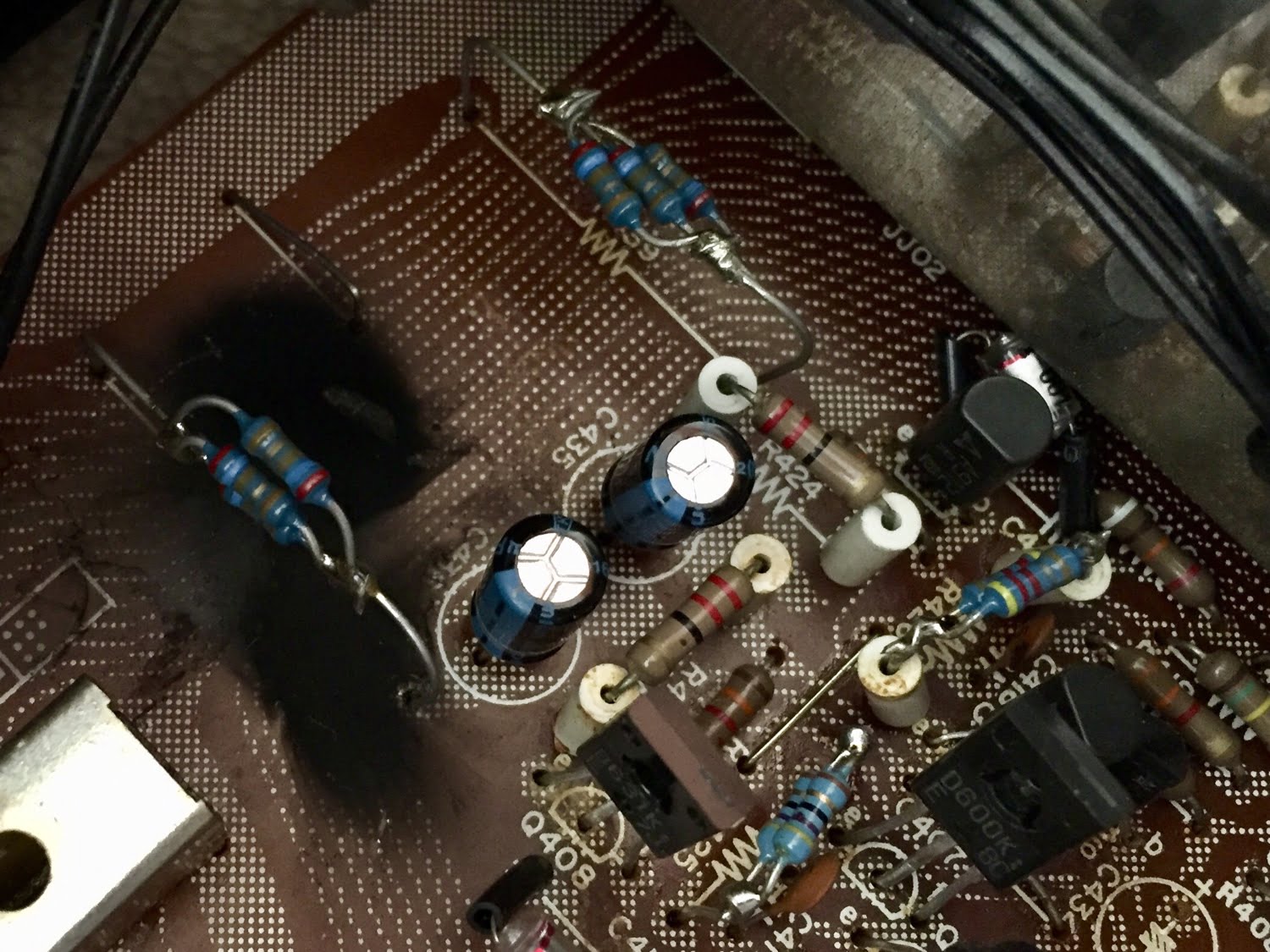
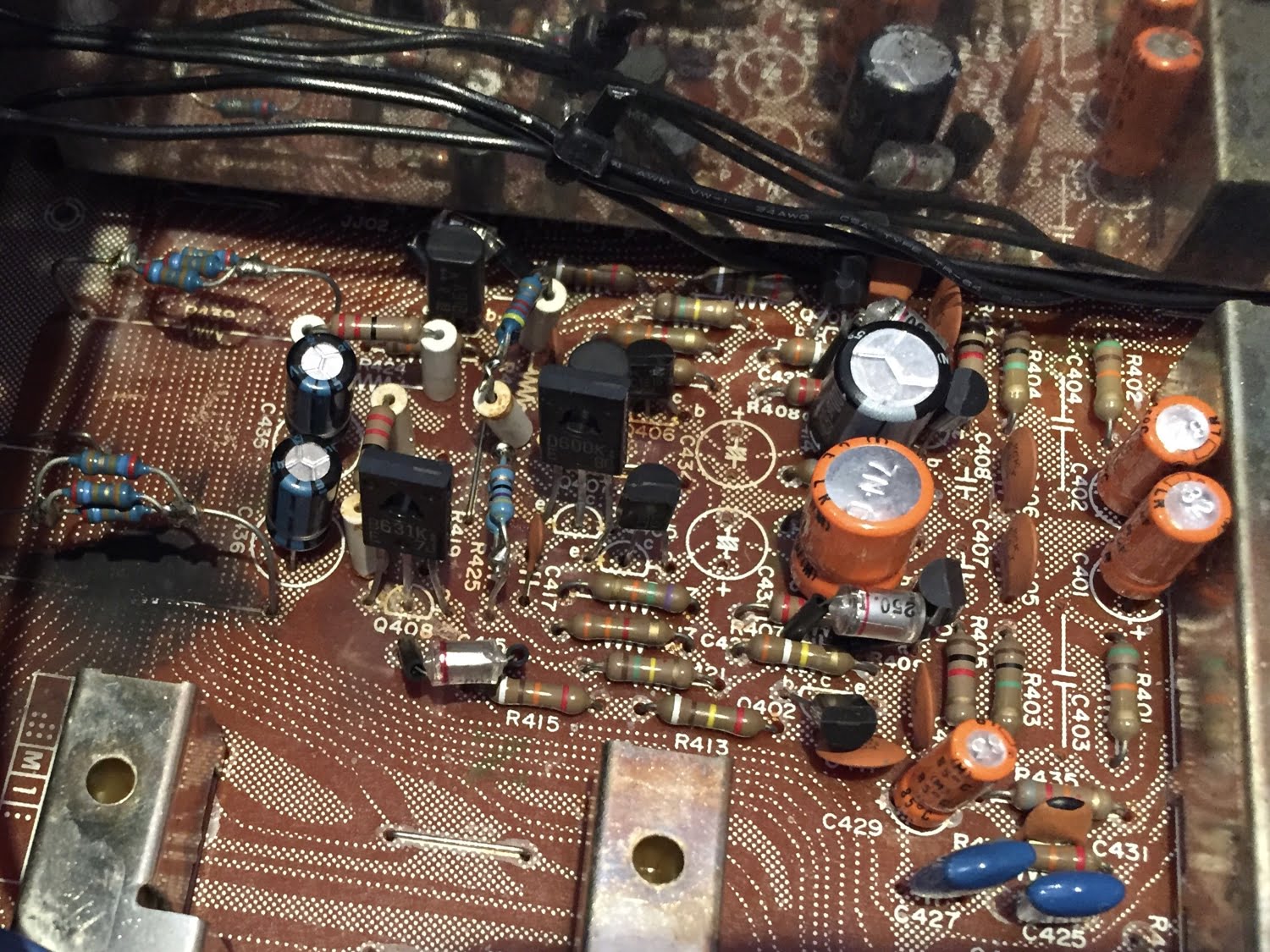
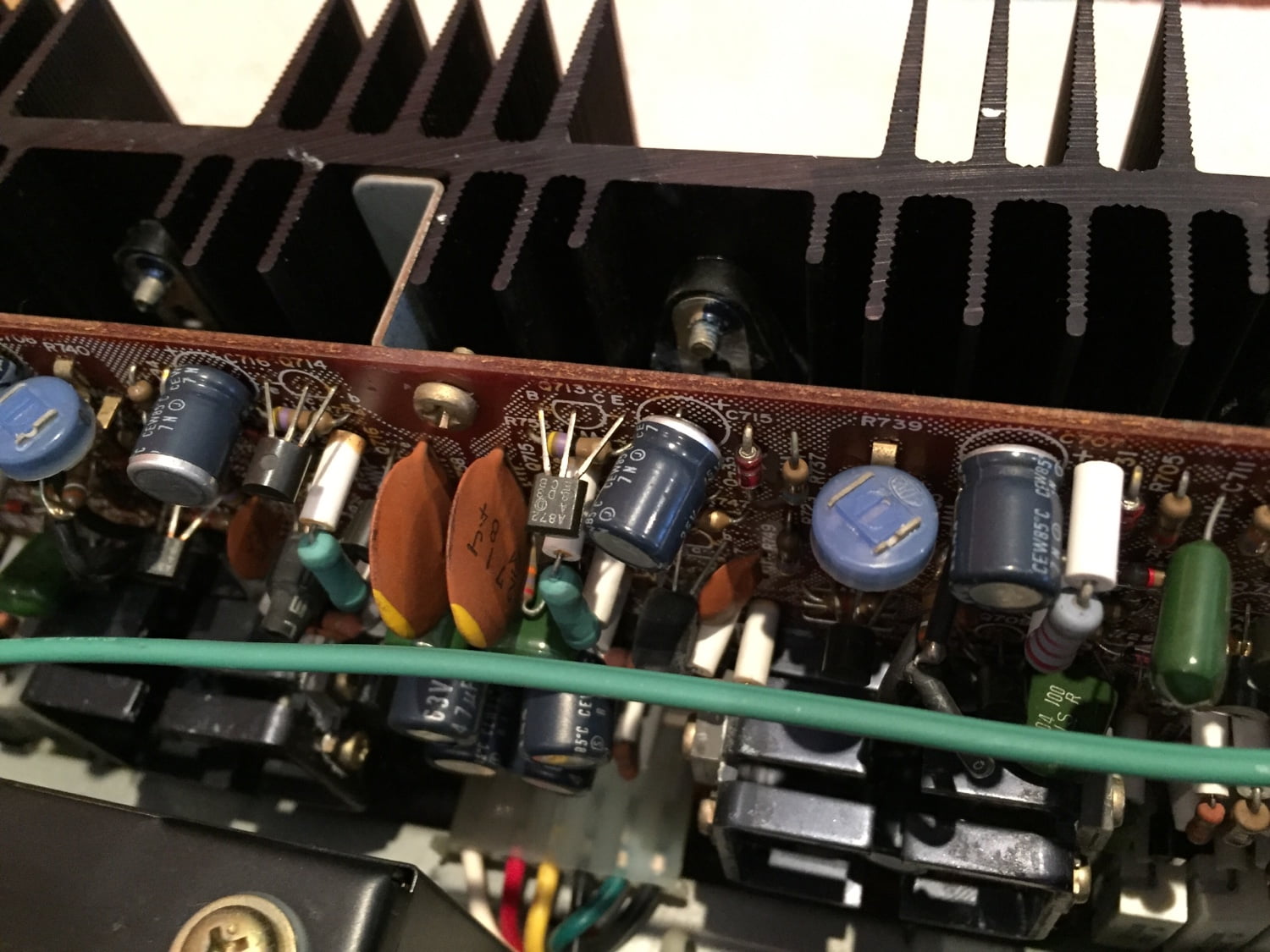
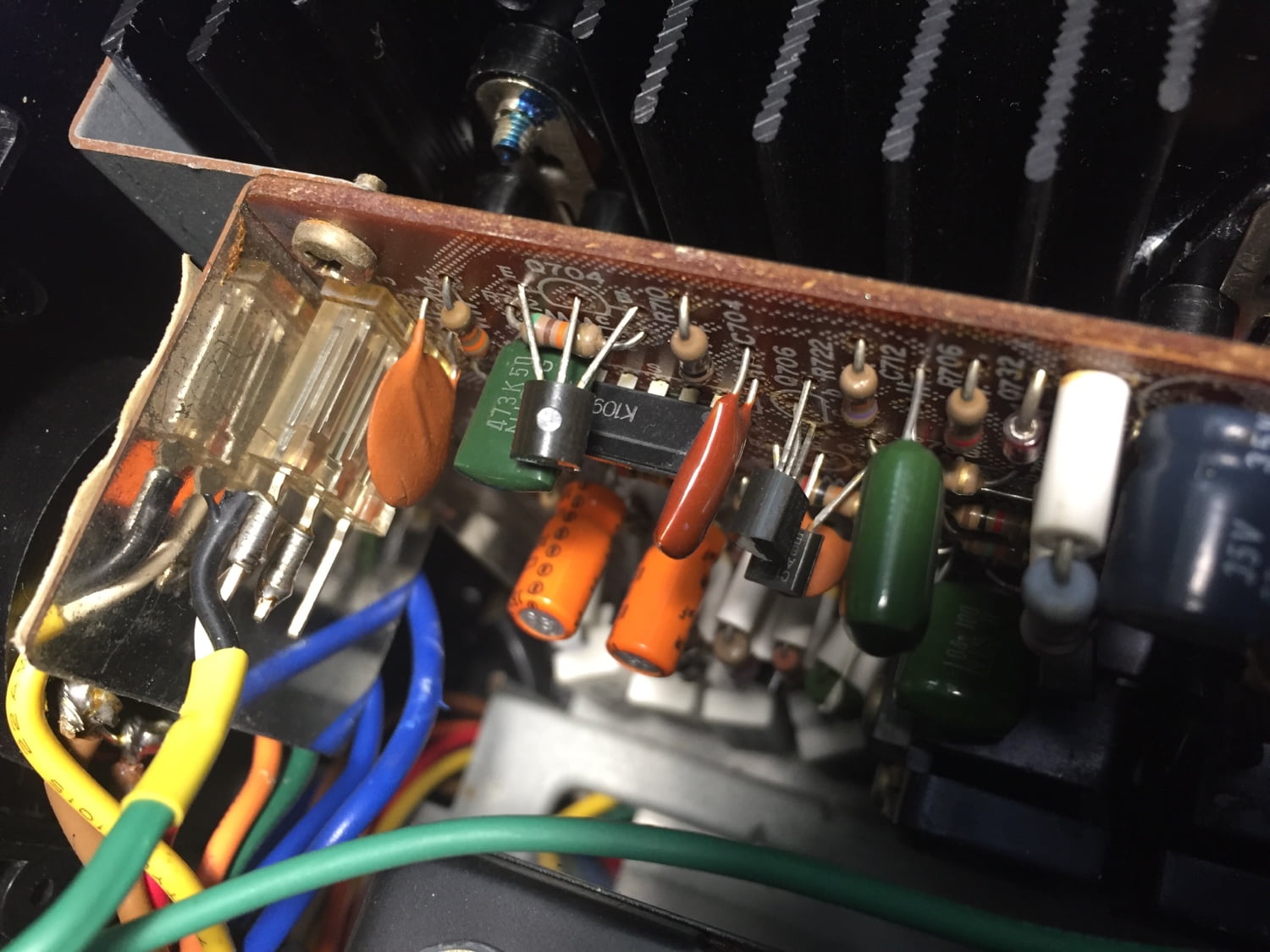
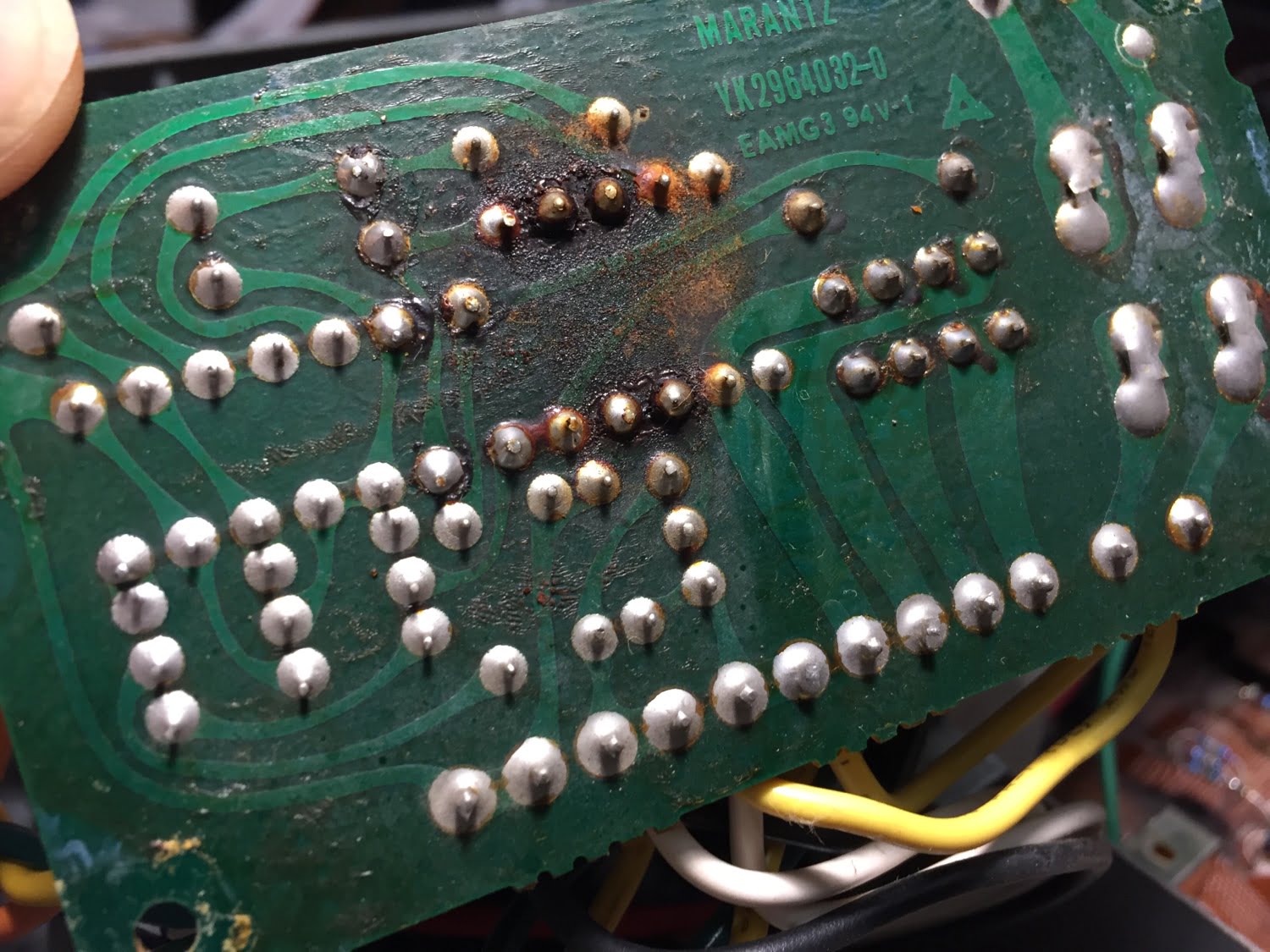
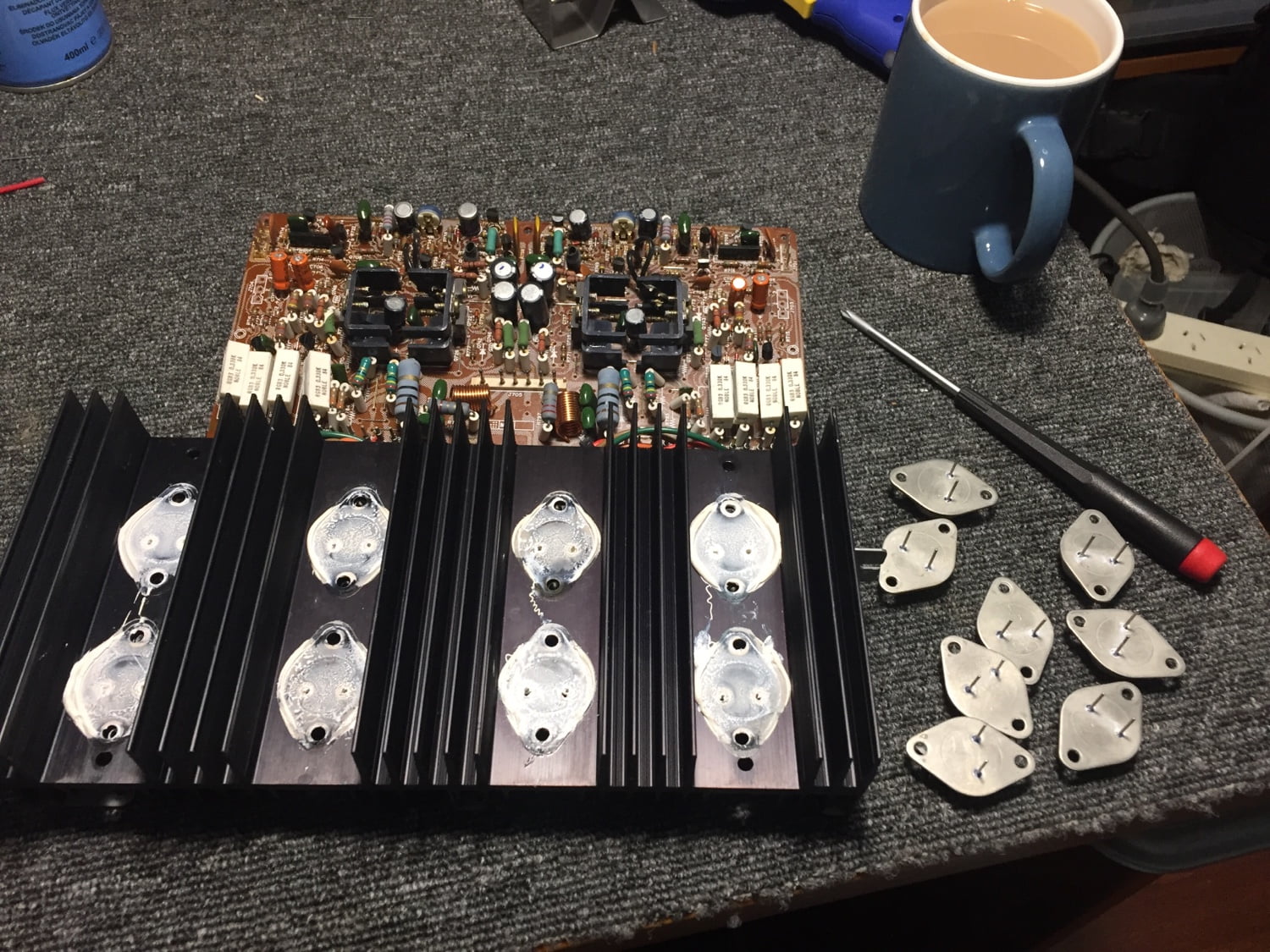
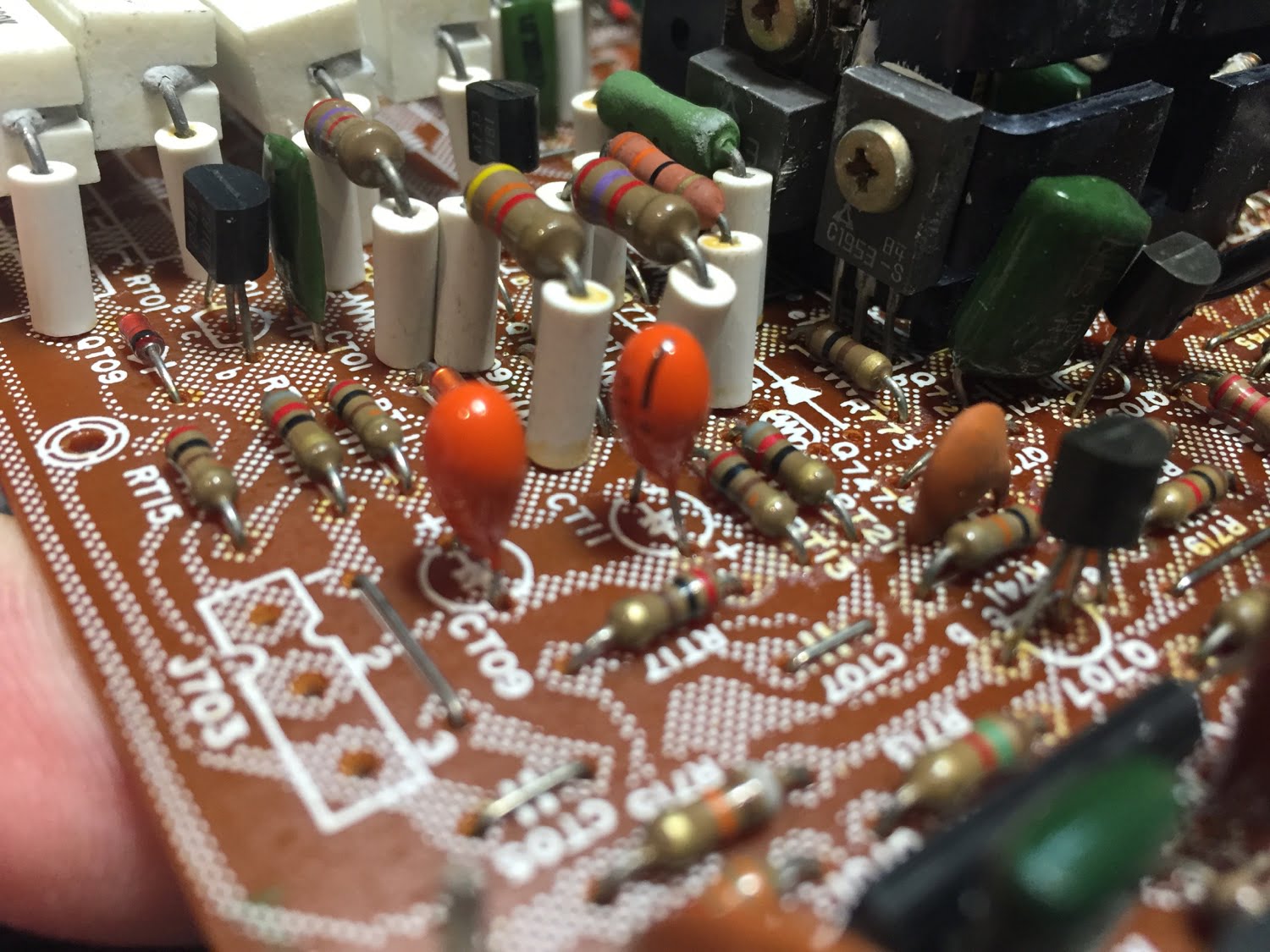
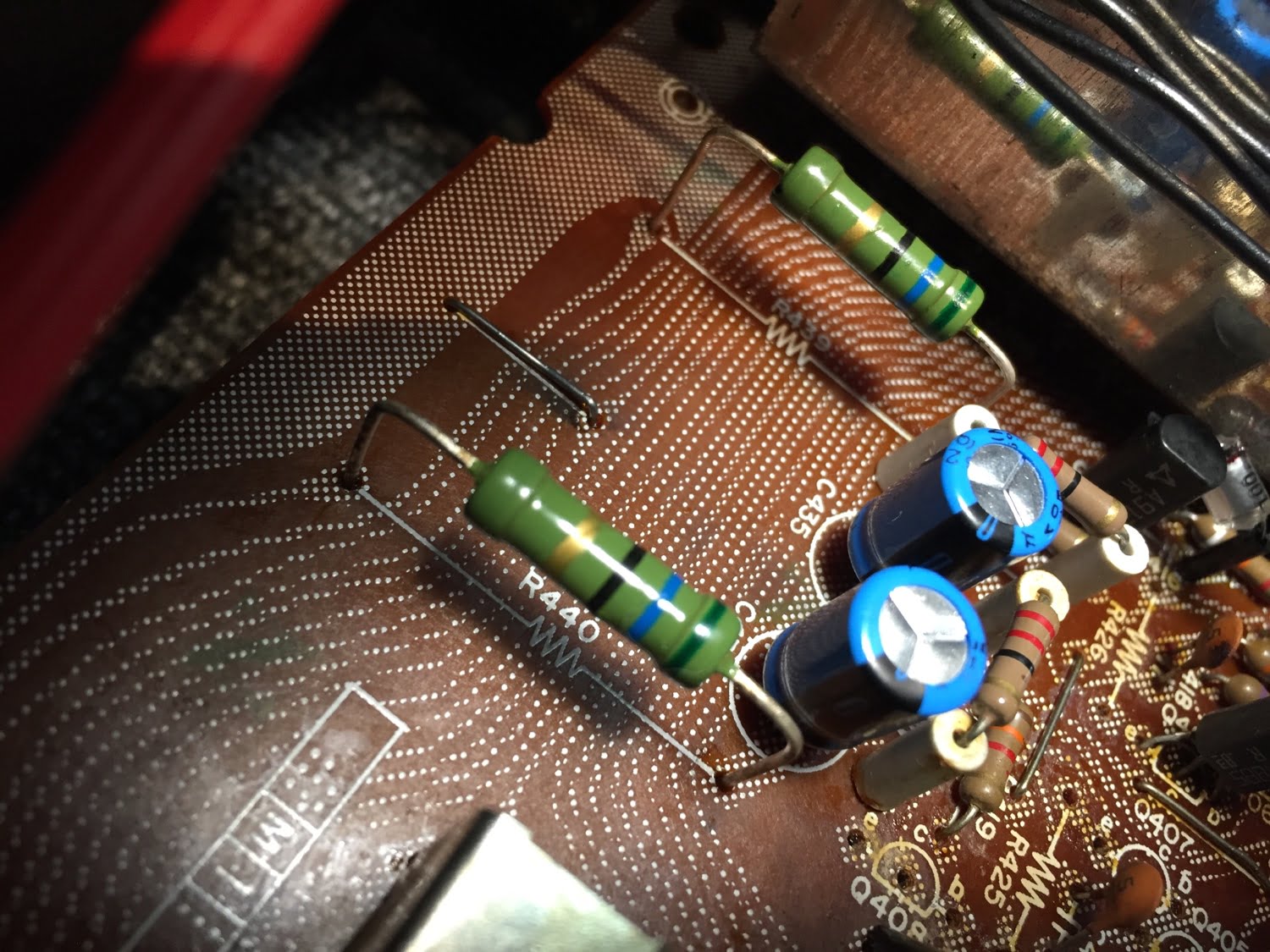
Dirty, but otherwise pretty tidy.Typical thermal paste and mica washer mess, but all original output devices. This is excellent news.And lots of dust…and flux…Really? This is the best you could do..? Our creative technician ‘made’ these resistors, because they didn’t have the specified value in the correct power rating. It’s a kludge and should never be done for anything other than testing purposes. It would have been nice if they’d cleaned the board under the vaporised part too. Note the two pairs of transistors – these should be two pairs of TO-92L packaged devices. Here, only one in each pair is an original TO-92L device. Q 408 for example is meant to be a complementary TO-92L device, but instead is a completely different TO-126 device. This is terrible, a recipe for bad sound and circuit instability.
Restoration
I use a similar restoration process for most amplifiers and preamplifiers. I start with a careful inspection before removing all the boards and separating the functional blocks. Then I focus on restoring each board or block, before reassembly, lubrication, adjustment and testing.
Cleaning the Chassis
This part is relatively straightforward if it’s done right. Obviously, water and electronics can mix, but only when done in a very particular way. Drying is a critical part of the process! I use a regimen I’ve developed over many years now.
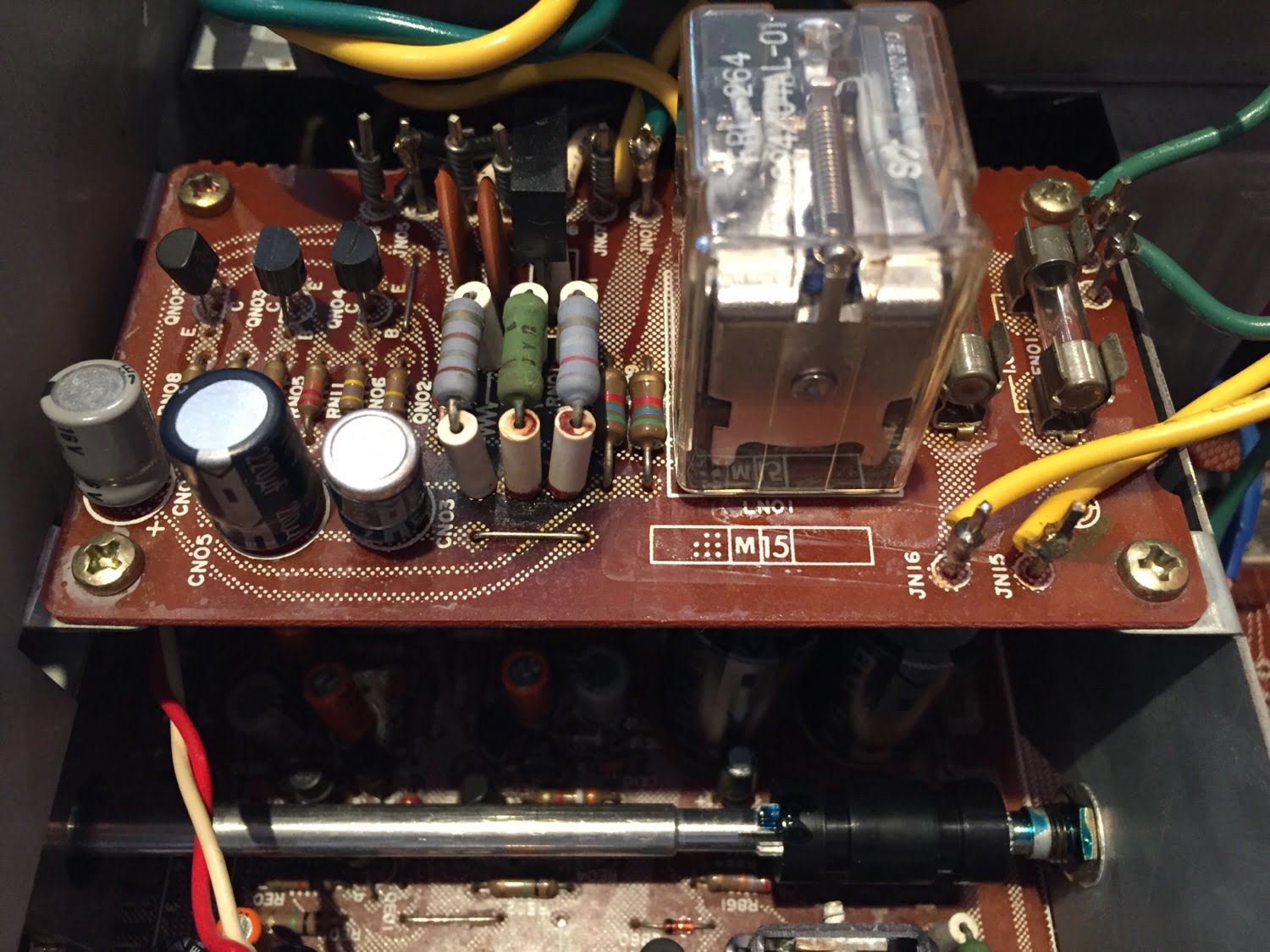
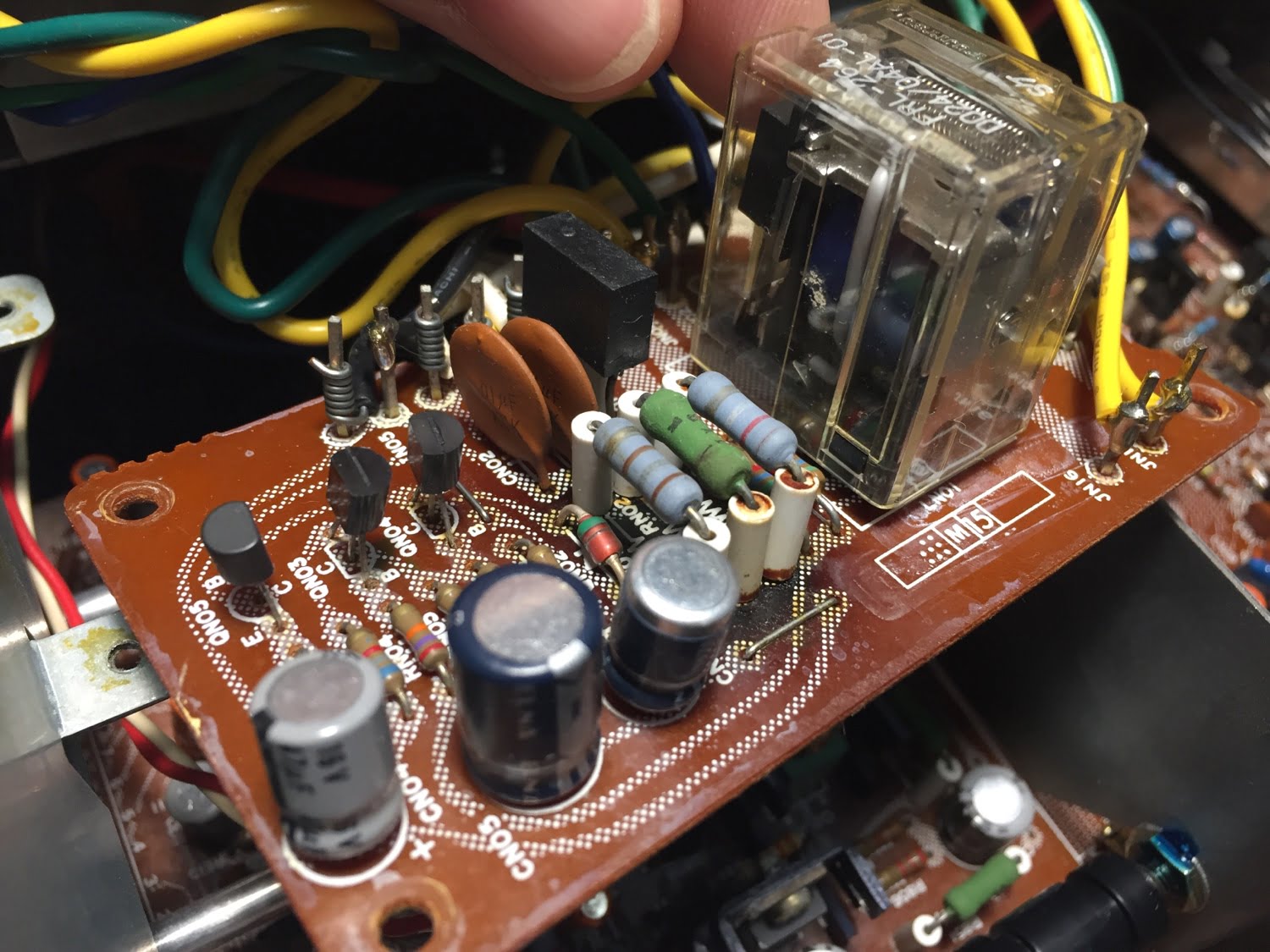
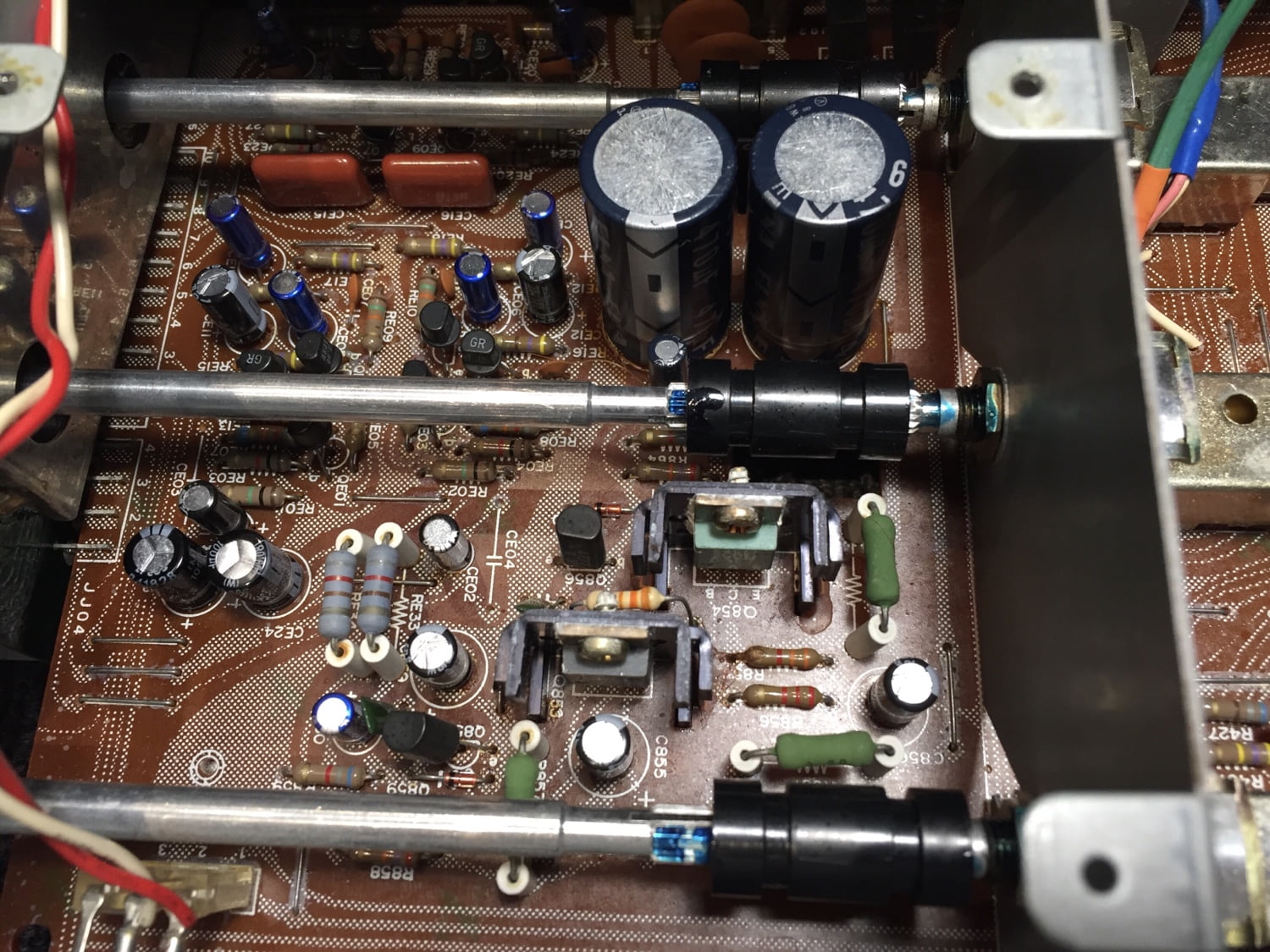
This looks much better. With a clean chassis, I can at least now see what I’m really working with.The 1152DC is essentially spotless nowAfter washing, the mess here is more obvious. Can you spot the three mismatched pairs of transistors? This 1152DC will never work properly like this, no amplifier would.Lots of heat-damaged capacitors. In a unit like this, with lots of smaller capacitors that show signs of heat stress, it’s good policy to replace all of them.Plenty of cheap, nasty flux from some past repair.More stressed caps on the protection board.Work is needed. Let’s go.
Board Overhaul
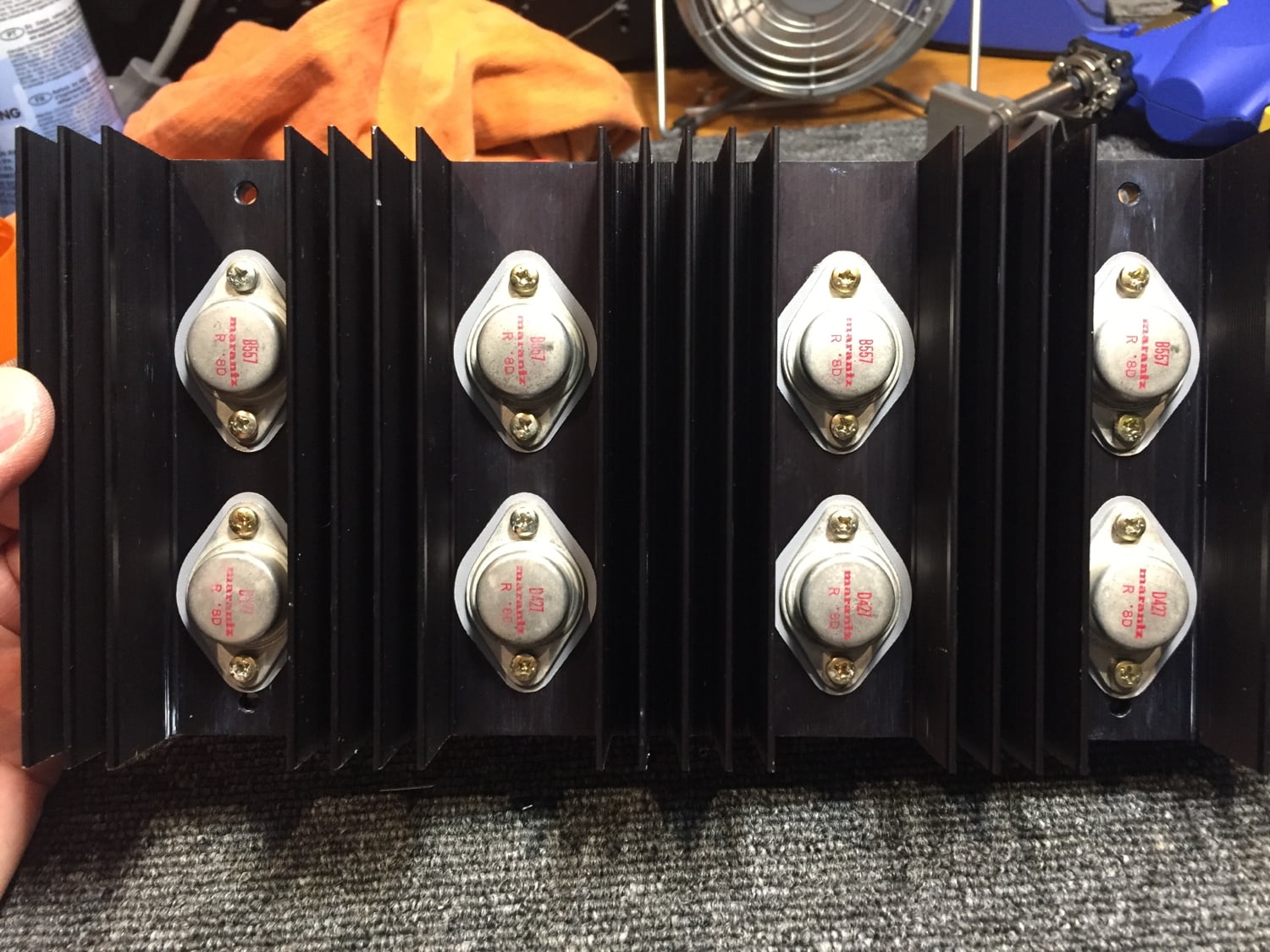
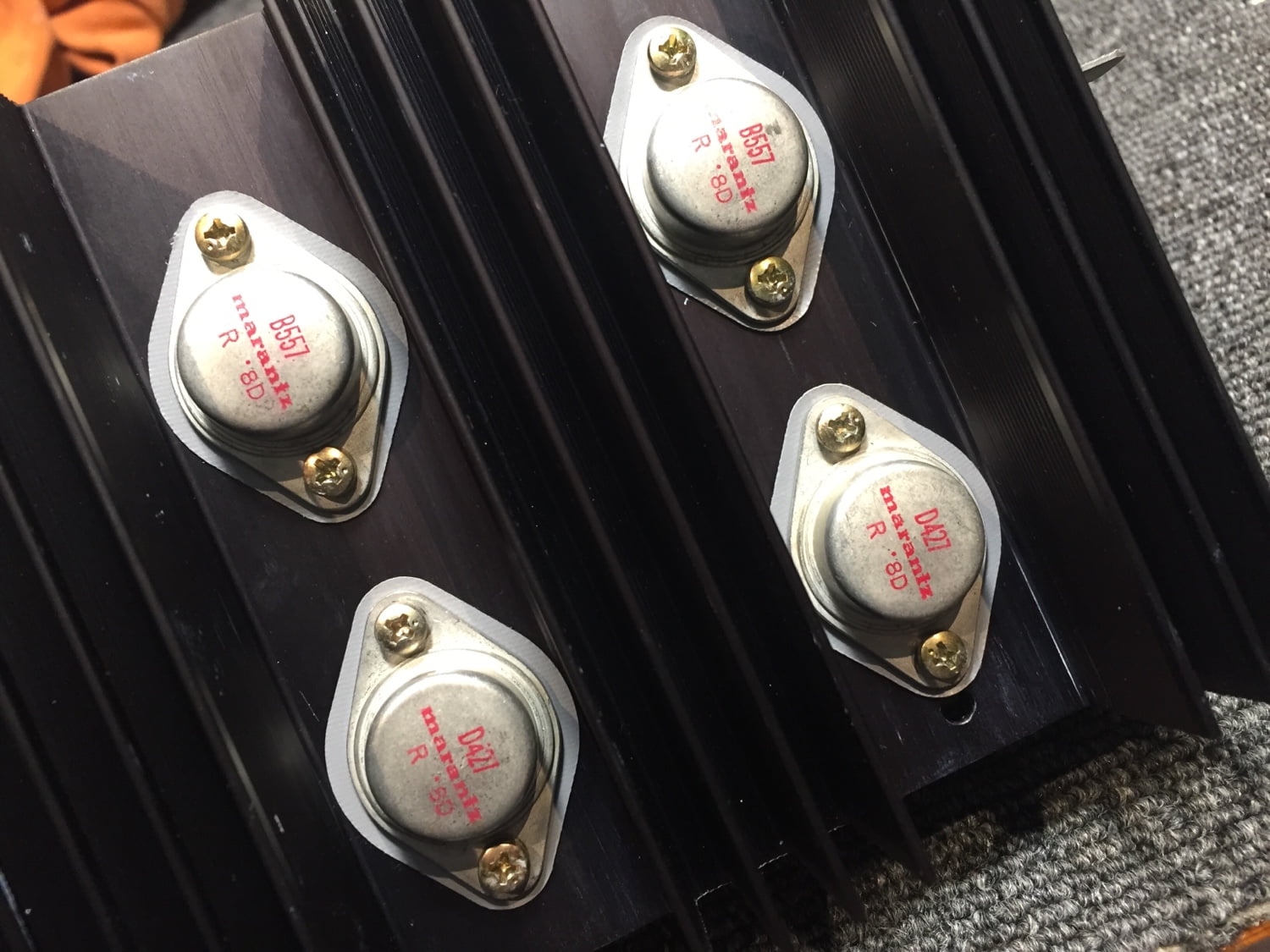
As usual, I’ve used premium parts, including vintage resistors of the correct power rating, high-quality capacitors and NOS transistors that meet or exceed original specs. Output devices are factory original, contributing to the classic Marantz sound.
We will focus here mostly on the amplifier module.
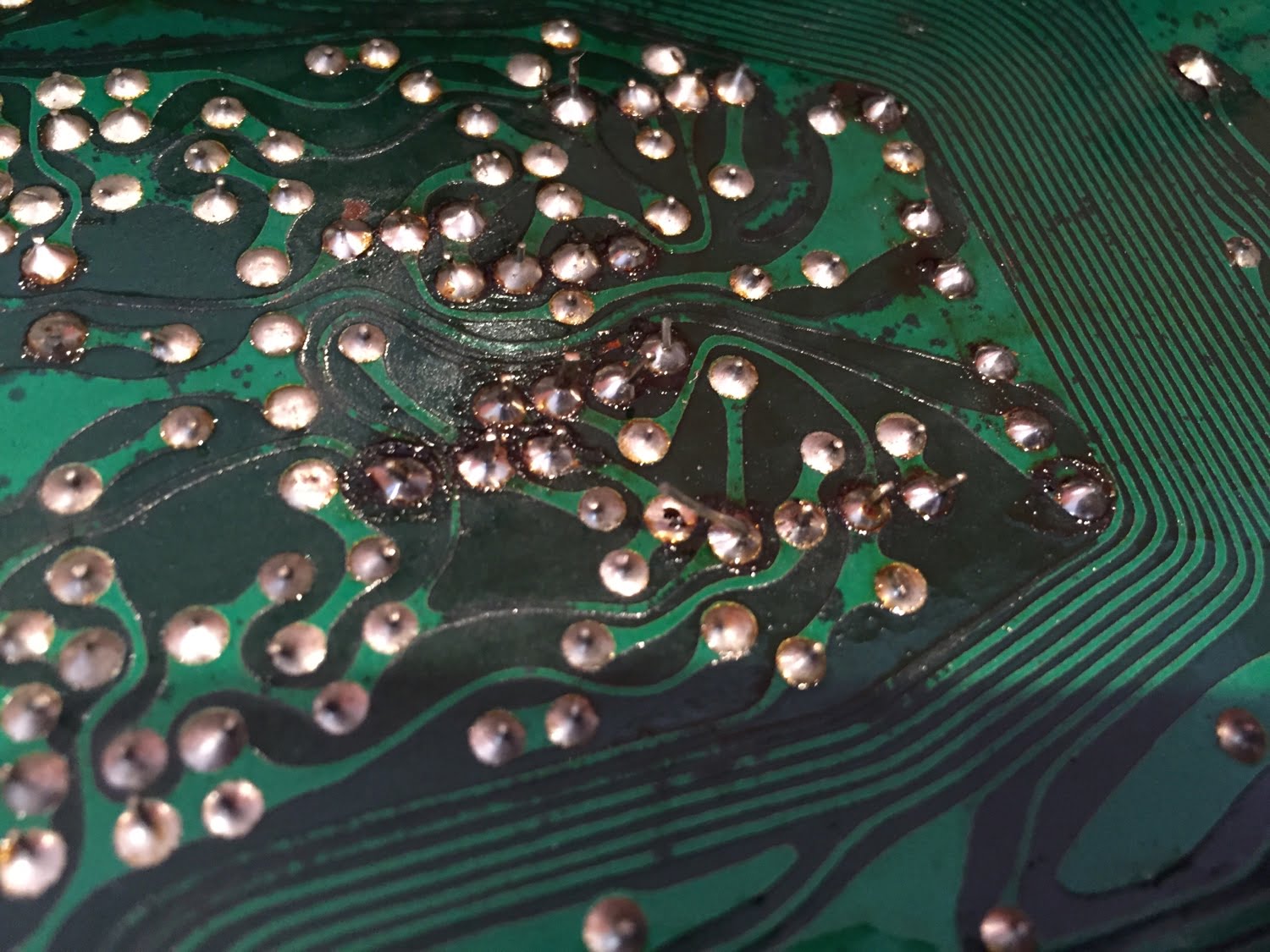
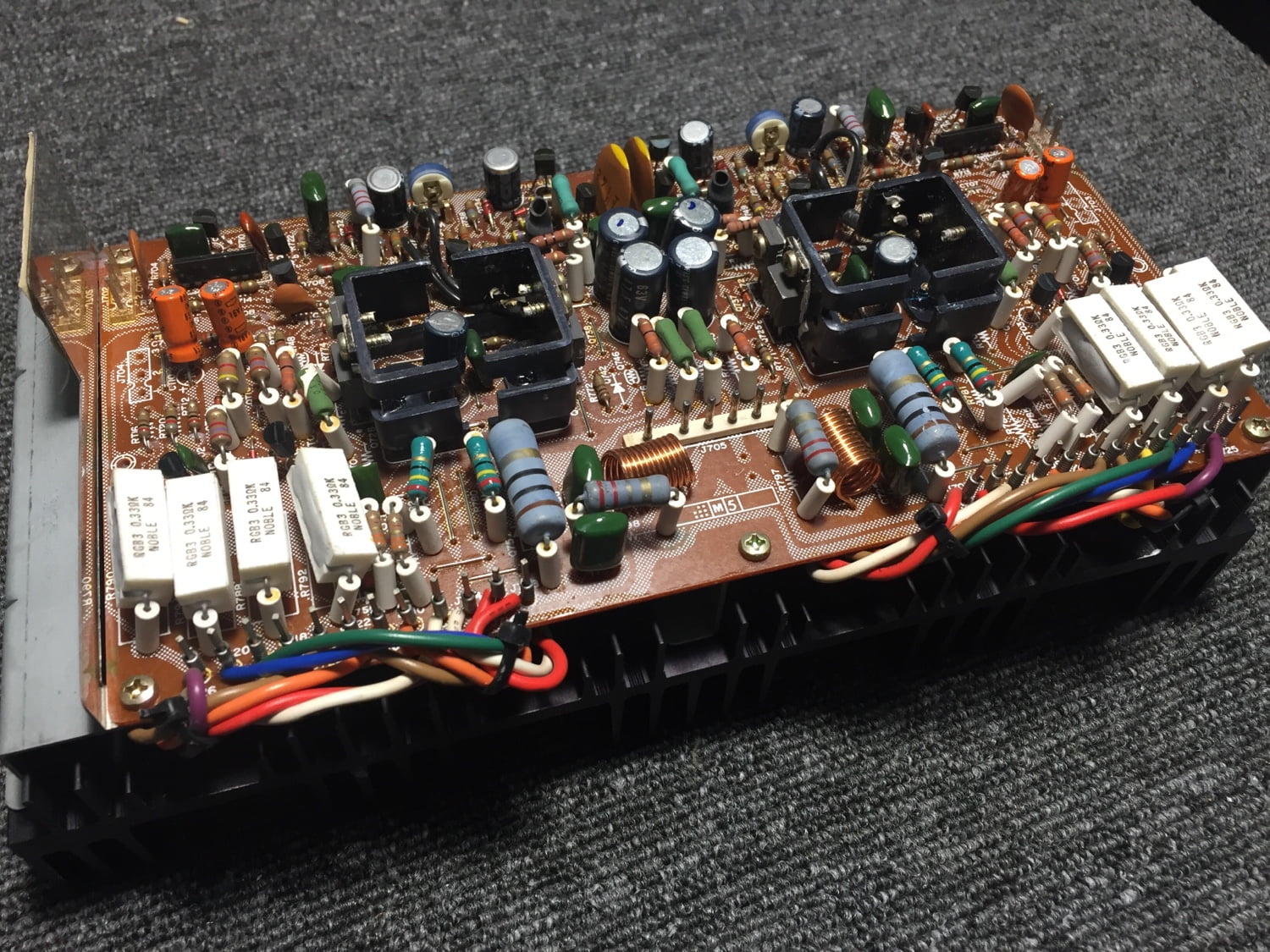
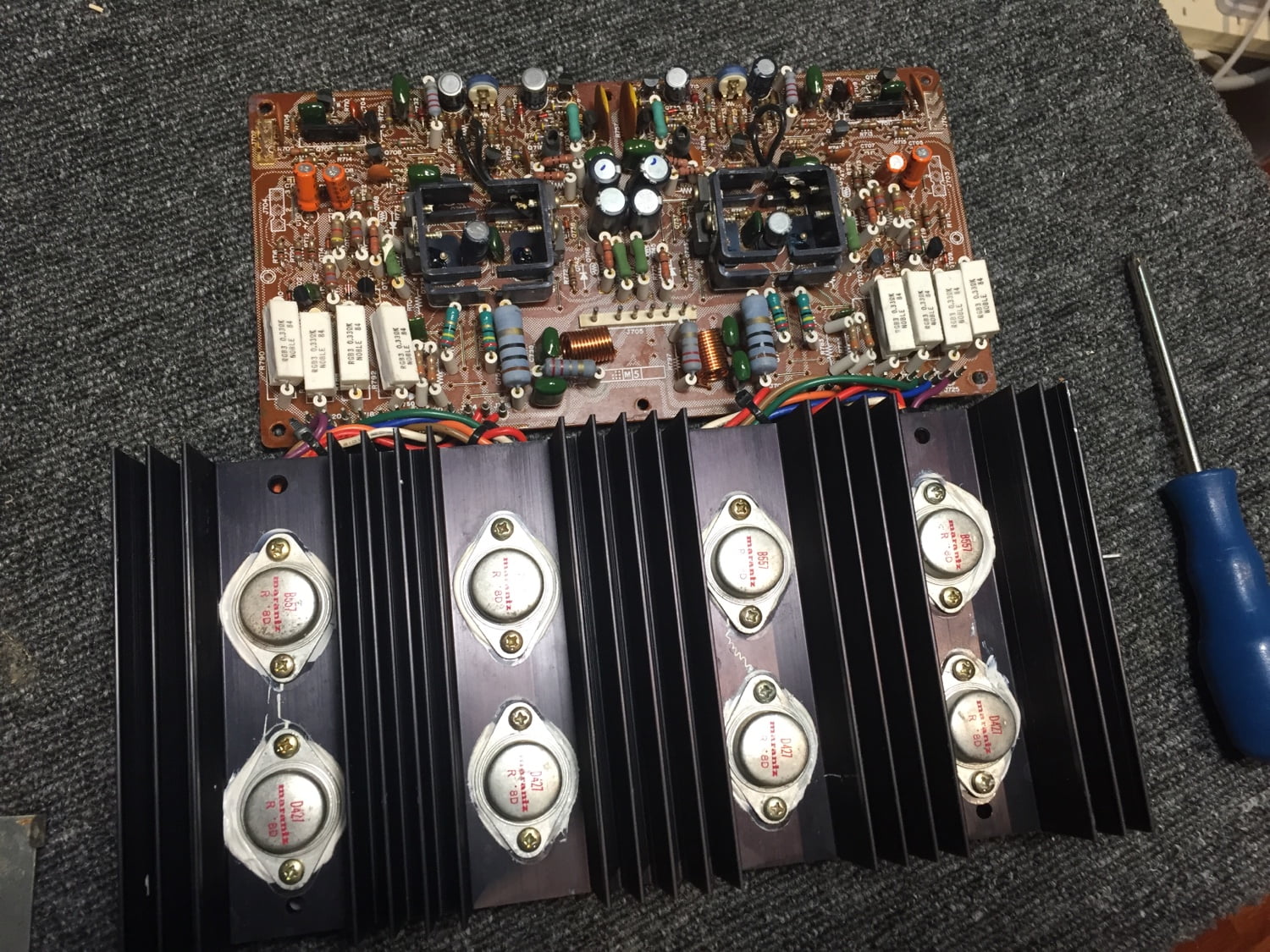
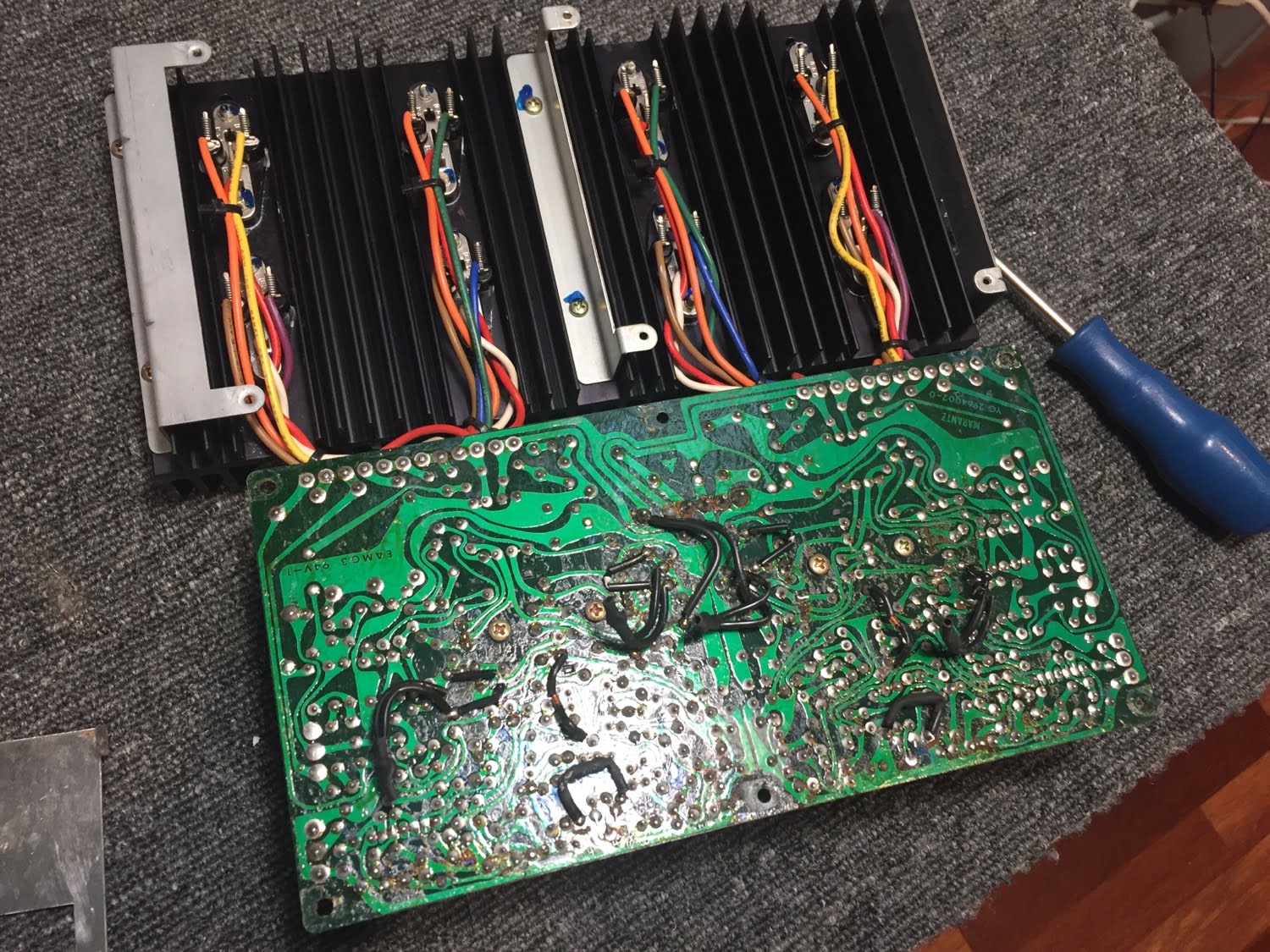
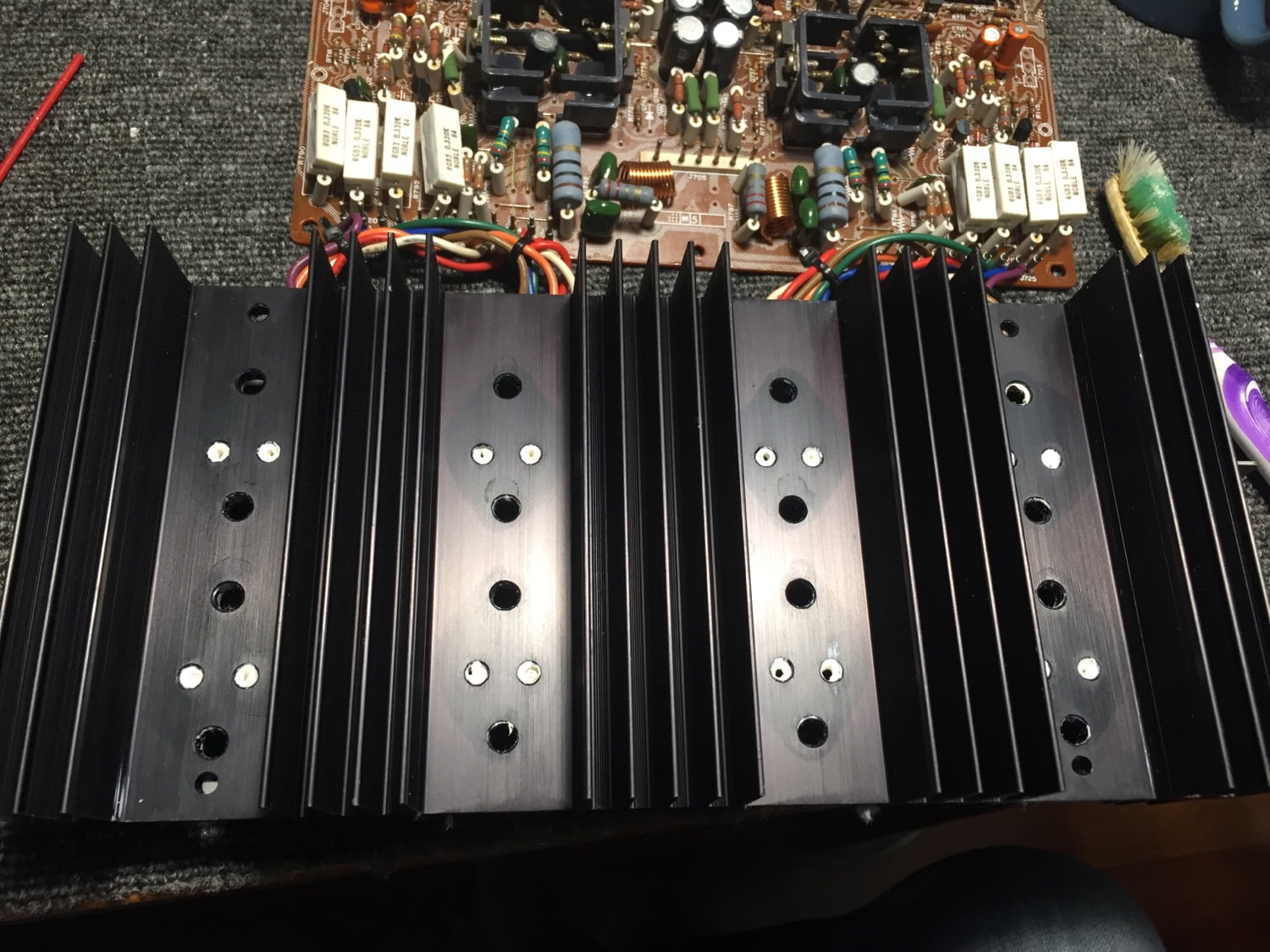
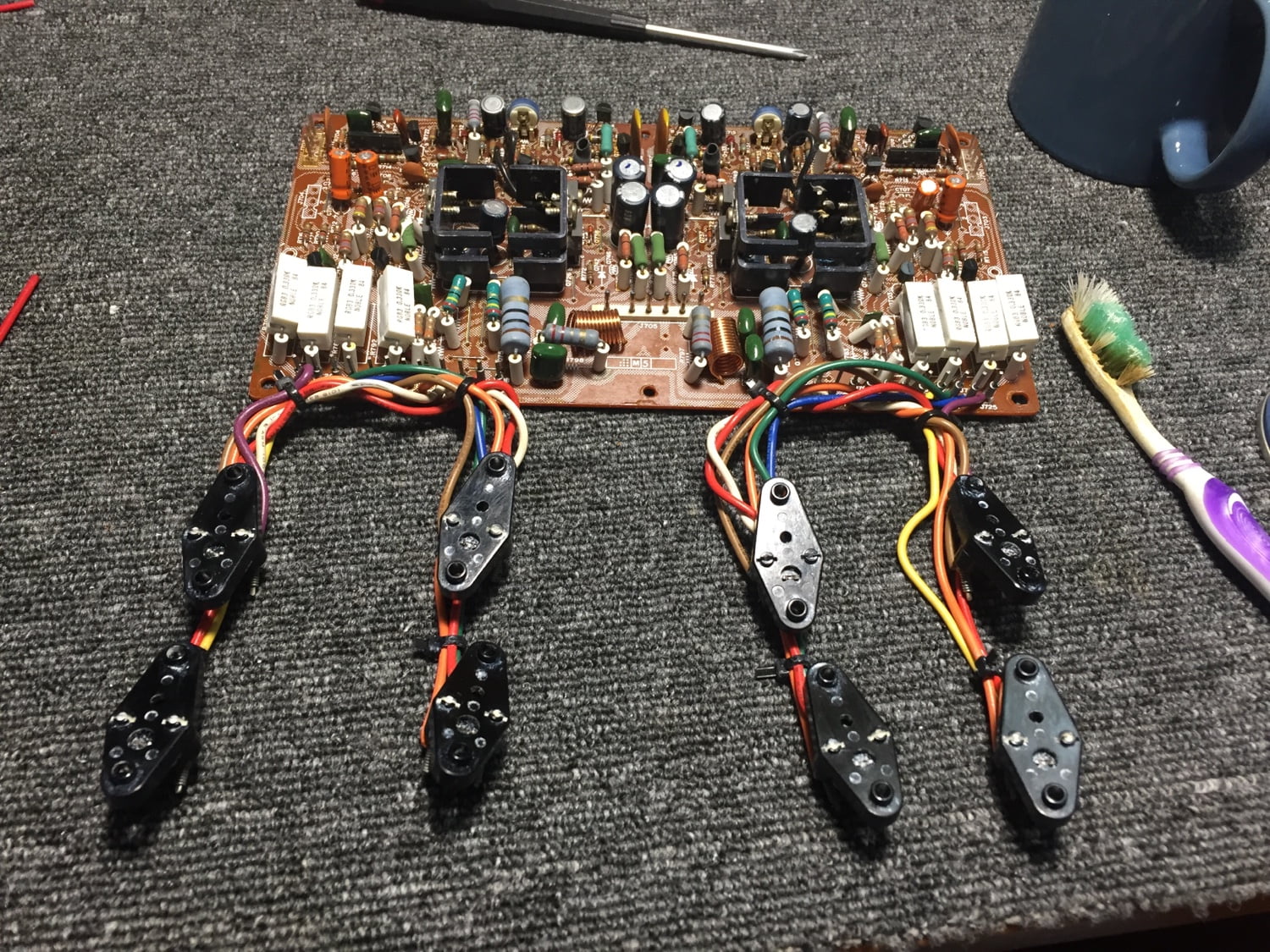
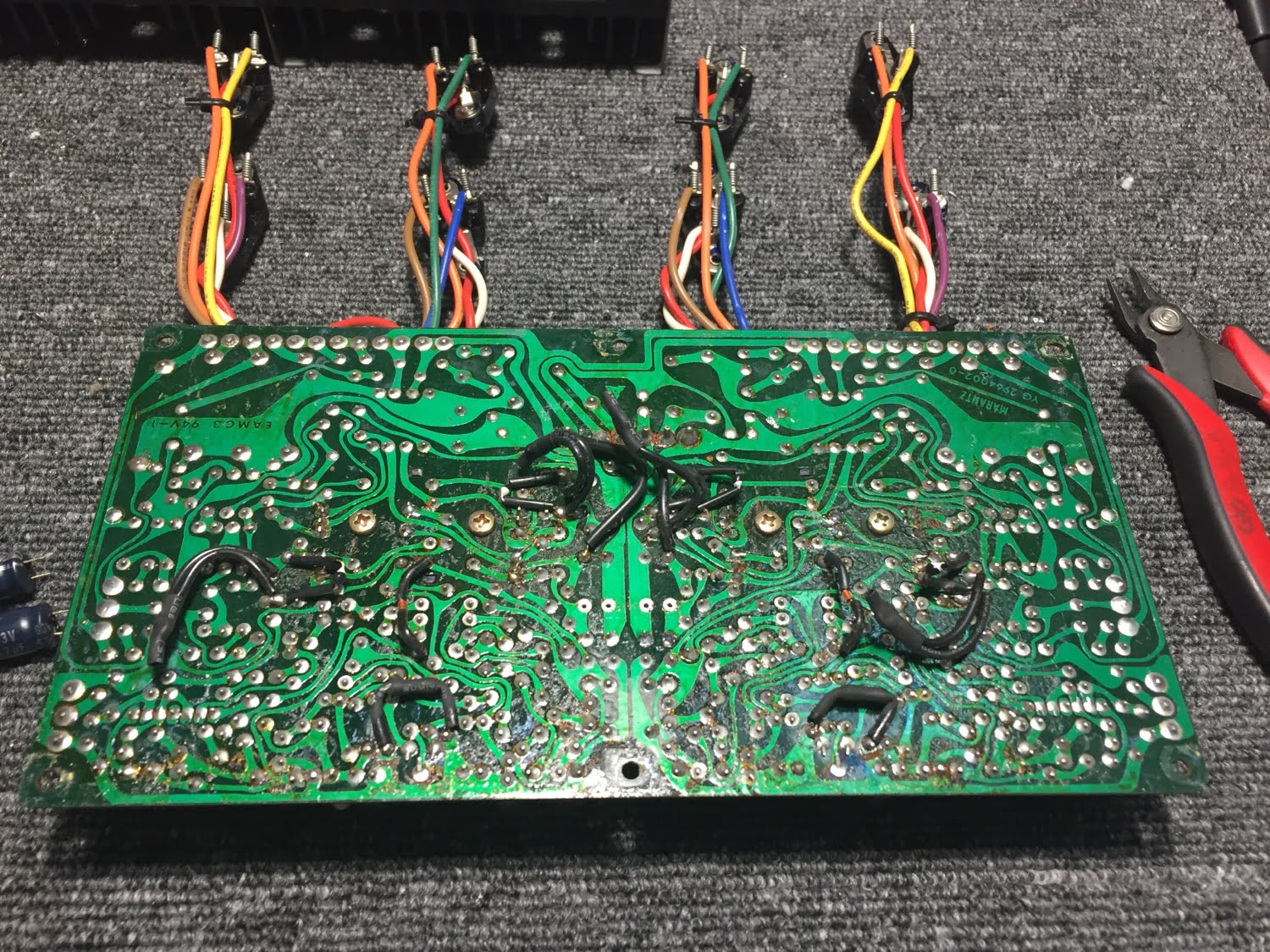
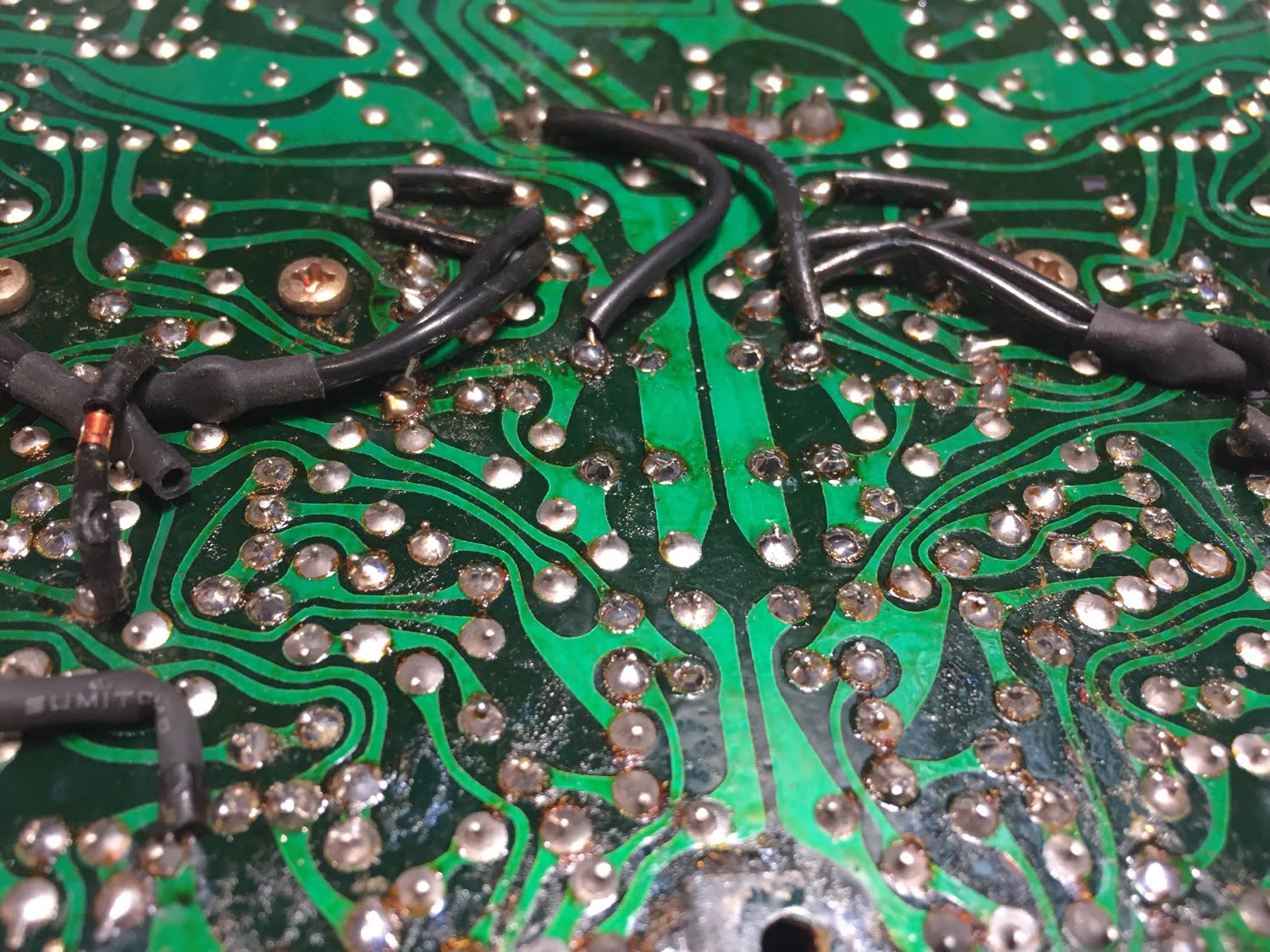
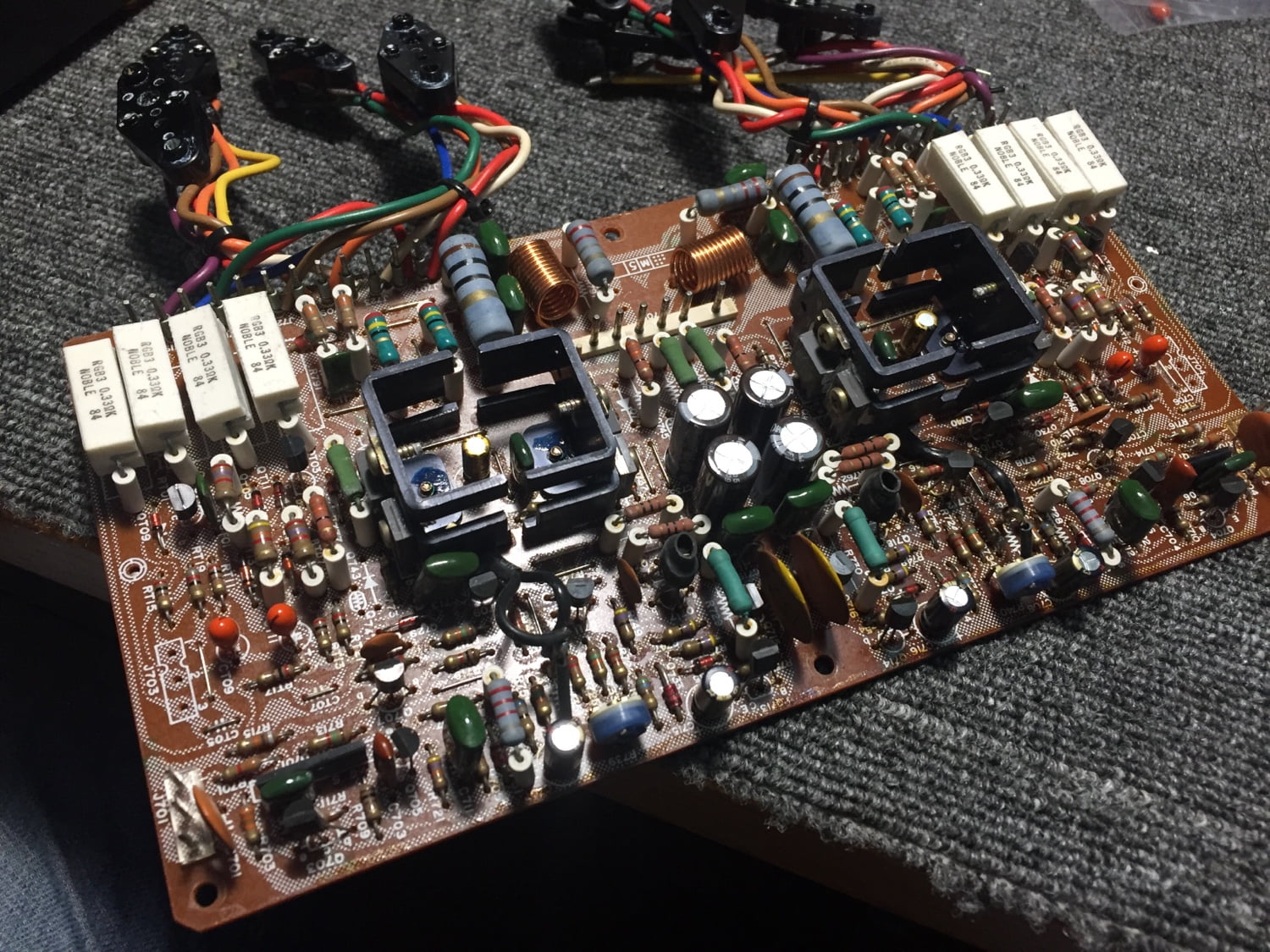
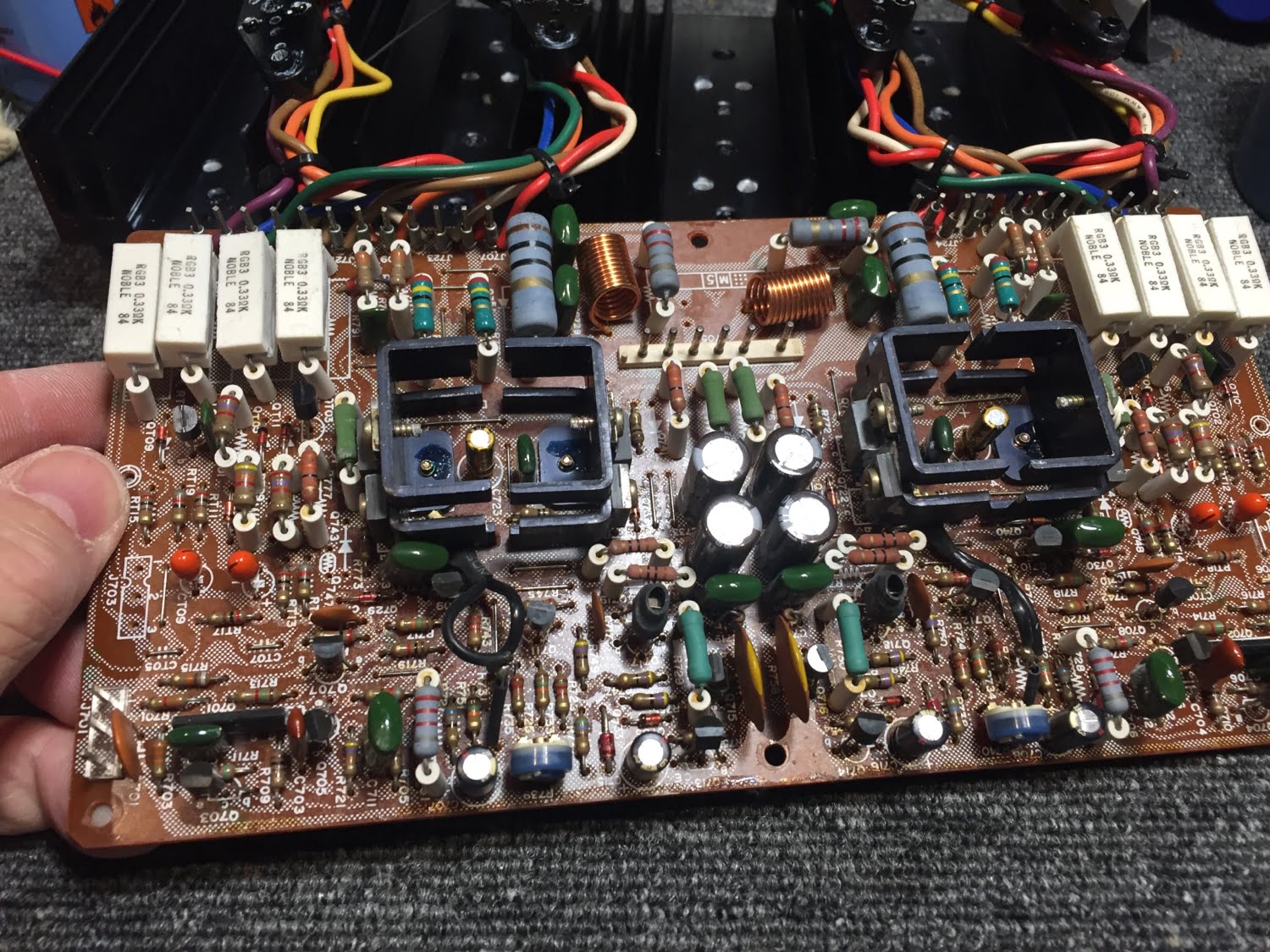
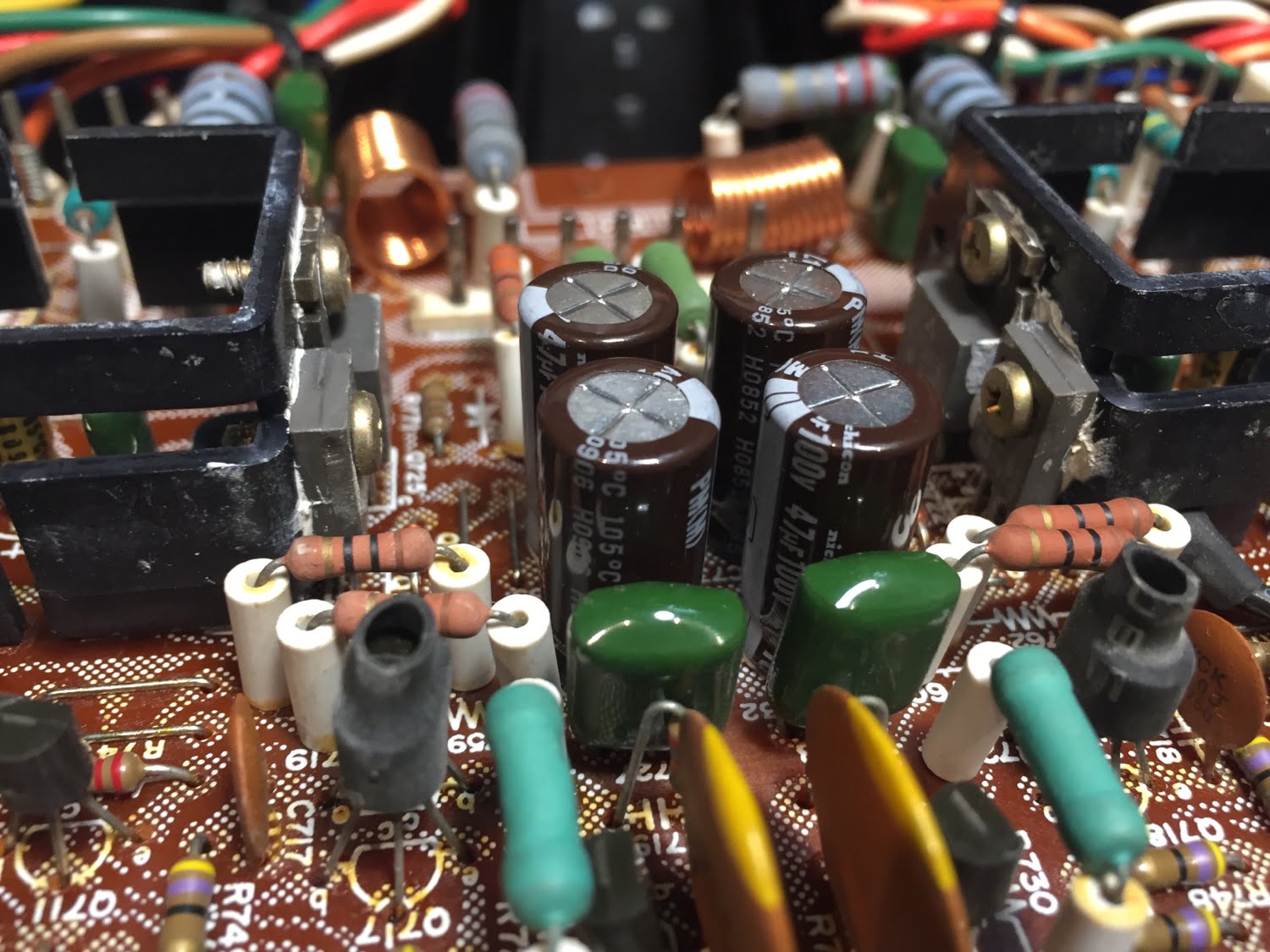
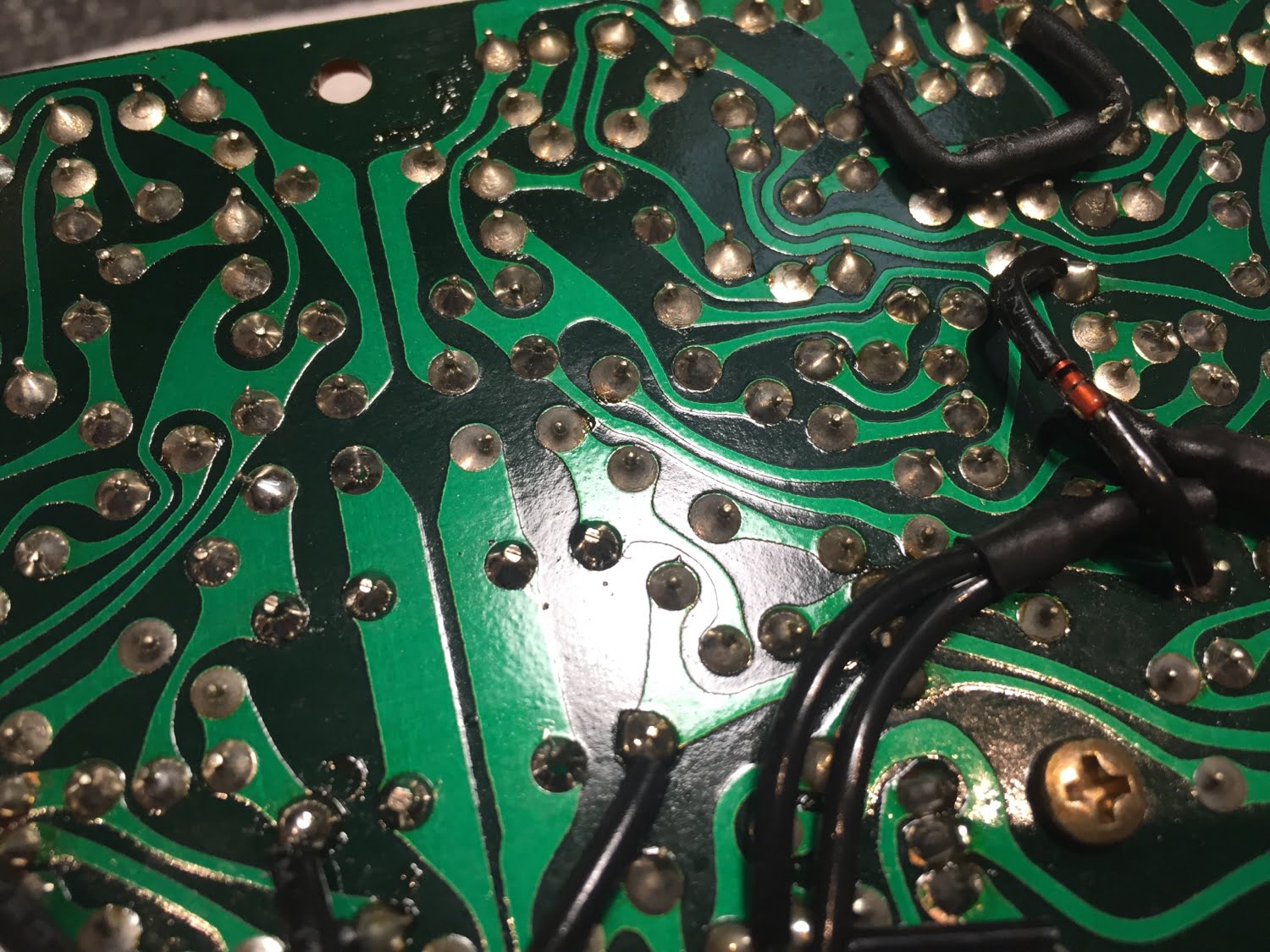
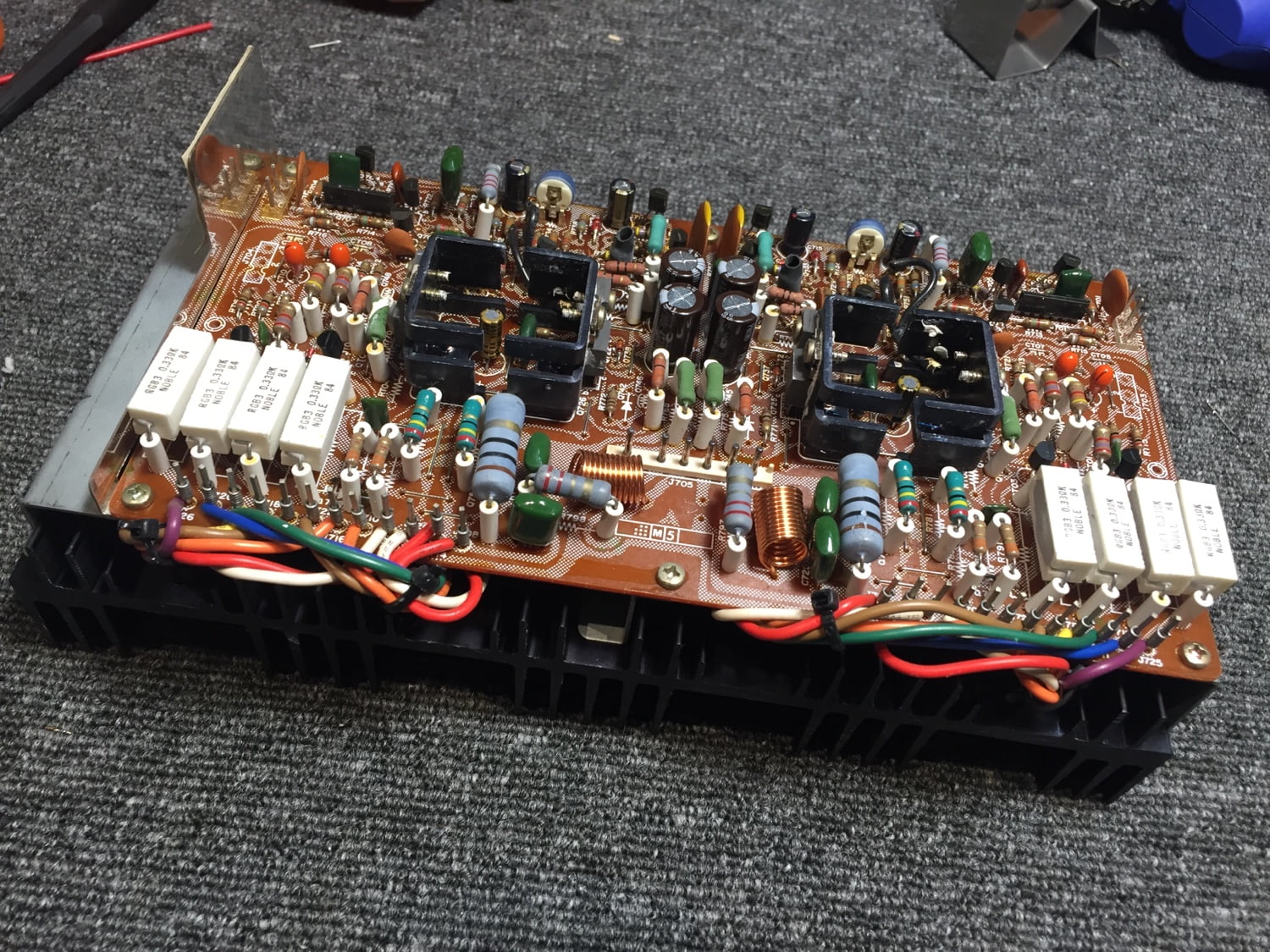
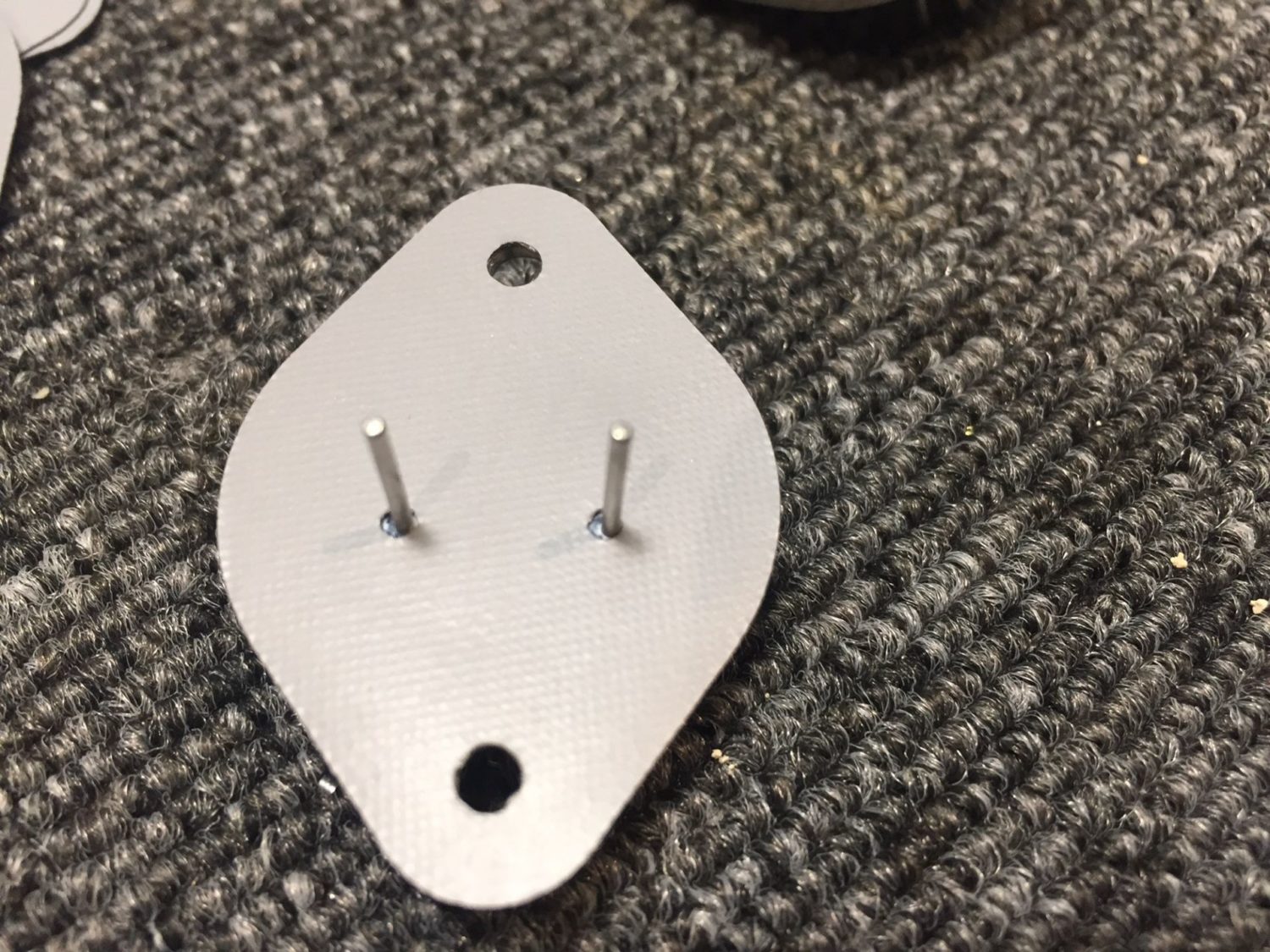
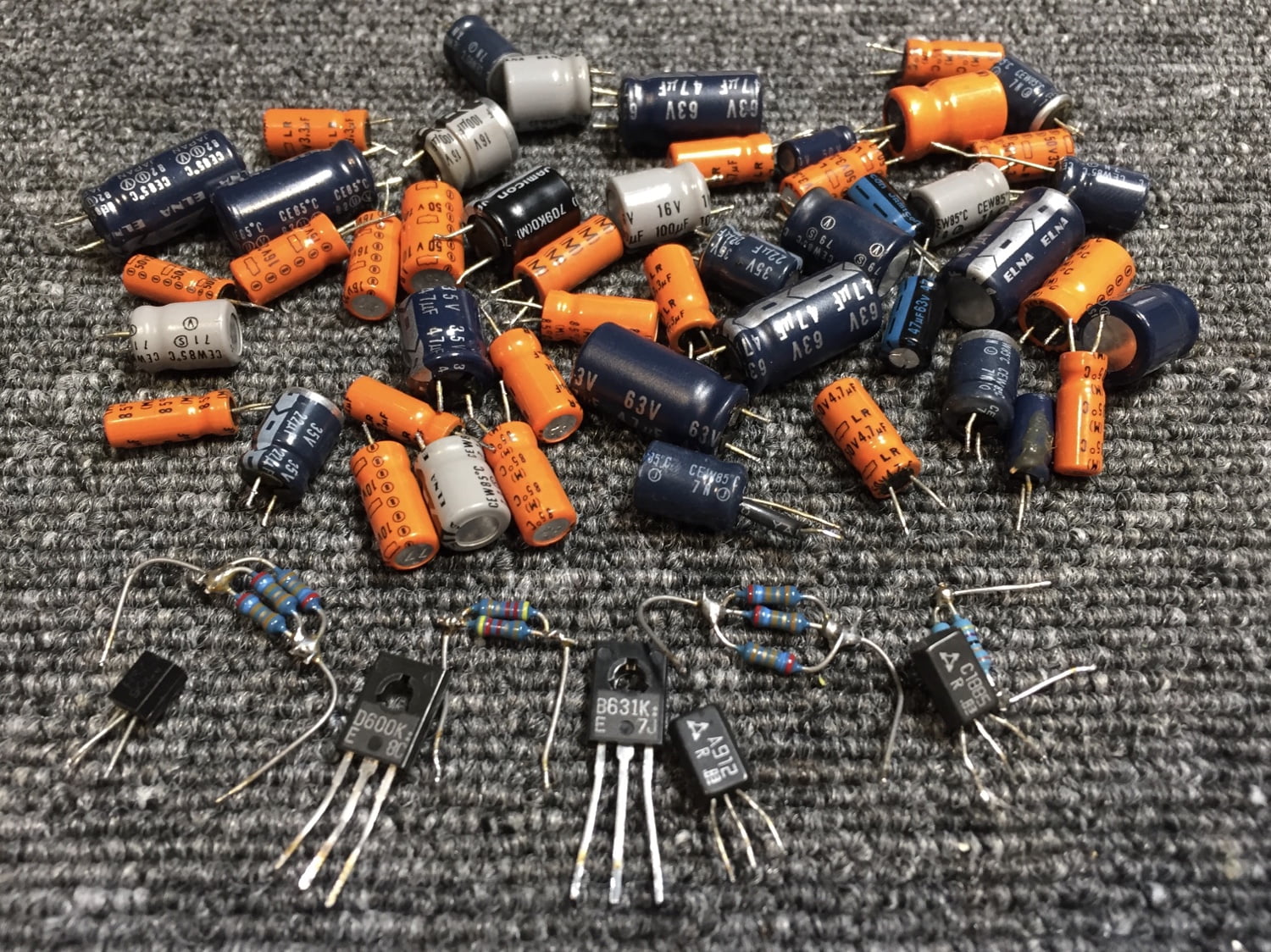
A complete, original module. This tightly packed board will receive new capacitors and new thermal interfacing for the output transistors. Everything will be cleaned and tidied.Access is straightforward, thanks to Marantz engineers.The heatsink and transistors need cleaning to remove all traces of thermal grease. This is a good time to test output devices.Time now to get to work on restoring this board.Plenty of wiring on the back of the board. Not sure if these are kludges or as designed, but it’s hard to imagine Marantz would choose to do this.Check out all the crusty old flux. You’d think that manufacturers would clean boards during manufacture, but in consumer-grade gear like this, they just don’t. I removed all this flux.Like magic, here’s the finished board, complete will new caps.High-spec Nichicons, 105 degree rated, low ESR.Here I’ve installed some vintage tantalums that sound great and look the part. Marantz used plenty of tants in their gear, for sonic reasons.You can actually see all the traces now! What a difference de-fluxing makes, this looks 100% better and makes future fault-finding easier too. I’m big on de-fluxing, but then you already know that…Reassembled module.I’ve mounted all devices on silpads…They provide a low-maintenance, stable thermal interface.They also make things much cleaner and neater.Fixing the burned board you saw previously. Note the super-premium Beyschlag metal film resistors and Vishay capacitors. These parts are expensive, but this is the right way to do the job.Here it is, cleaned and with matched replacement transistors and new caps installed.Here are the parts I replaced in this restoration.
Results
I’m pleased to report that this overhauled 1152DC sounds great. Switches and controls are completely silent and the amplifier has a lovely warm sound you’d expect from a gorgeous vintage piece like this. Everything works as it should and, whilst I’d love to keep it, she needs a new home where she will become the centrepiece of a great vintage hi-fi system.
Since completing the restoration, I advertised this beautiful 1152DC for sale. She now has a new home in sunny Queensland!
Lots of sharp edges on these older Marantz components, but the styling is just classic.Plenty of slider-style potentiometers that Marantz and consumers seem to love!I’ve never really known what a ‘console’ amplifier is, perhaps someone else knows..?!What a lovely amplifier. They certainly don’t make ’em like this anymore!
If you would like me to look at your classic Marantz equipment, don’t hesitate to get in touch.
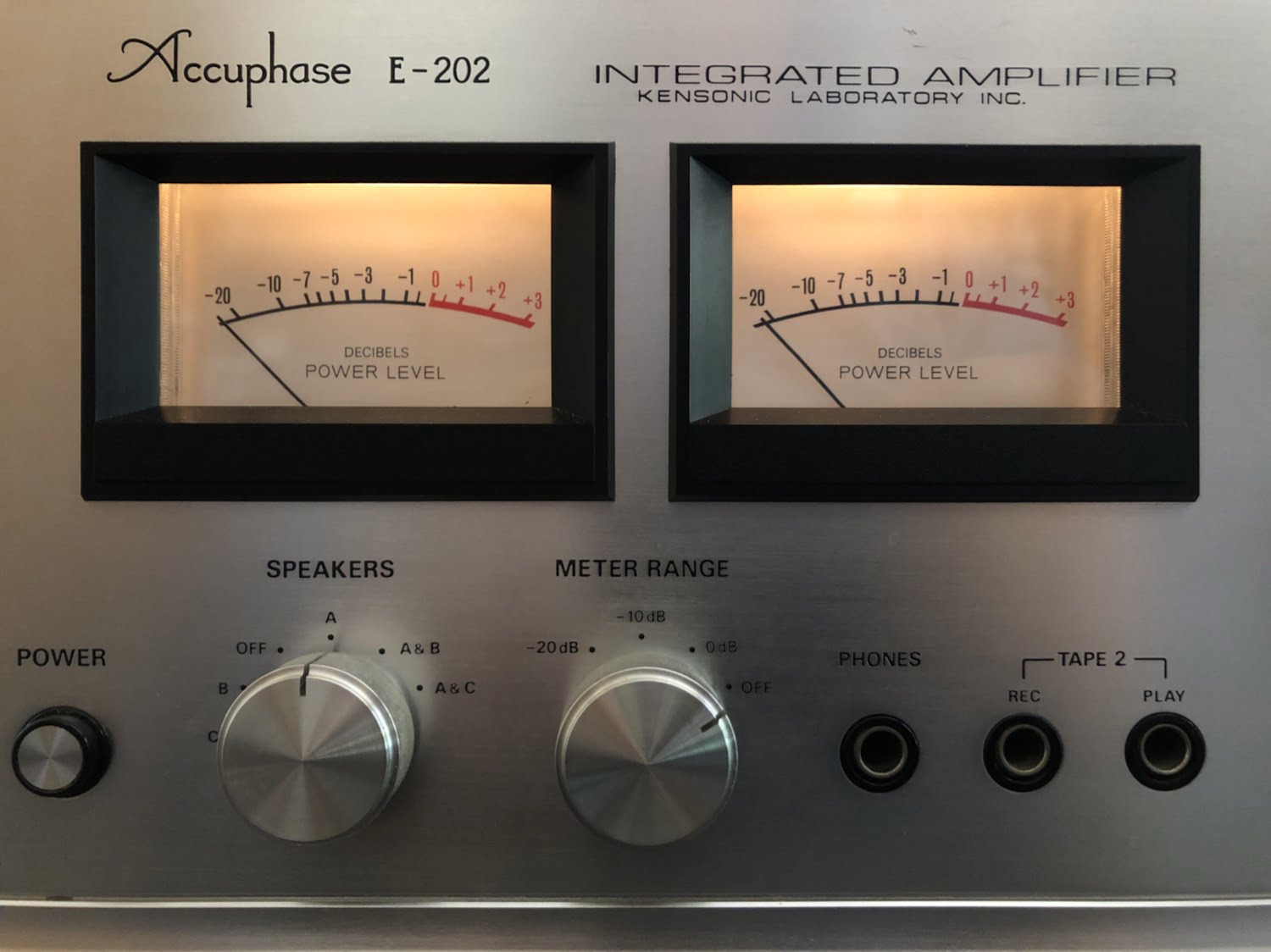
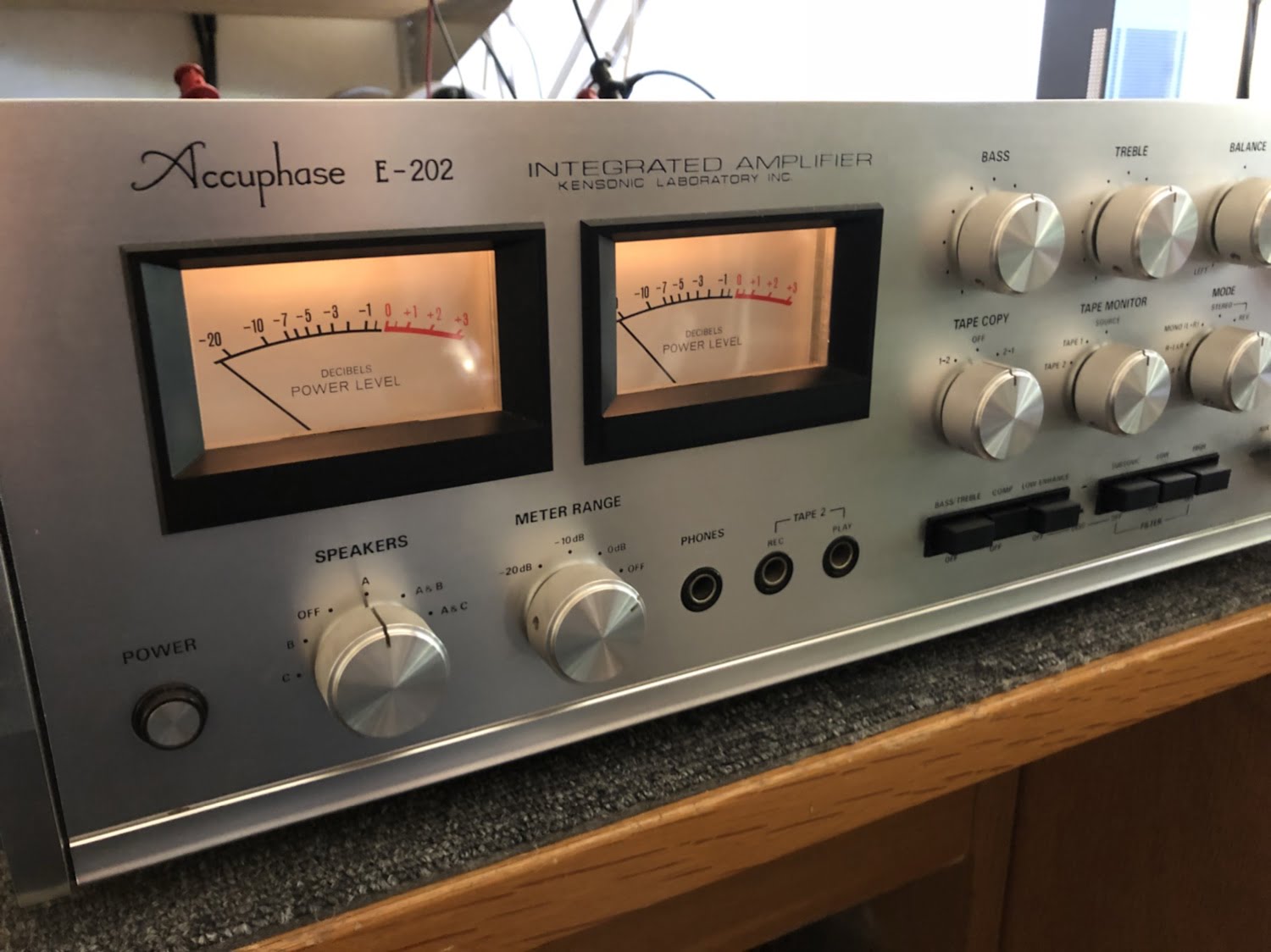
I’m repairing a gorgeous Accuphase E-202 integrated amplifier and there’s a need for careful transistor matching in audio gear like this.
Choosing and matching transistors correctly is critically important when repairing or restoring audio electronics. I’ve learned this over the years, through experience and from people who’ve been doing this for much longer than I have. In this article, I look briefly at matching small-signal transistors.
Matching transistors helps an amplifier run well. That’s why Accuphase took the care to do it when they built these amplifiers, but sadly, many repairers seem to take less care. Most just whack in whatever transistors they have lying around and hope for the best.
Get transistor matching wrong though, and your unit will exhibit high levels of noise and distortion, DC offsets, or worse. The other consideration is that many faults are mistakenly attributed to capacitor problems when they are in fact caused by drifty, noisy or mismatched transistors.
The Accuphase E-202
The Accuphase E-202 is a beautiful amplifier and this beautiful example had some gremlins, as they often do at this age. Apart from needing a major service, the unit had a fault that was especially irritating, for her owner and me, causing the unit to randomly go in and out of protection. This E-202 featured several pairs of mismatched transistors from previous repair goofs. Several original pairs and single transistors had also drifted over time and/or become leaky.
These factors caused DC asymmetry in the amplifier modules and instability in the protection circuit. The DC asymmetry in the amplifier blocks can be trimmed out, but noise and distortion are compromised. There’s no trimming possible in the protection circuit though, so that’s a bigger issue.
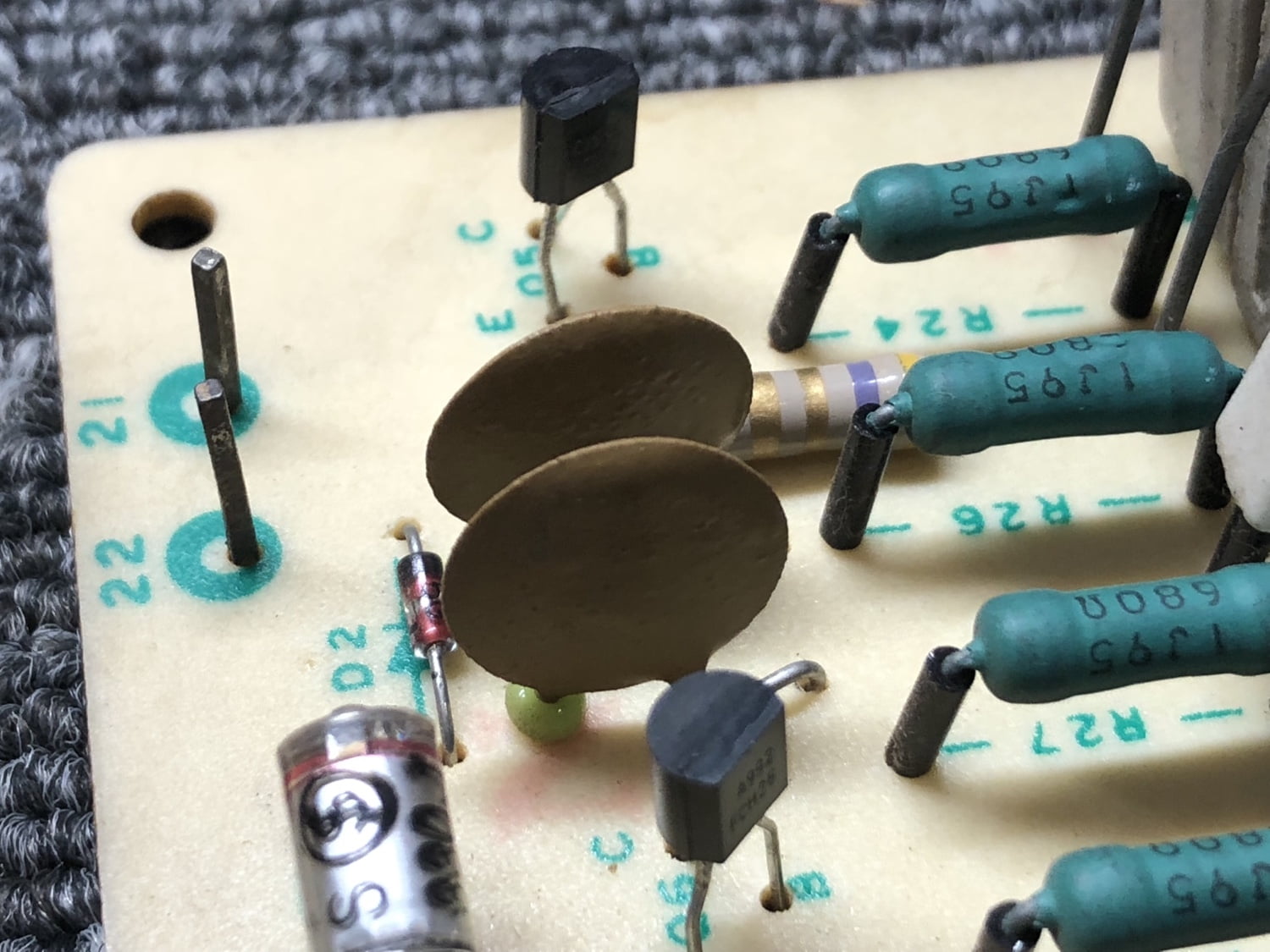
Whoever worked on this before me apparently replaced only one device out of a matched pair. What’s worse is that they used a different device type, creating problematic mismatched pairs. Worse still, these different parts didn’t match the specs for the original parts, a common error.
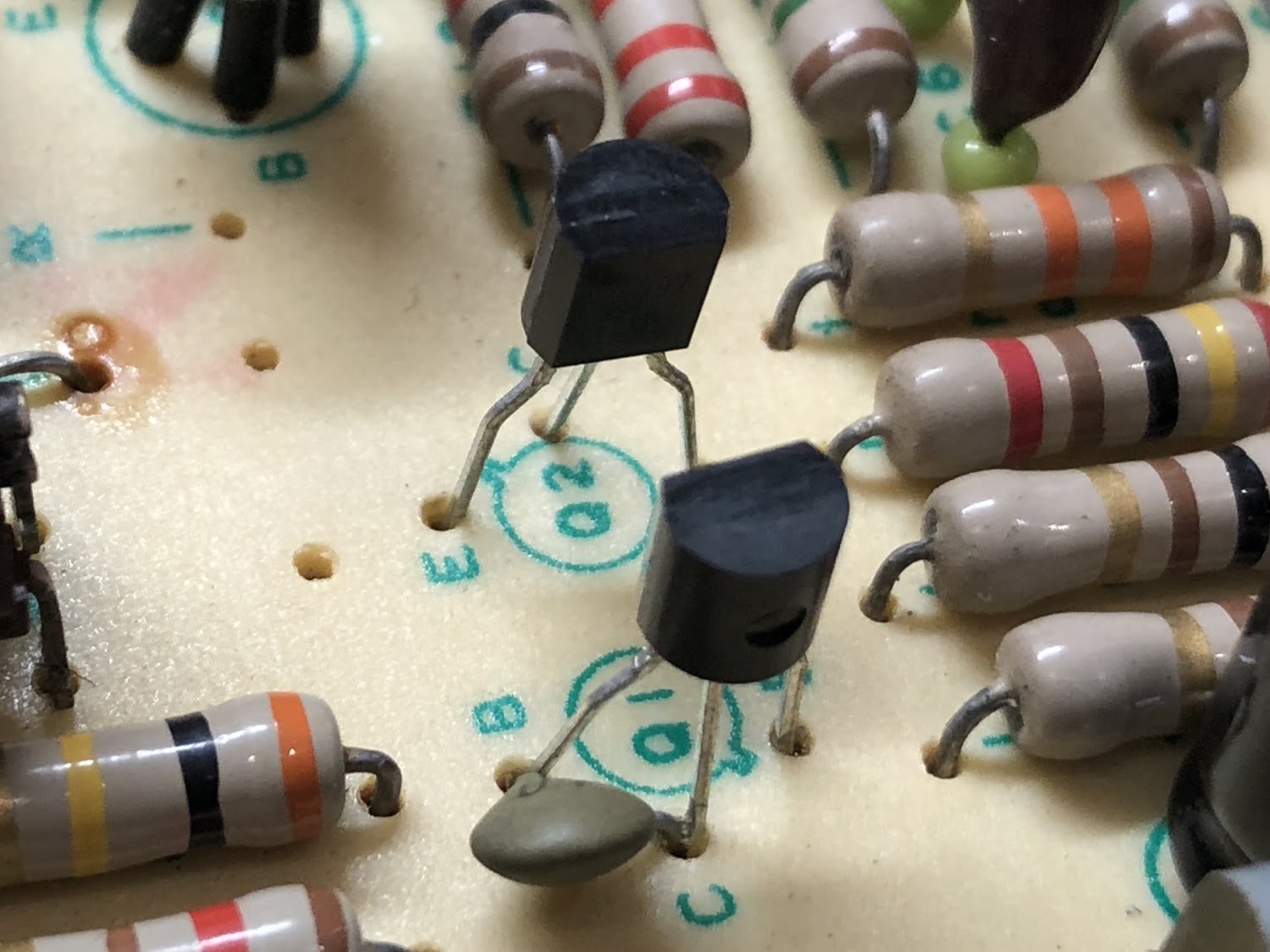
One of the matched pairs in the E-202. This is a complementary pair, not a differential pair. With complementary pairs, gain matching is less critical, but the parts have to be complementary. As this unit came to me, these were not complementary pairs, signs a repairer is lazy, or just doesn’t know any better.
From a technical standpoint, this isn’t acceptable even in a simple amp or preamp. It’s a definite no-no in a high-end hi-fi amplifier, the distortion and noise specs of which depend on carefully matched pairs.
Transistor Matching Basics
Let’s say one transistor in a differential pair becomes noisy, a common occurrence in preamplifiers and amplifiers. From worst to best practice, here are the repair options:
Replace only the noisy transistor, with a different, incorrect type. The worst idea, very common.
Replace only the noisy transistor, with an identical, correct part. Better idea, less common, good practice.
Replace both transistors with an identical gain-matched pair from one batch. Least common, best practice.
I hand-matched this differential pair, found at the input of each amplifier module. Having 50 or 100 transistors to choose from allows me to select perfectly matched pairs like this. Sometimes pairs like these are thermally bonded together to ensure even better matching as they warm up.
If we are dealing with complementary pairs, ie two different but well-matched transistors designed to work as a pair, one should always use the correct or another complementary pair with very similar specifications.
When transistor matching, it’s critically important to:
Select the right transistor for the role
Have enough of those transistors to enable you to
Hand-match parts where possible
Achieving the Match
The trick is to be set up so that you can match parts when needed. A few things help, like learning about the commonly used transistor types, the most important specs when matching, how to substitute parts and so on.
Having enough of the parts one is trying to match is critical. You want at least 50, preferably 100 transistors of a given type, from the same batch. Spread this over some commonly found transistors and you can see the need to carry some stock.
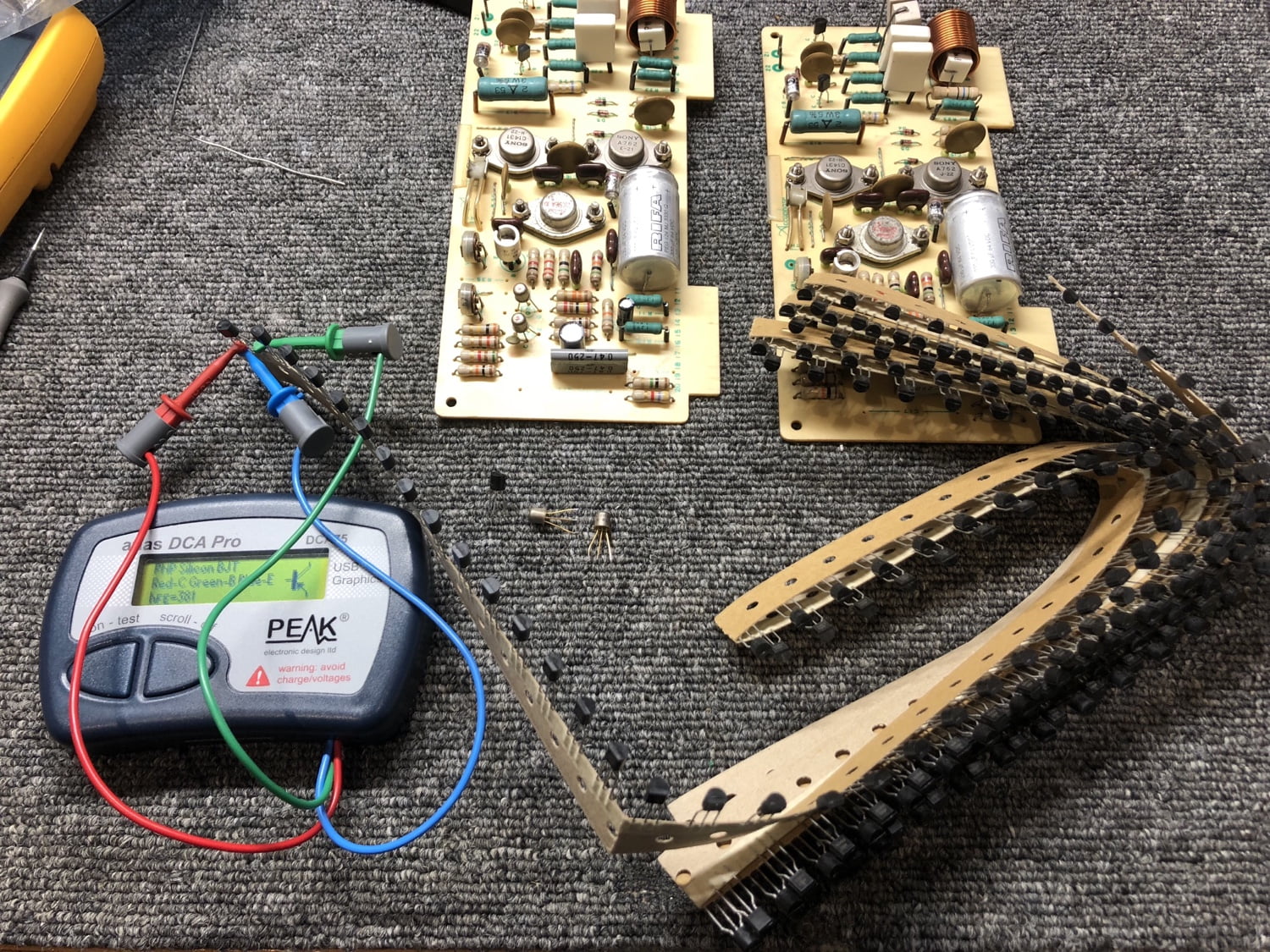
You also need equipment. A curve tracer is a great first choice, something like the Tektronix 576 is ideal. These are big, heavy, complex and expensive, however. Instead, I use a Peak Atlas DCA Pro DCA75, an excellent, compact and accurate semiconductor analyser and curve tracer.
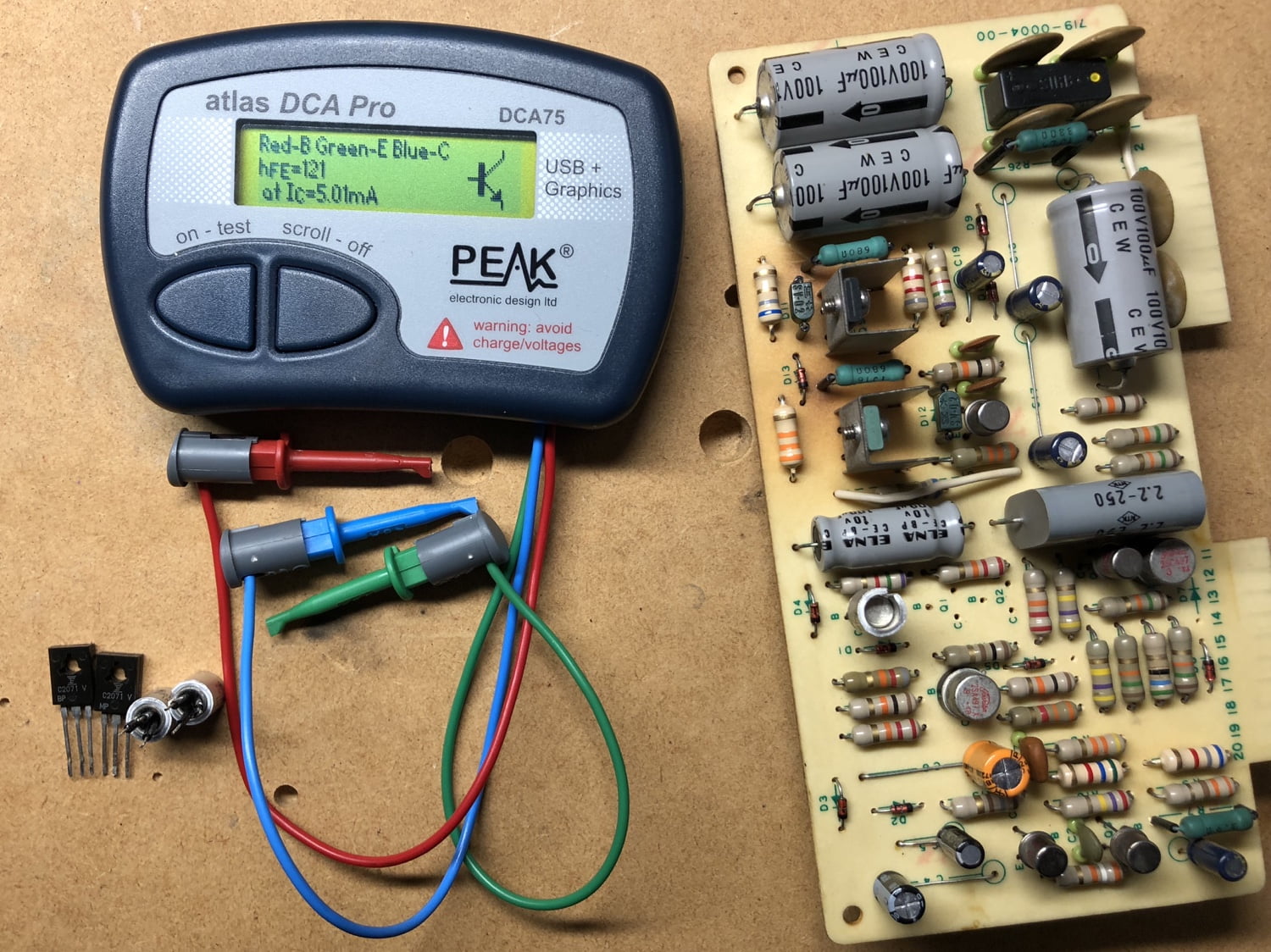
Transistor matching, with the Accuphase E-202 amplifier boards in the background. There are nearly 100 transistors here, all of the same type and from the same batch. I’m using my Peak DCA75 to match the current gain within a small window. The DCA75 is a low-current curve tracer, handy for matching small-signal transistors like these.
Then you get testing, recording results as you go. The idea for differential pairs is to match current gain or hFE as closely as possible, within 1 or 2 if possible. It’s also best not to hold the transistors when testing, as this changes their hFE.
Using the DCA75 to match a pair of vintage transistors to replace a pair that has gone out of spec on the protection board. In the end, I replaced 5 transistors on this board.
I replaced some complementary pairs in this E-202, plus some differential pairs. Not all of them needed replacing, but I did so because the repair brief here made it prudent to do so. Two pairs of transistors on the protection board were especially important in this repair and one device was leaky. In the end, I tested all eight and replaced five transistors in the circuit.
Results
With the correct approach, it’s possible to fix almost all semiconductor problems even in old equipment like this E-202. I keep stock of replacements for all the devices in these lovely amplifiers.
Installing several matched pairs of devices greatly improved the overall performance of the amp and the protection circuit now runs reliably. The unit will run and sound better with correctly matched parts.
If you’d like to discuss matched transistors for your gear, get in touch!
Hi audio friends, just a very quick update today to let you know about a few website improvements I’ve made recently.
Firstly, I’ve revamped my contact page and conact form, making it easier to submit enquiries. I’ve added a country of residence field, which helps me respond to the many overseas messages I receive. Thes significant website improvements really help prospective new customers, and me!
Next, I’ve added a feedback form to my Customer Feedback page. This allows you to directly submit feedback about the work Liquid Audio has done for you. While you’re there, why not read some of the great feedback Liquid Audio has received?
Finally, I’ve dramatically improved my FAQs. I’ve added a bunch of questions and answers about repairs, warranty, post-purchase inspections and many more. I hope you find them useful.
I have many more stories on the go, I’ll be adding new content as fast as I am able, in between repairs and servicing. In the meantime, I hope these website improvements help.
Rippling bass lines, droning guitars and pounding drums filled Perth Arena last night, as Queens of the Stone Age kicked out the jams for a very appreciative crowd.
Josh Homme and the band were in fine form as they ground out a long list of classics and new stuff from their repertoire. We were lucky enough to be up the front, in the pit, but things mostly stayed pretty civilised.
Clockwork Orange theme music played as we watched this, very impressive.
Gig-goers were treated to great visuals and awesome sound as Queens of the Stone Age played one great song after another. I was particularly impressed with the awesome LED stage lighting and effects. I particularly liked the LED light sticks that Josh relentlessly kicked and dragged around the stage.
Light stick ‘thing’ after an attack by Josh Homme! Stage looks great doesn’t it?This just looks cool too…
Homme swaggered around the stage, engaging with the crowd and occasionally spitting uncomfortably close to band mates! There was great camaraderie on show and the guys clearly enjoyed themselves. They were in fine form too, I didn’t hear a bum note the entire night.
Great lighting and superb sound marked an excellent performance.Epic, clean, tight performance
All in all, Queens of the Stone Age put on a memorable performance. I have to give it up for Perth Arena too. It felt much more intimate than I remembered, no doubt partly due to being down the front this time, instead of sitting down, which really sucks. The sound was great, everyone could see what was going on and this really is a huge improvement over the old Entertainment Centre.
The Musical Fidelity M1 DAC shares some of the same DNA as the awesome Tri-Vista 21 tube DAC. Come along as I upgrade this M1 and discover just how good she can sound.
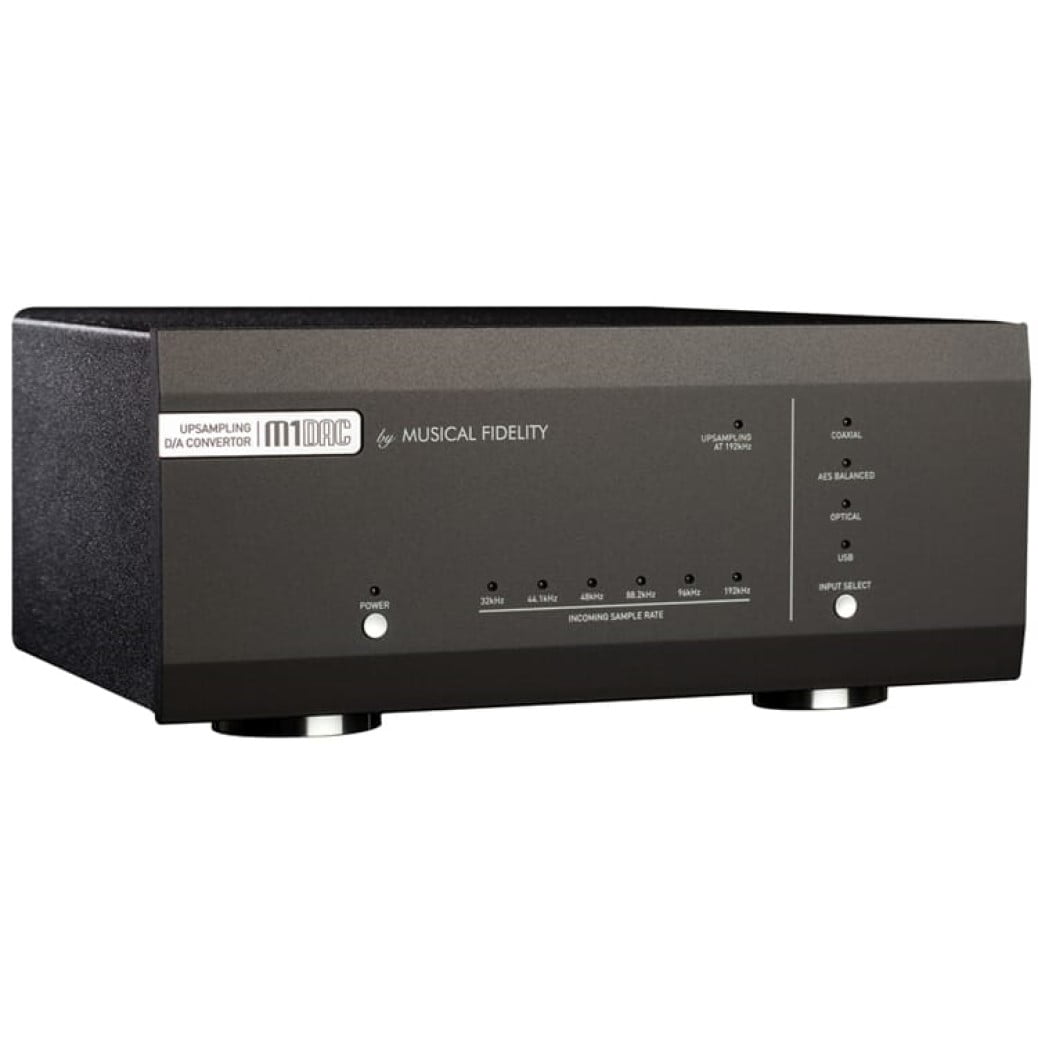
Think of the Musical Fidelity M1 DAC as the little DAC that could. For its very modest asking price, you got and get a lotta DAC for the money. Excellent technical performance, good looks and smooth sound make the M1 DAC a winner, especially now on the used market. The changes I’ve designed here elevate its performance to the next level.
The M1 DAC has, at its heart, the TI/Burr-Brown DSD1796 DAC chip. The DSD1796 is a high-spec chip, with excellent signal-to-noise performance and very low distortion. It’s not as good as the DSD1792 found in the Musical Fidelity Tri-Vista 21 DAC and others.
Both chips are in current production (in 2018) and the DSD1792 is still the second most expensive audio DAC chip TI sells. In qualities of 1000+, the DSD1796 retails for around $3USD a piece though, vs $12USD each for the DSD1796, reducing manufacturing costs considerably.
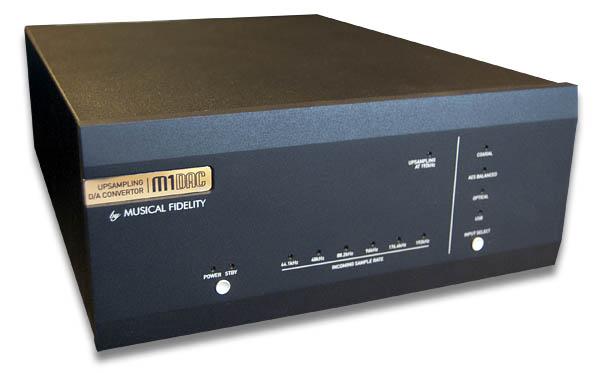
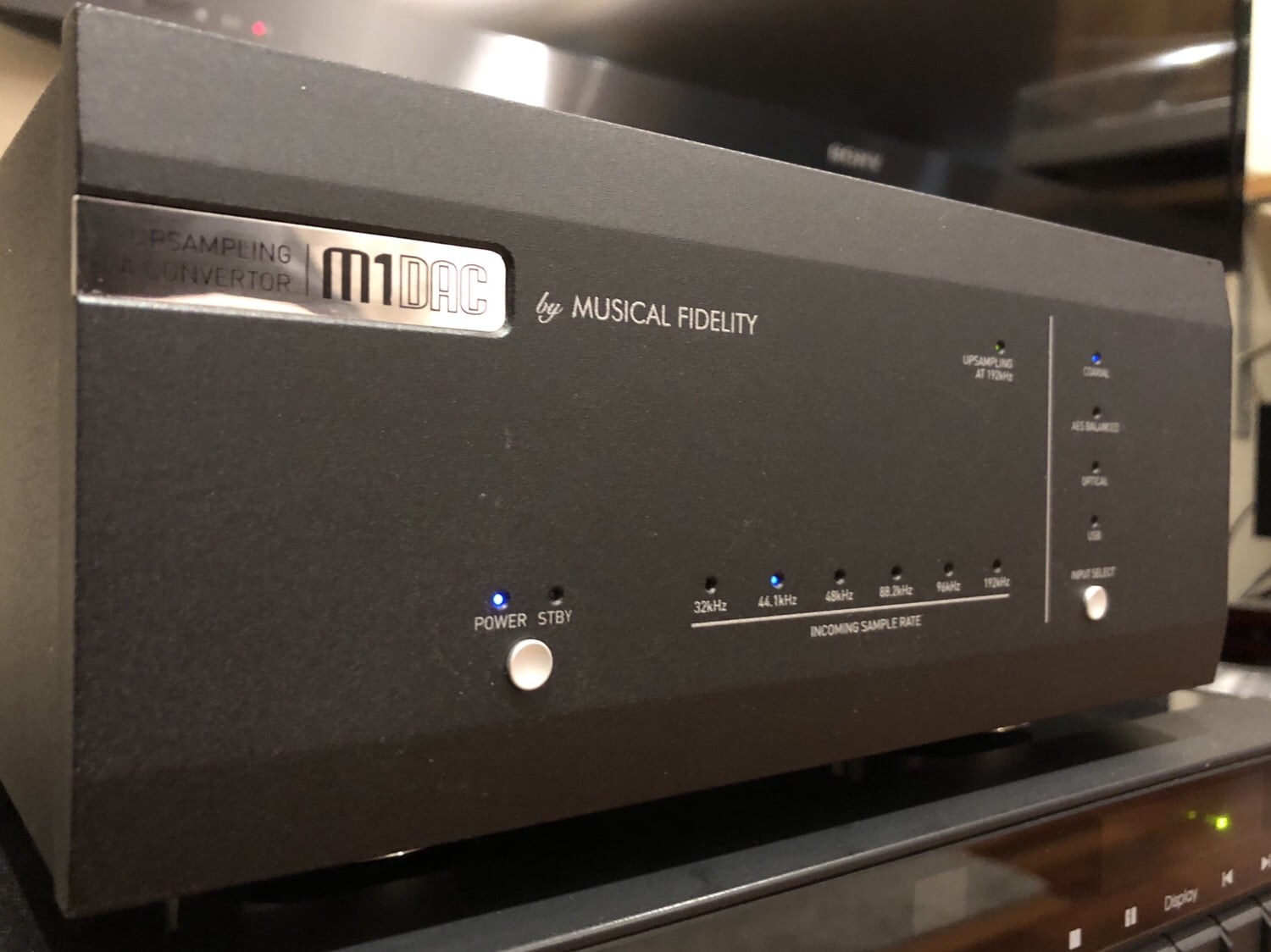
The M1 DAC I modified
The M1 DAC uses a switched-mode or switching power supply, not “switch-mode” as you’ll often see them mistakenly called. A switching power supply or SMPS is cheaper to make than a linear power supply. They are also better suited to standby operation and multi-voltage usage, but alas, they are also noisier.
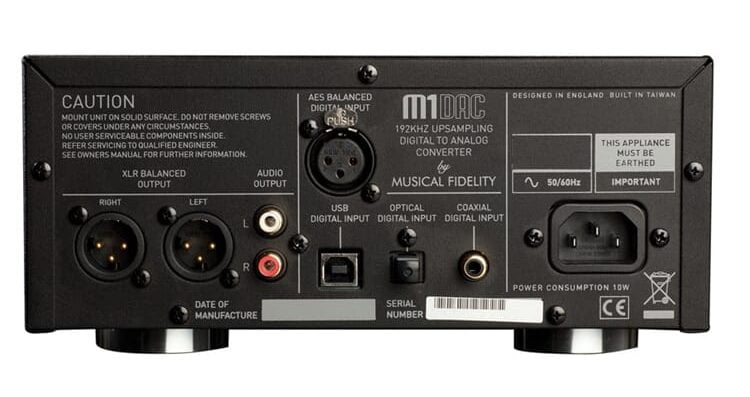
Usefully, the M1 DAC has four digital inputs – coaxial, TOSlink, AES/EBU and USB. These toggle with a tactile push button on the front panel. Fit and finish are very good and the DAC feels very solid and well-built, which it is.
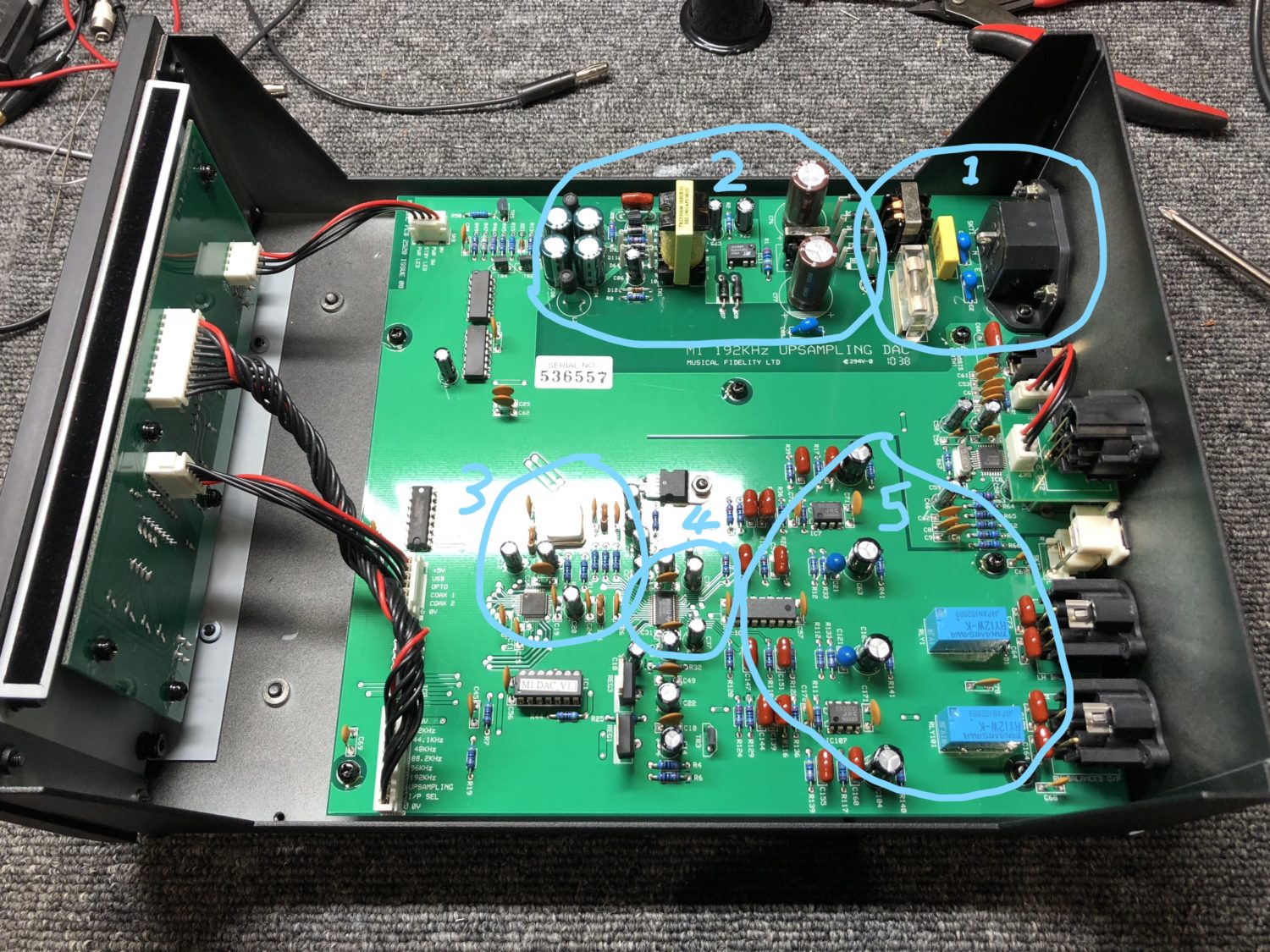
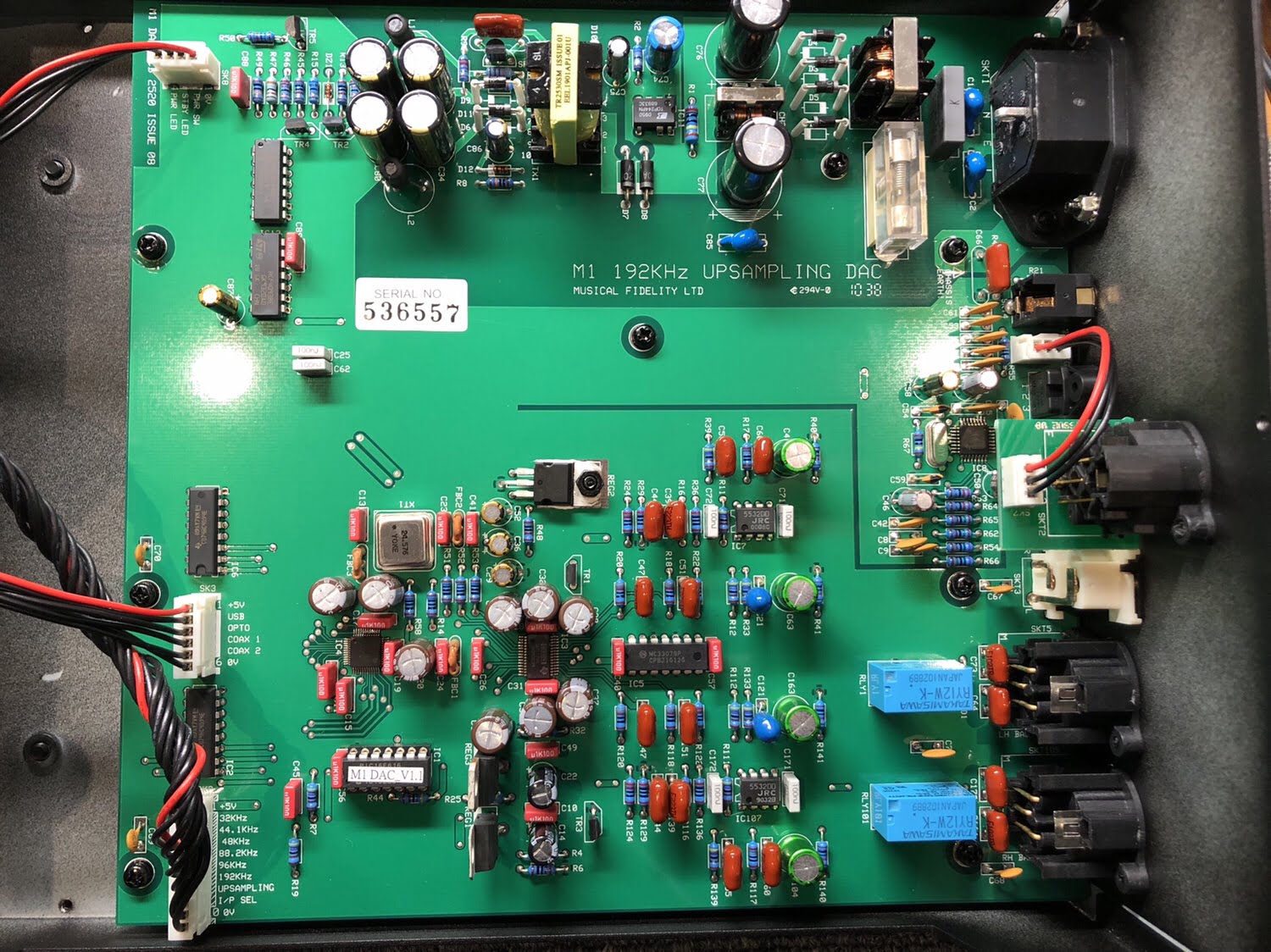
Inside the M1 DAC, with Mike aged 5 annotations: 1. Mains input and filters 2. Rectification, filtering, switching, more filtering 3. Oscillator and sample rate conversion 4. Digital to analog conversion 5. Current to voltage conversion, output buffering and muting. The USB input sits between 1 and 5.
Versions
There are two versions of the M1 DAC. The first was produced until the end of 2010 and has the cleanest internal layout. Its limitation is the USB input, which only accepts data at up to 16/48kHz. Many won’t care about this, I for one.
The second version, produced from January 2011, has an improved USB input accepting data at up to 24/96kHz. The layout of the output buffer is more cramped, but MF may have cleaned up the grounds because the second version measured slightly quieter in Stereophile’s testing.
RCA coaxial connector SPDIF 32-192 kbps (16-24 bit stereo PCM)
TOSLINK optical connector 32-96 kbps (16-24 bit stereo PCM)
USB type ‘B’ connector for computer/PDA - 16-24 bits, 32-96 kbps (Determined by source file/computer settings)
Outputs
Line-level RCA (single-ended)
Line level XLR (balanced)
General
Dimensions - WxHxD (mm): 220 x 100 x 300
Weight (unpacked/packed): 3.4 kg / 4.1 kg
Reviews
The M1 DAC was generally well-received at the time of release. Stereophile enthusiastically reviewed the M1, with Sam Tellig stating:
“What I mainly heard from the M1 DAC was nothing: an absence of artifacts, if you want to get fancy. There was no fudging of detail, no smearing of transients. Purity of tone was exceptional—and this remained true when I took the M1 DAC upstairs to play with its brother, the M1 HPA headphone amp. So addictive is this DAC that I can’t bear to replace it with another…”
“It may be affordably priced, but in almost all ways, Musical Fidelity’s M1 DAC offers performance that is close to the state of the art.”
JA
It’s quite clear from these comments that these guys were very impressed with the M1 DAC. Many others were too, like Audio Stream, TechRadar and HiFi Review.
Liquid Audio Upgrades
The M1 DAC sounds good out of the box, dead quiet, smooth and grain-free. But it’s also somewhat dull, lacking air, resolution and microdetail, compared to the best DACs I’ve heard and owned. I wanted to see what I could do for this little DAC in terms of some modest, carefully implemented improvements.
I planned a series of upgrades, similar in spirit to those I developed for the Tri-Vista 21 DAC, and more recently this Tri-Vista 21 DAC. As usual, I focussed on the power supplies, DAC and signal path, utilizing better quality parts and greater attention to bypassing and decoupling.
As I often do, you can watch an accompanying video to this article over on my YouTube channel:
Be careful or at least mindful of the comments section of my videos, and others. I monitor the comments to ensure misinformation and BS don’t lead my viewers astray, but people still try. I had a guy say that what you should do here is not any of the carefully considered work I’ve done of course, but instead “Replace ‘trafo’ with 200VA,”. Yeah. This commenter obviously missed the part where the M1 doesn’t even use a transformer of the type he was referring to! Comment gold like this is usually removed, it’s easier than arguing with people 😂
Before…
It’s worth taking a look at everything before we start, to see what Musical Fidelity did and where improvements can be made.
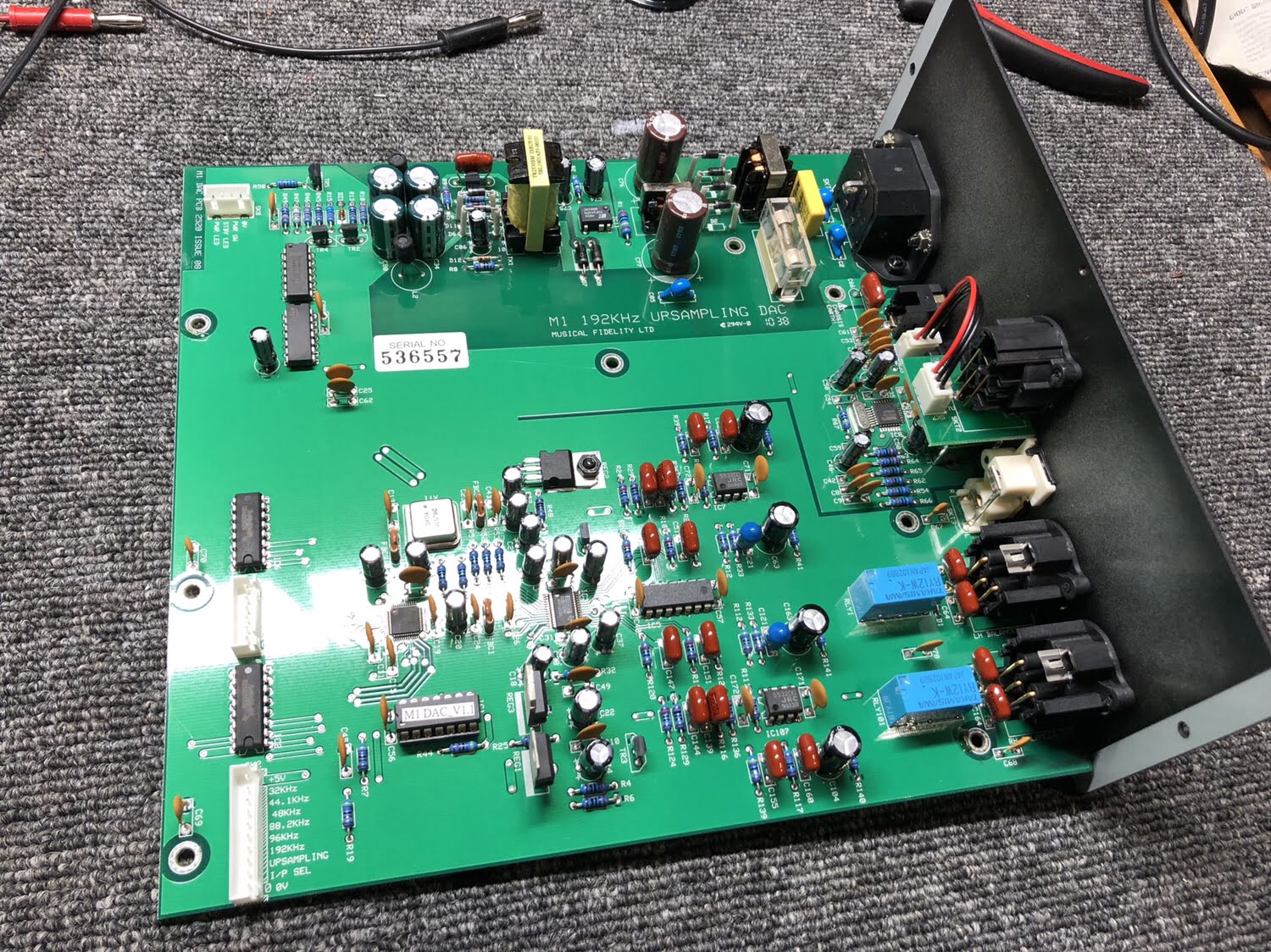
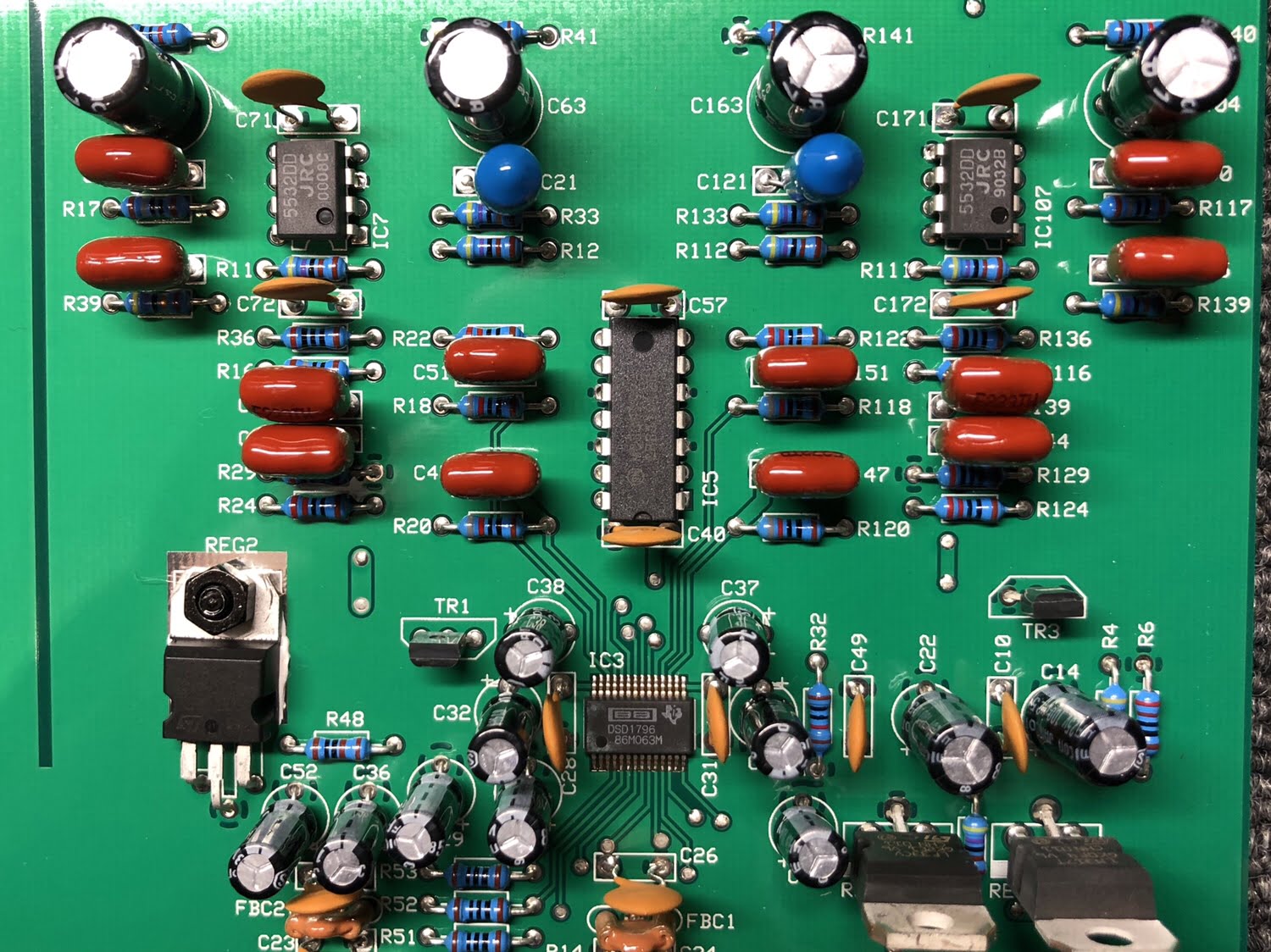
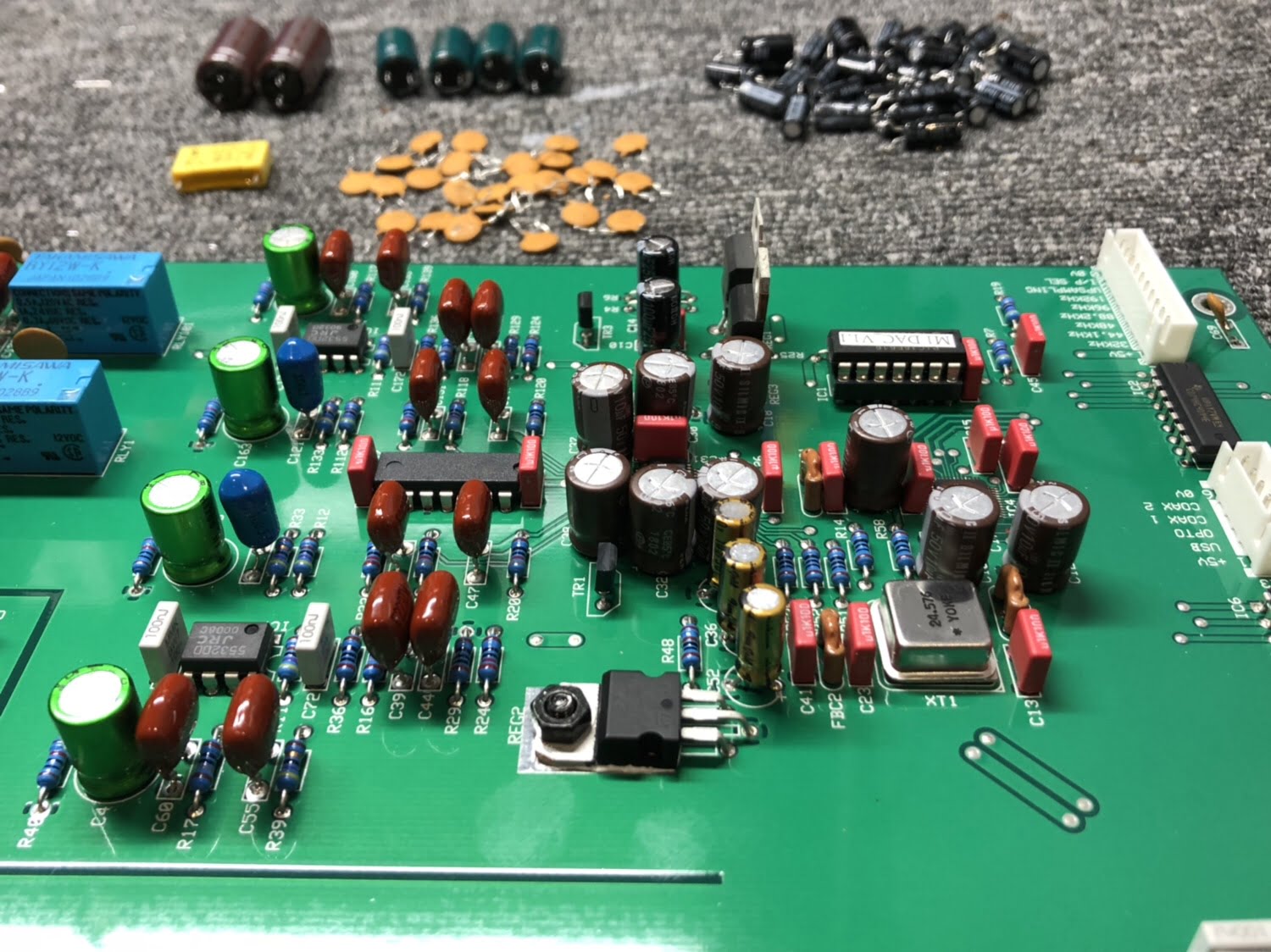
The mainboard, removed from the chassis. This board is nicely made but populated with the usual cheap Jamicon caps, film caps and ceramics. It’s easy to work on though.In this image, we see several local power supply regulators like REG2; IC3 – the DSD1796 DAC chip; IC5 – the weakest link here, in my opinion, the quad op-amp; IC7 and 107 – the JRC5532DD output buffer op-amps. The black capacitors next to them are the output coupling caps. These are obvious targets for improvement.Typical MF, loads of Jamicon caps, certainly not the worst in the world, but these can be easily improved.
After…
Now, let’s look at how I improved things for the M1 DAC.
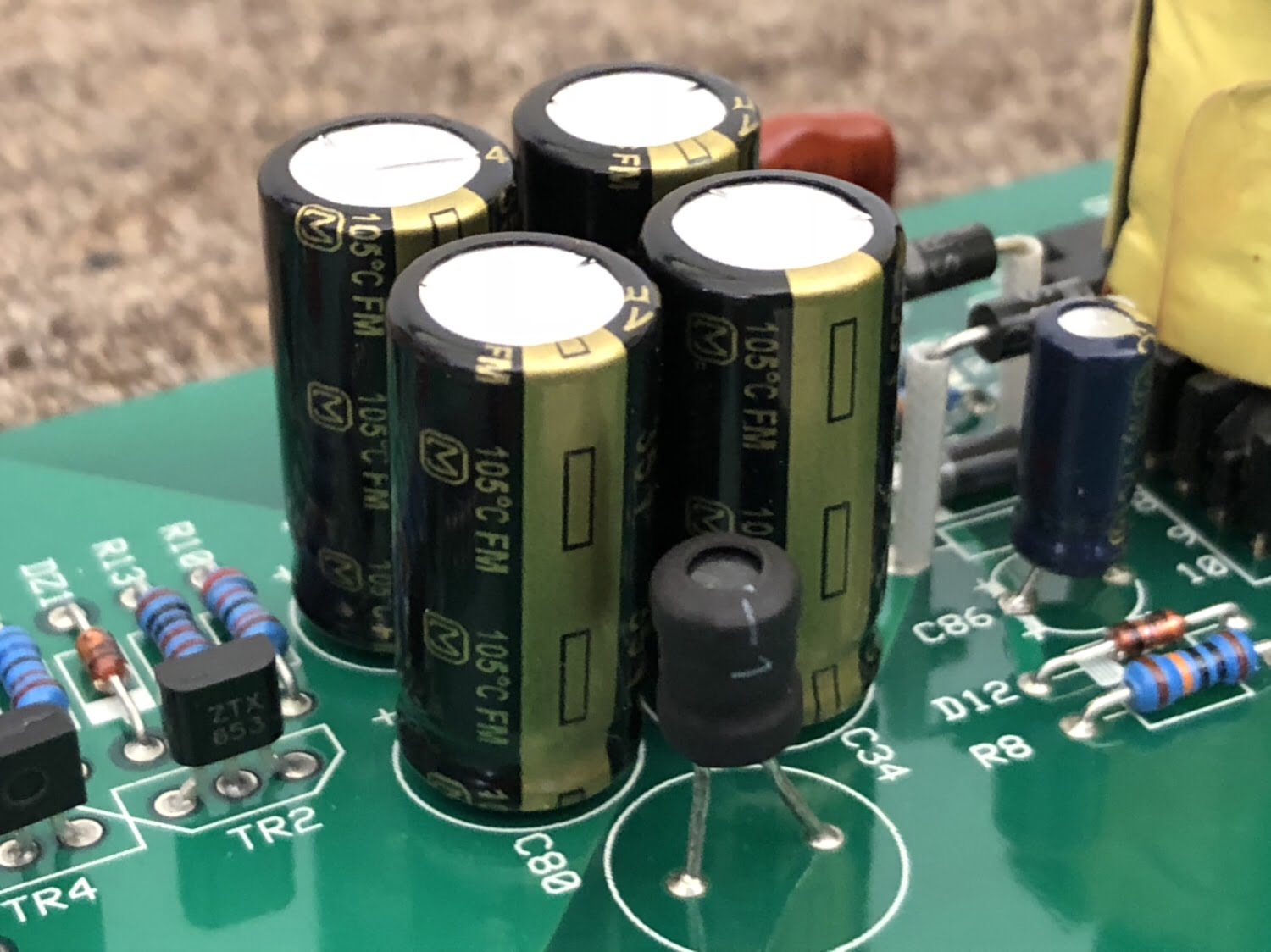
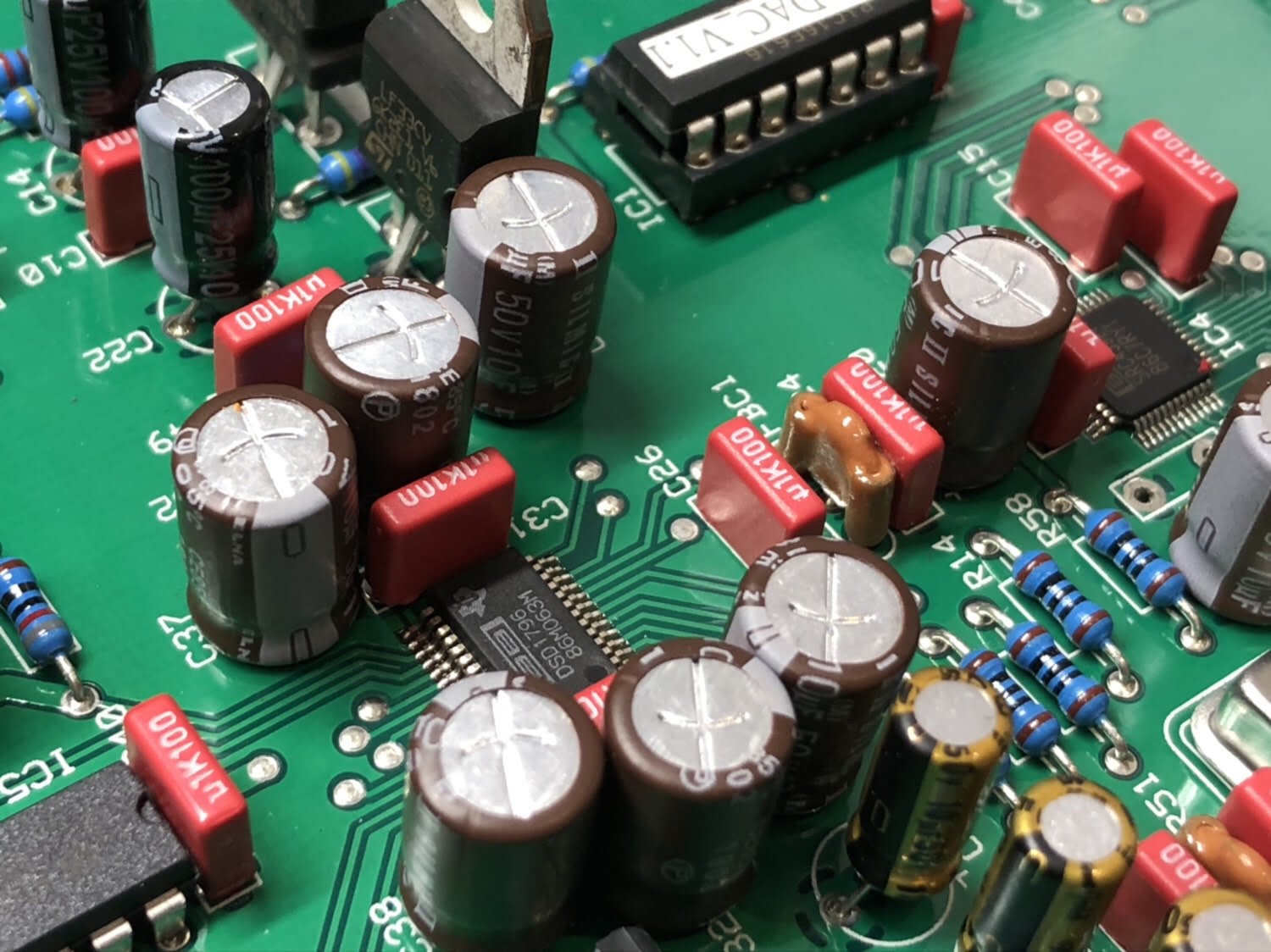
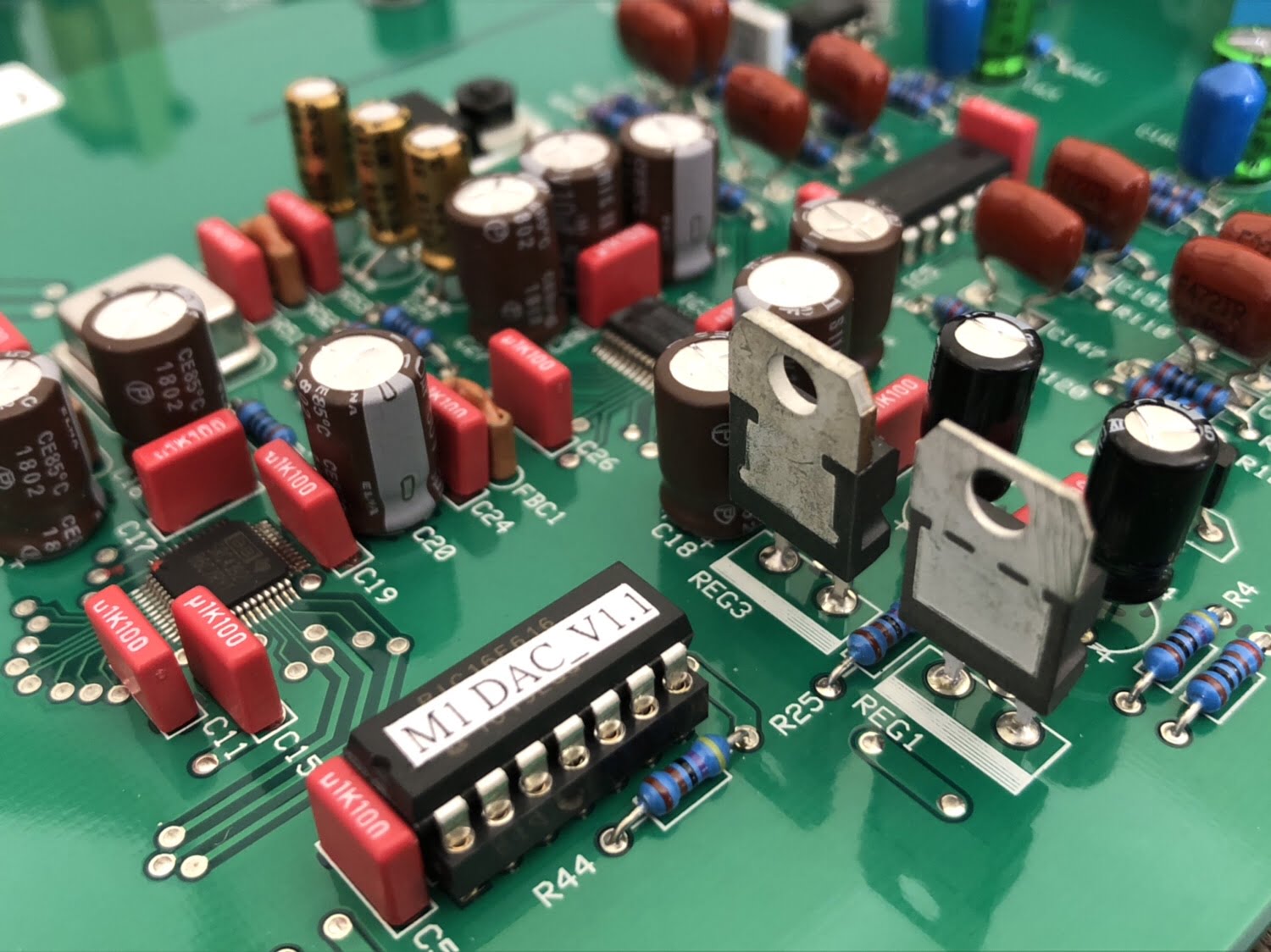
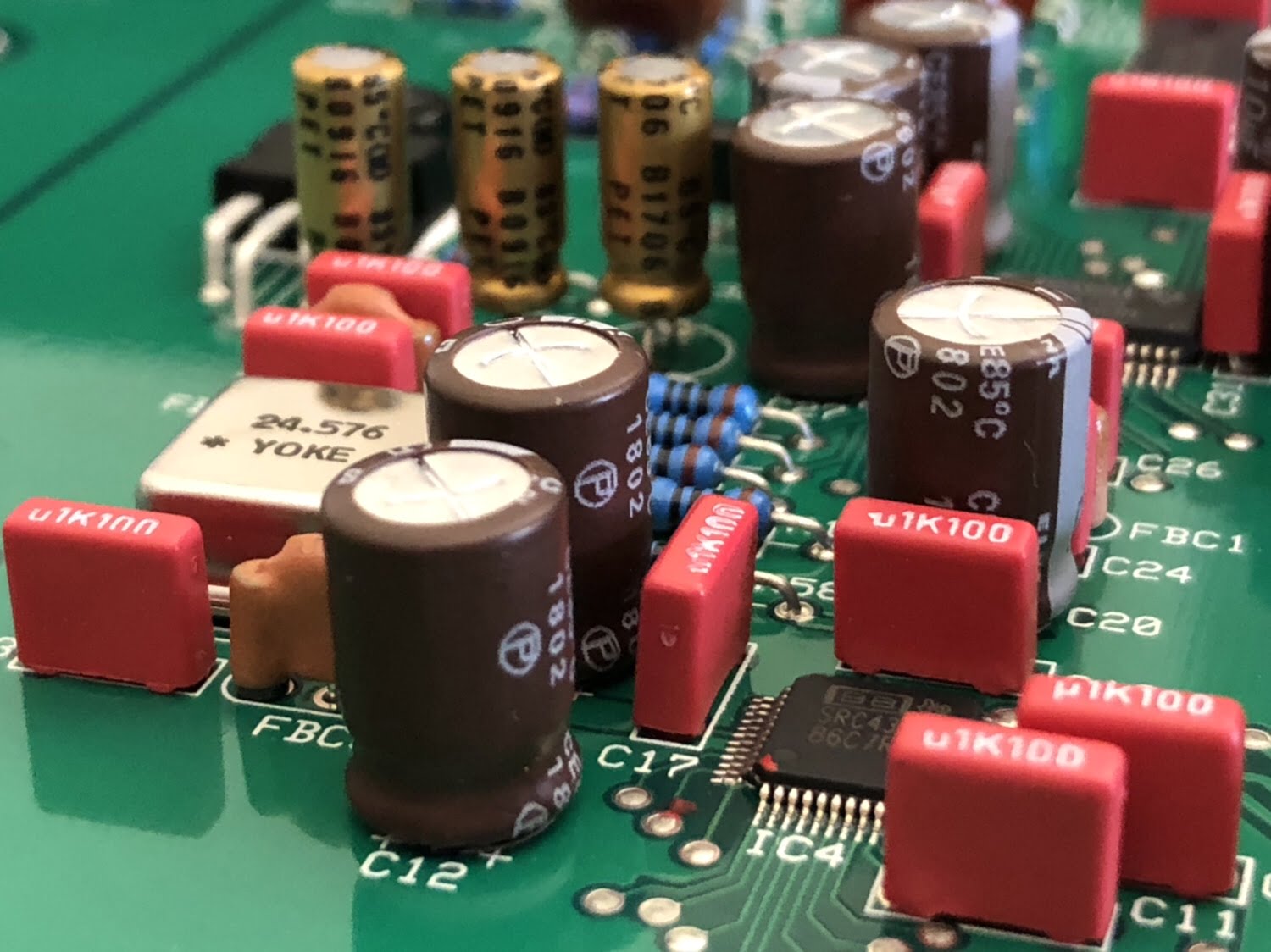
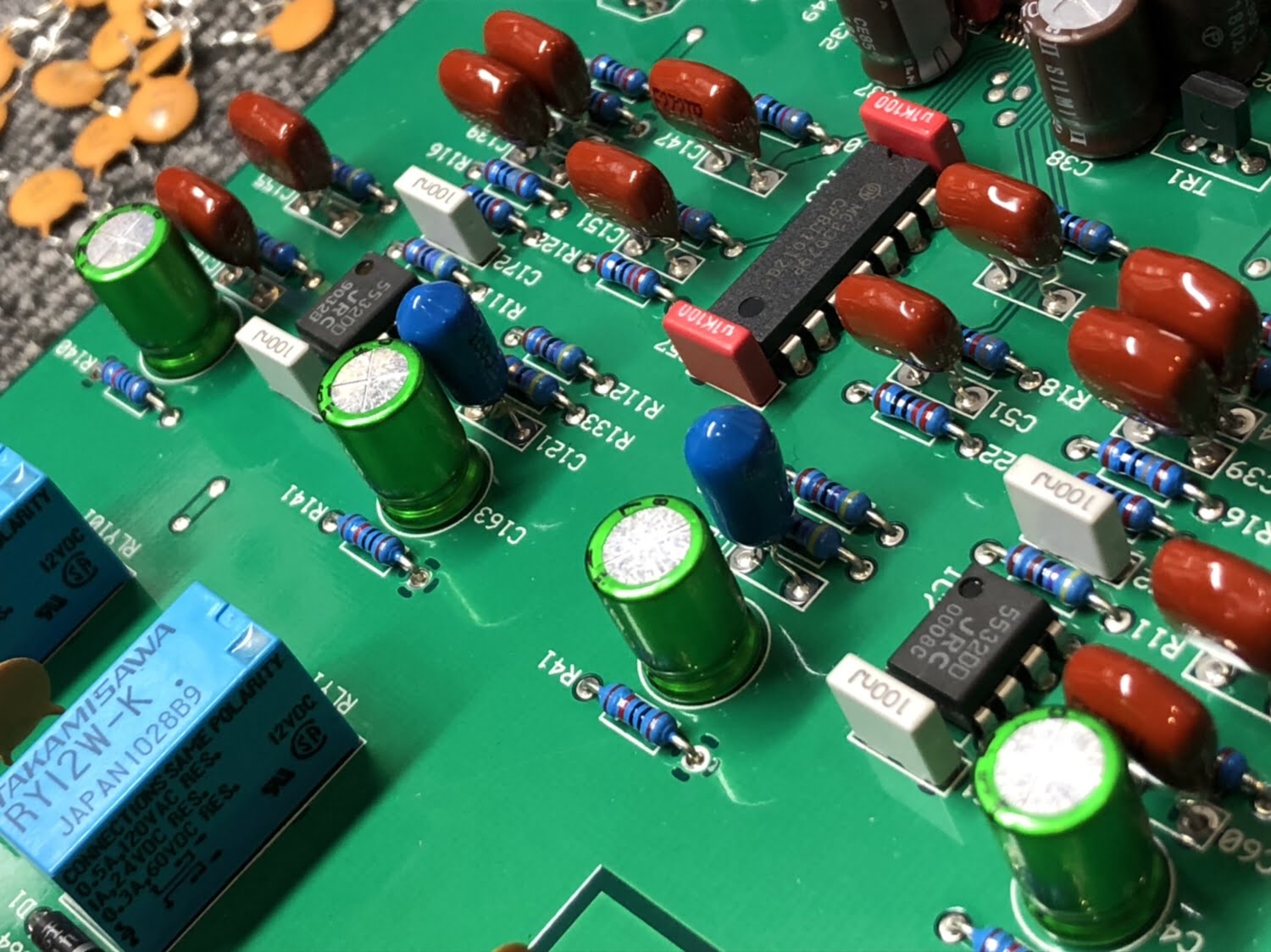
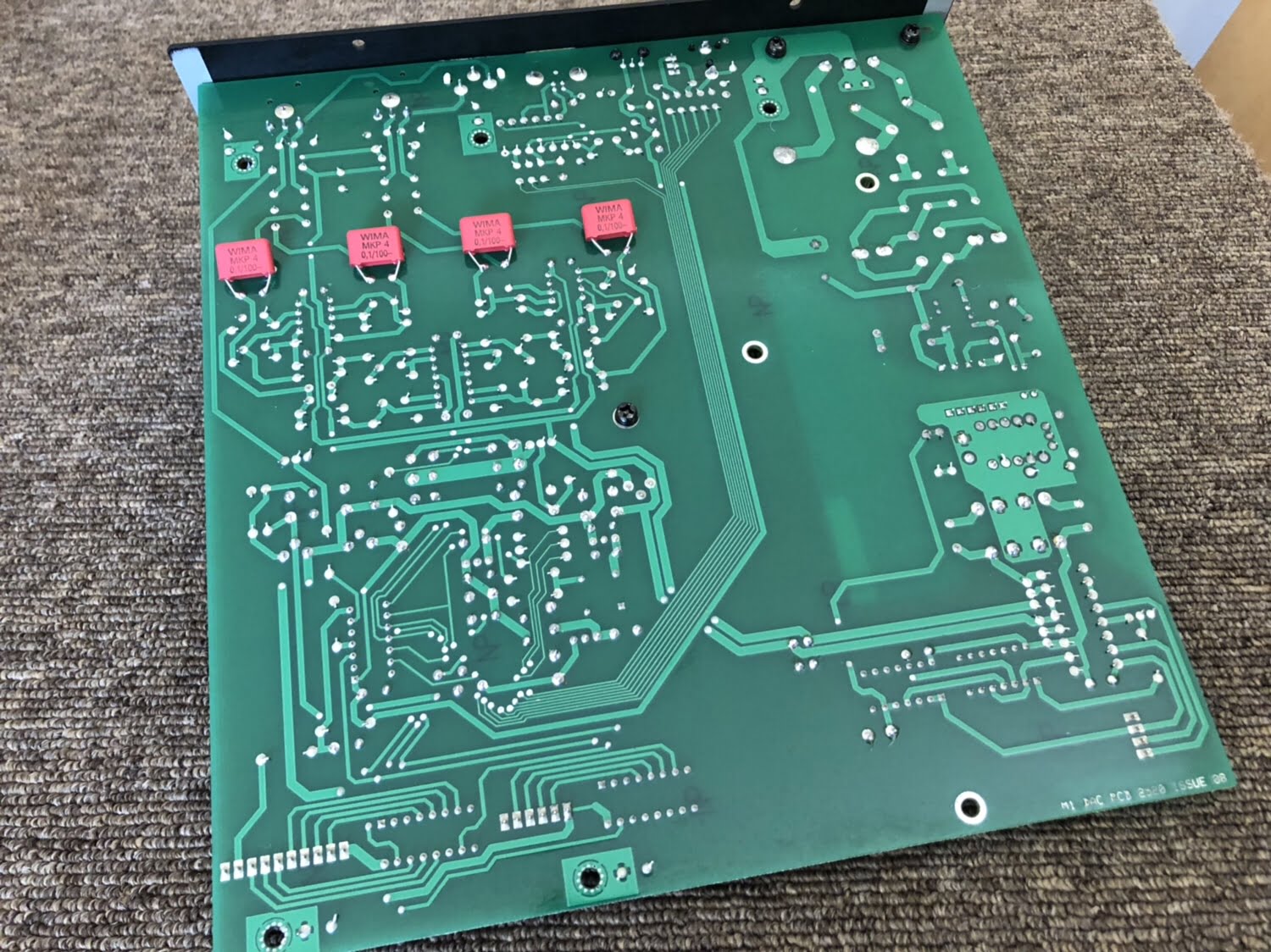
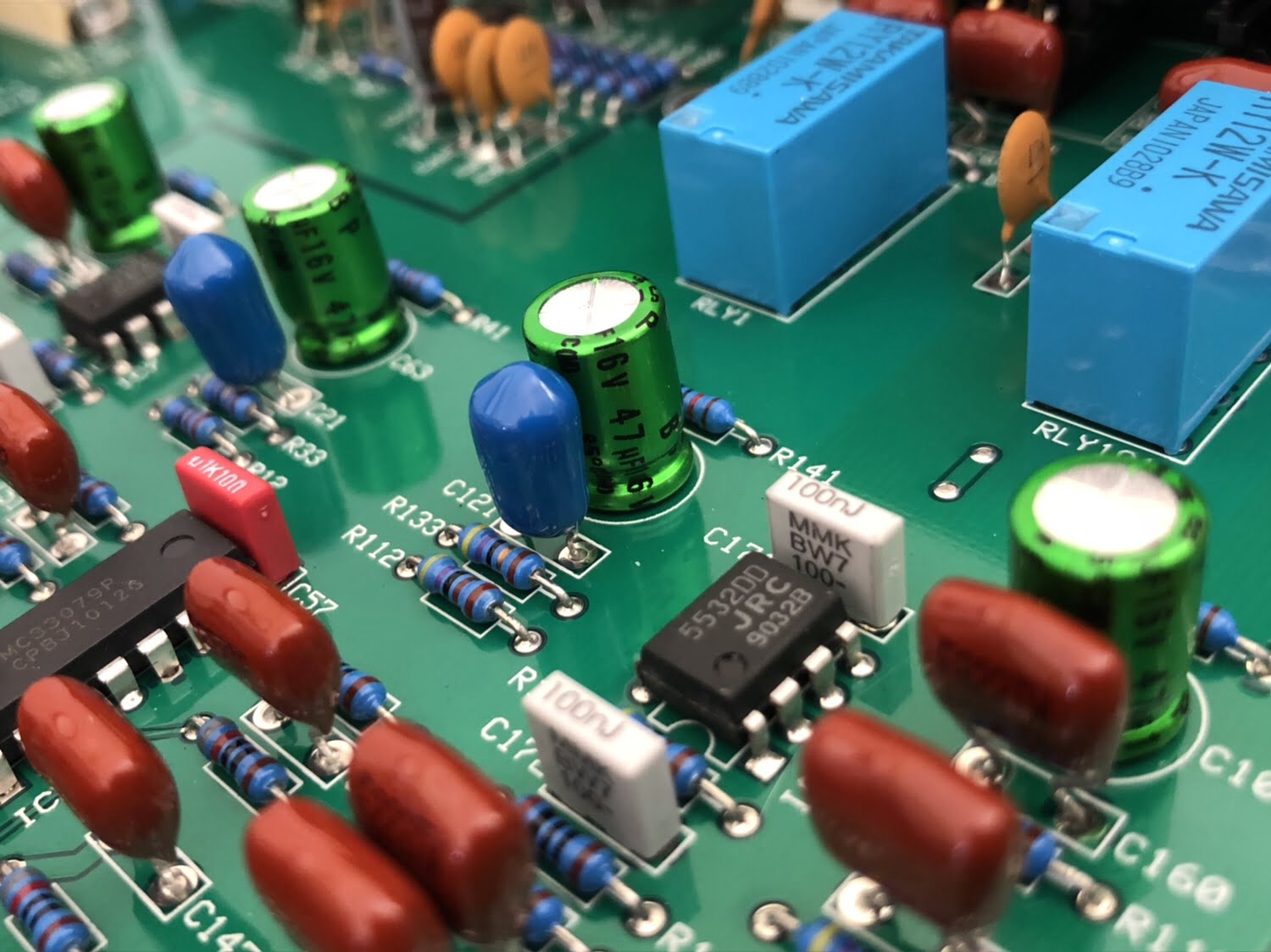
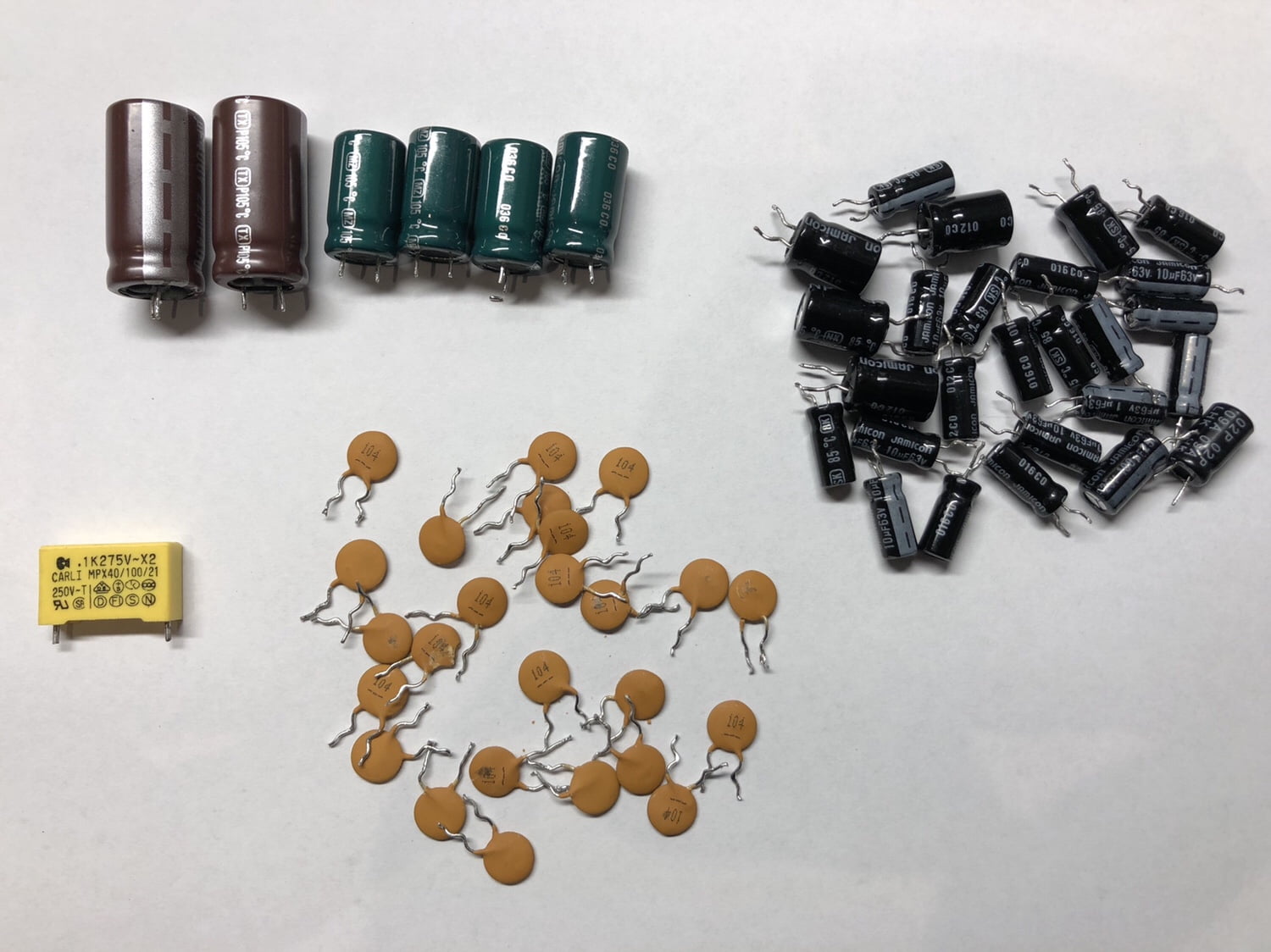
I replaced the Jamicon capacitors with Panasonic FM, low ESR, high temp, high ripple current parts.I replaced all the electrolytic, film and ceramic caps in the critical digital and analog signal areas. Here you can see a range of Elna SILMIC, Nichicon Fine Gold and WIMA film capacitors. I used some of my best parts from stock, because I could and why not?Regulators, operational firmware and lots of nice caps here now. Elna SILMIC caps are a premium grade capacitor, specifically designed for critical areas like DAC chip local filtering, as used for here. Each WIMA replaces a ceramic decoupling or bypass cap. MF did great design work, but the accountants got in the way and made them cheap out in production.Note the component installation neatness, something I’m very particular about. Leads should be as short as possible and I like everything to be straight, aligned and aesthetically perfect. For me, if someone opened this, they should have no way to know it was ever improved, except for the superb quality parts.The low-quality output coupling capacitors had to go. I’ve replaced them with these green Nichicon MUSE bipolar caps. I’ve further improved them with WIMA polypropylene film bypass capacitors, under the board for the best performance.Here are the WIMA bypass capacitors. These improve the performance of the MUSE coupling capacitors.Another shot of those pretty MUSE bipolar audio grade capacitors. Note the cream ERO rail decoupling caps around each JRC5532DD op-amp. The 5532 has been around a long time but is a technically excellent op-amp.Fully upgraded mainboard, with original factory parts in the background.The 60 or so parts I’ve replaced in this M1 DAC. I’ve also added a few more not visible here. The yellow mains suppression X2 cap was completely dead. I replaced it with a premium Kemet part.The finished M1 DAC. The end result is very pleasing, the DAC sounds much nicer than in stock form.
Further Improvement
Is there room for further improvement? Of course, but I believe the art lies in finding the balance between price and performance. This is a budget DAC and I’ve hopefully created the best bang-for-the-buck improvements one might reasonably make to an M1. The DAC has limitations, most notably in terms of the output buffer. Not much can be done here, other than to focus on the coupling capacitors and possibly change the quad op-amp for something better.
Realistically, the amount of work and quality of parts I’ve used in these modifications take this M1 DAC to its limit. I would not suggest doing any more, because returns will be limited. I hit all of the low-hanging fruit, without overreaching. Some design limitations of the M1 such as that non-discrete output buffer I mentioned would require surgery to circumvent. Discrete op amps might help, but for me, that’s probably a bridge too far.
Performance
So, how does my modified Musical Fidelity M1 DAC sound after all this hard work? Fantastic! The upgrades have given her what I hoped they would – more air, more oomph and a more relaxed, musical sound. The DAC sounds less dull, more involving, resolves more detail now and is a big step up from stock.
I suggest utilising the balanced outputs wherever possible. Balanced signal transmission is technically superior and sonically beats the single-ended output, with obviously better bass performance. With balanced equipment, you get the added benefits of lower noise and the negligible impact of longer cable runs.
The Bottom Line
If you want to buy an M1 DAC and enjoy it as is, go for it. They sound great out of the box and are very capable for the money, which isn’t much these days. Alternatively, you may already own one and be looking to improve its performance. This is worth considering and, if done right, you’ll end up with a strong performer, definitely better than standard.
The M1 is no giant killer and does not perform as well as the PS Audio NuWave DSD is for example, but I definitely recommend the Musical Fidelity M1 as a high-performance, budget DAC, with a strong performance for the money and a solid upgrade path, should you wish to take it.
Get in touch if you’d like me to improve your M1 DAC.
Footnote
If you’ve enjoyed this article and appreciate the time and effort that went into creating it, you can say thanks by shouting me a drink or making a donation via the contact page or the donate button in the footer. You can feel good about giving something back too, because very few people bother, which is why I’ve stopped producing this style of article.
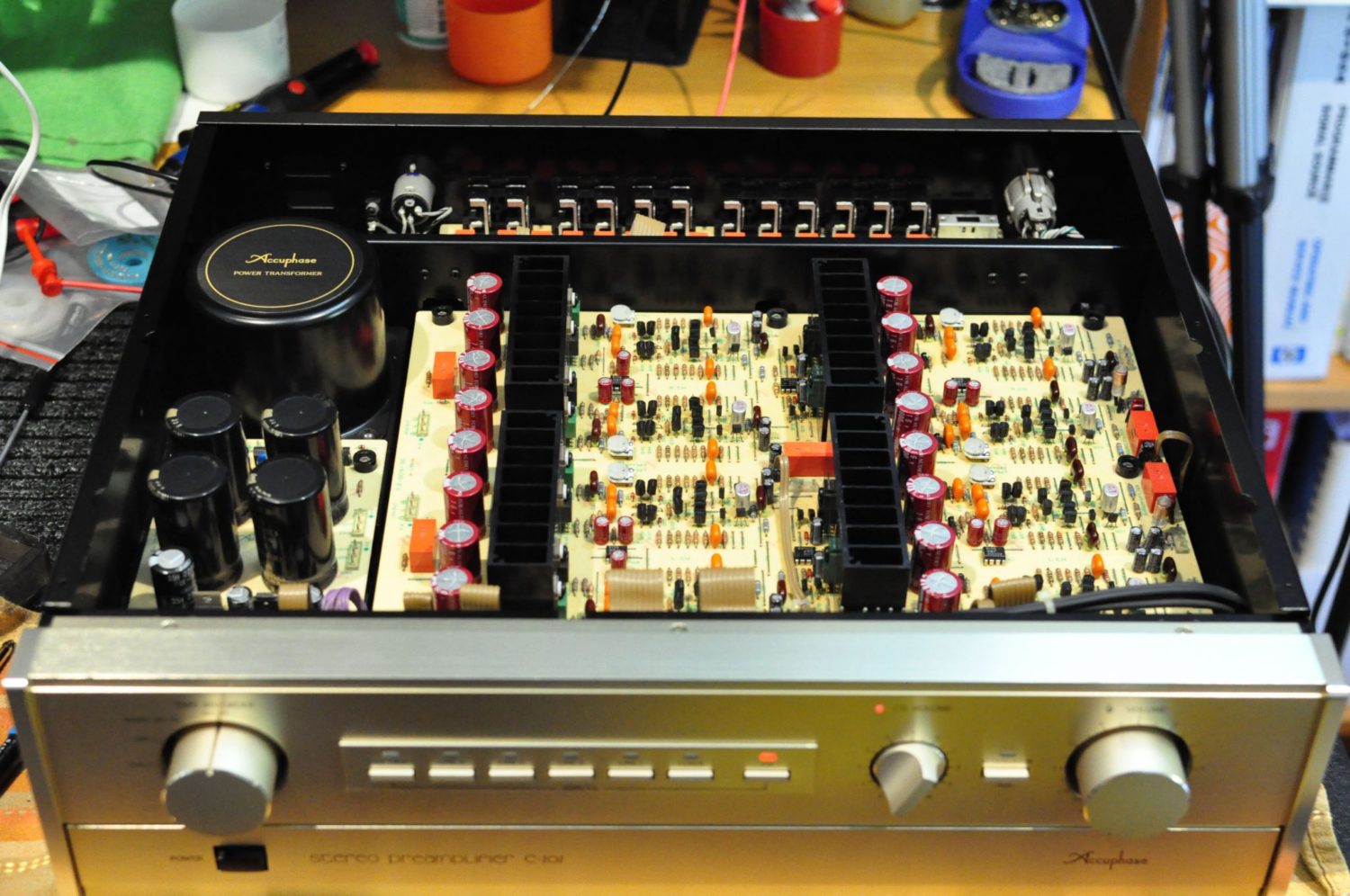
The Accuphase C-202 class A preamplifier is an extraordinary piece of hi-fi gear. Come along as I service and review this great preamp.
The Accuphase C-202 is a line-level, class A, fully balanced preamplifier. It also features a dedicated CD buffer circuit, with very little in the signal path. By any measure, it is a superb piece of gear. It’s not one of Accuphase’s best-known or most expensive pieces, which is good news if you decide to buy one. Prices for this 11kg Japanese-made beauty remain very reasonable, despite climbing since I wrote this article.
2025 UPDATE: As of 2024, I now use an Accuphase C-290, an extraordinary and considerably better-sounding preamplifier, with an AD-290 phono module. Prior to that, and after selling the Accuphase C-202 you see here, I owned and loved an absolutely beautiful Accuphase C-280V. The C-290 is better than anything I’ve used before, but it is a lot more expensive than the still excellent C-202 or the C-280V.
Design
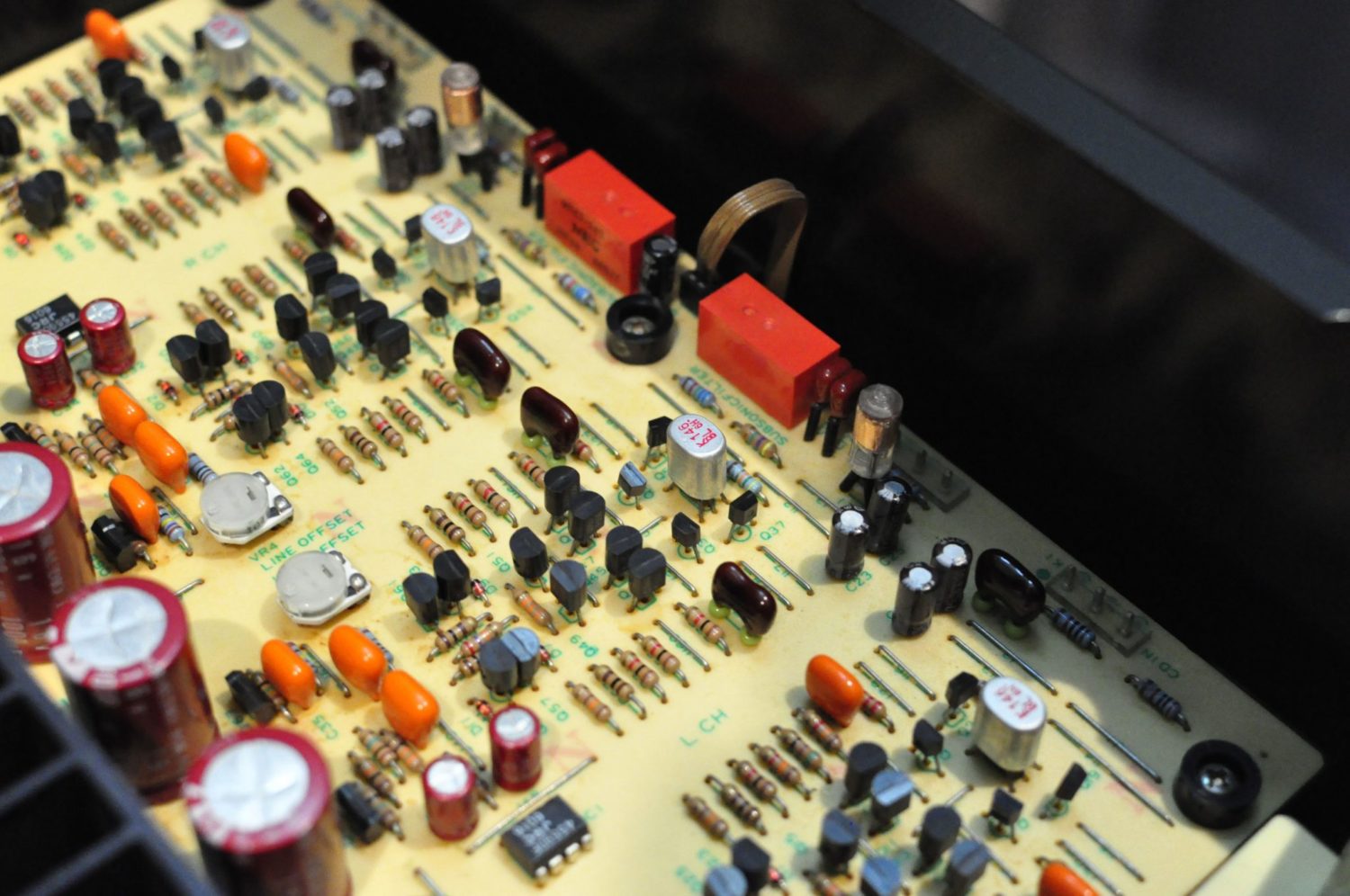
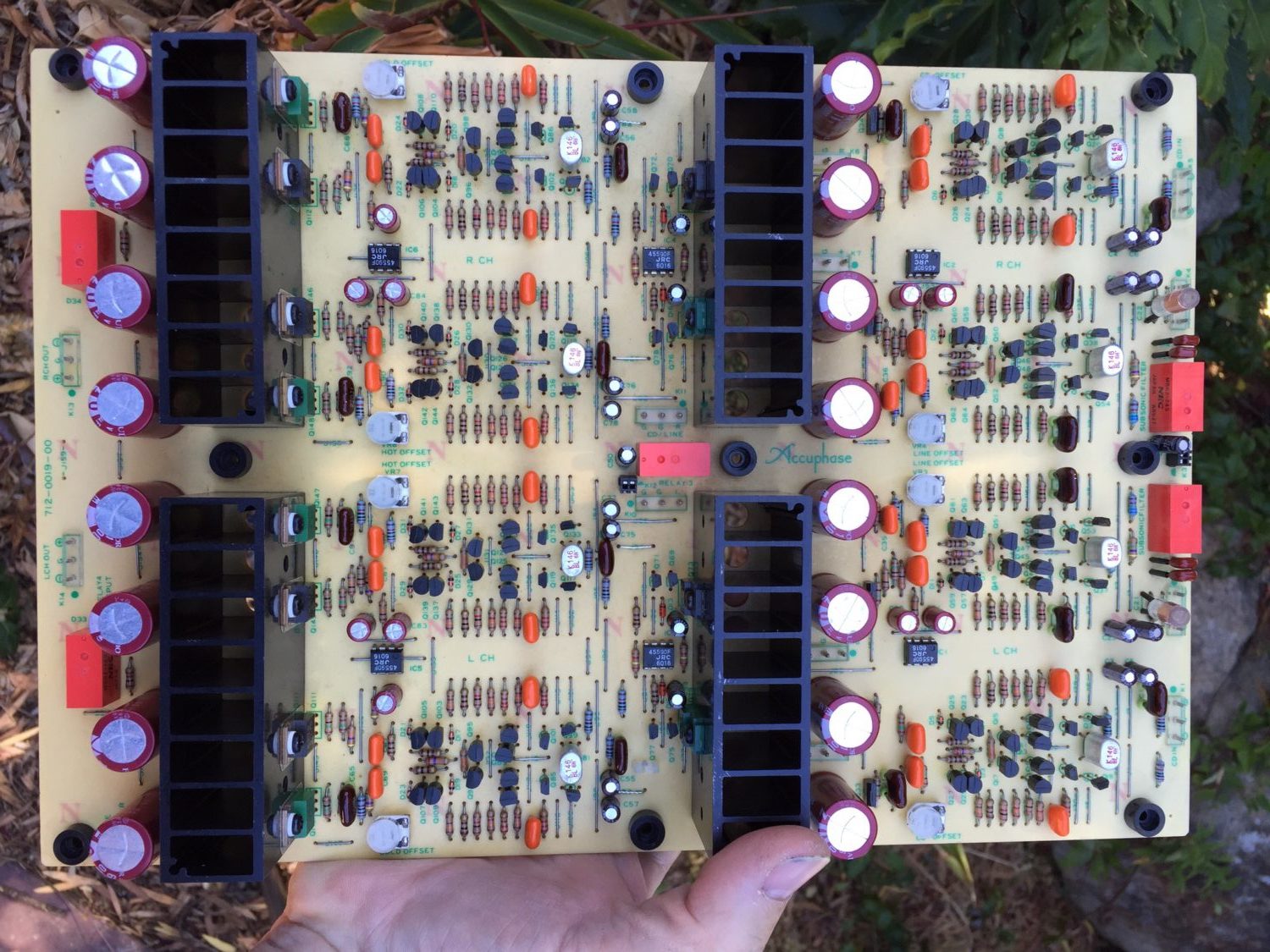
Key design features include fully balanced circuitry from input to output, JFETs at every stage, completely symmetrical layout, class A operation and zero ICs or capacitors in the signal path.
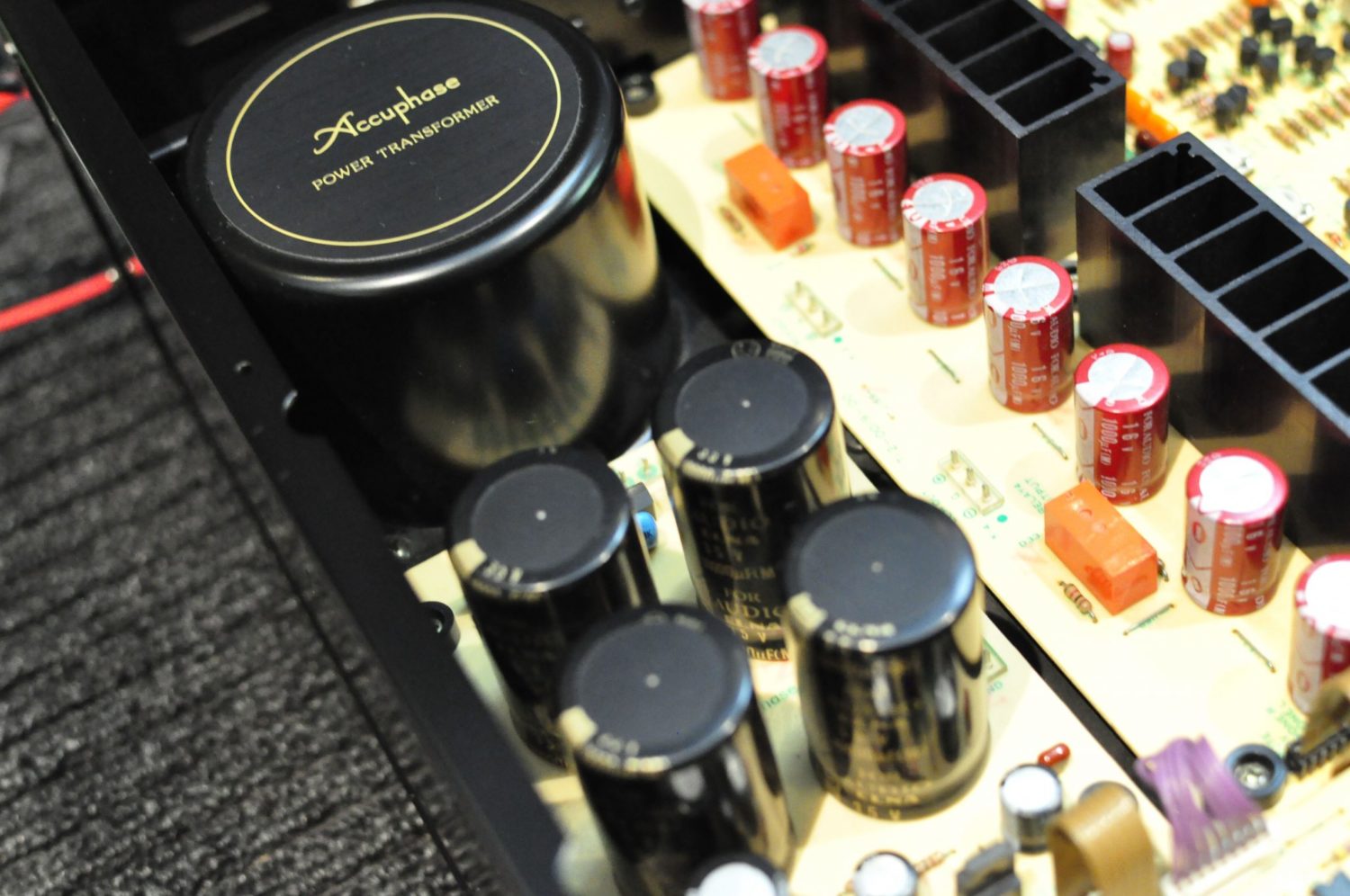
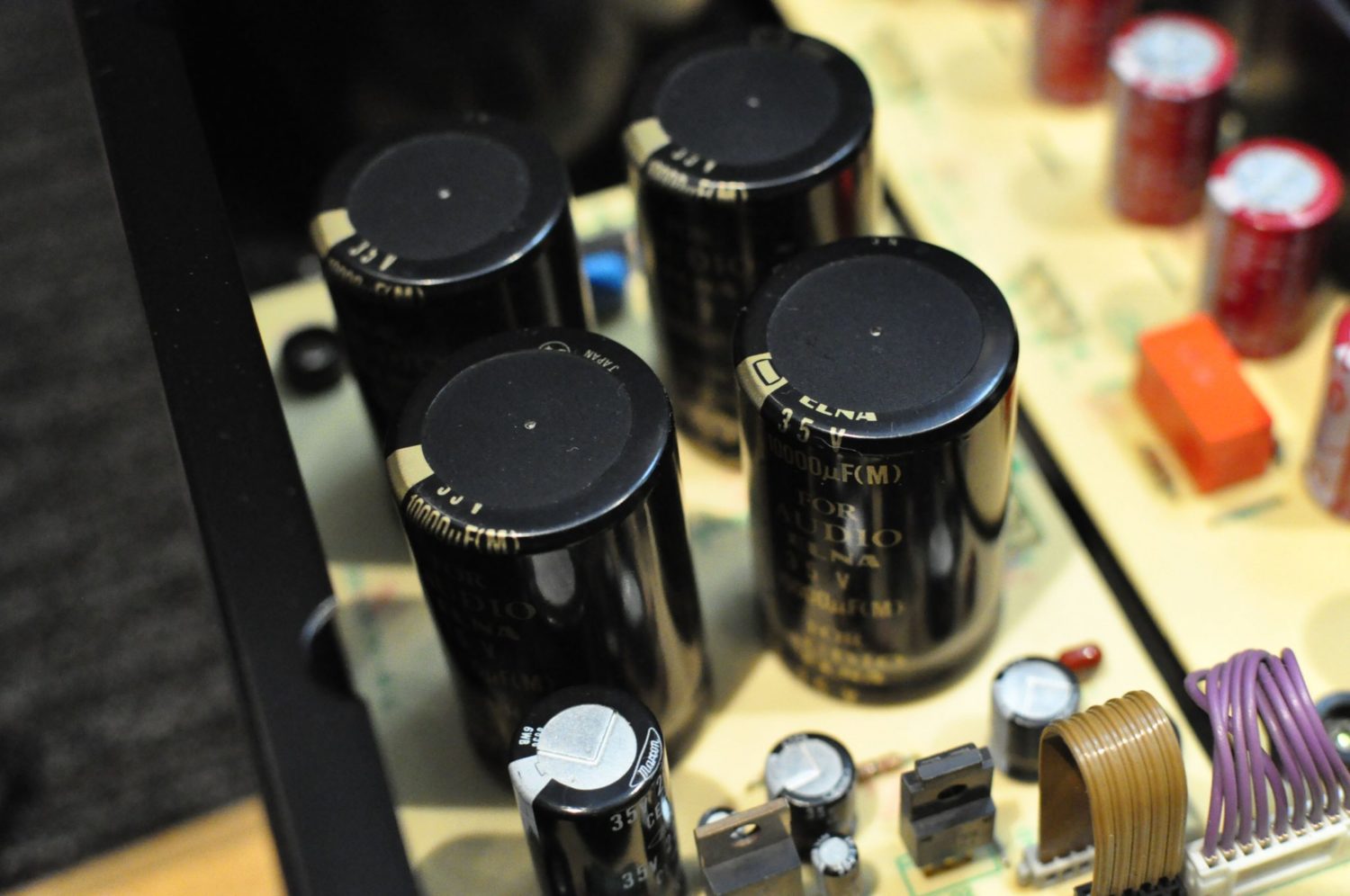
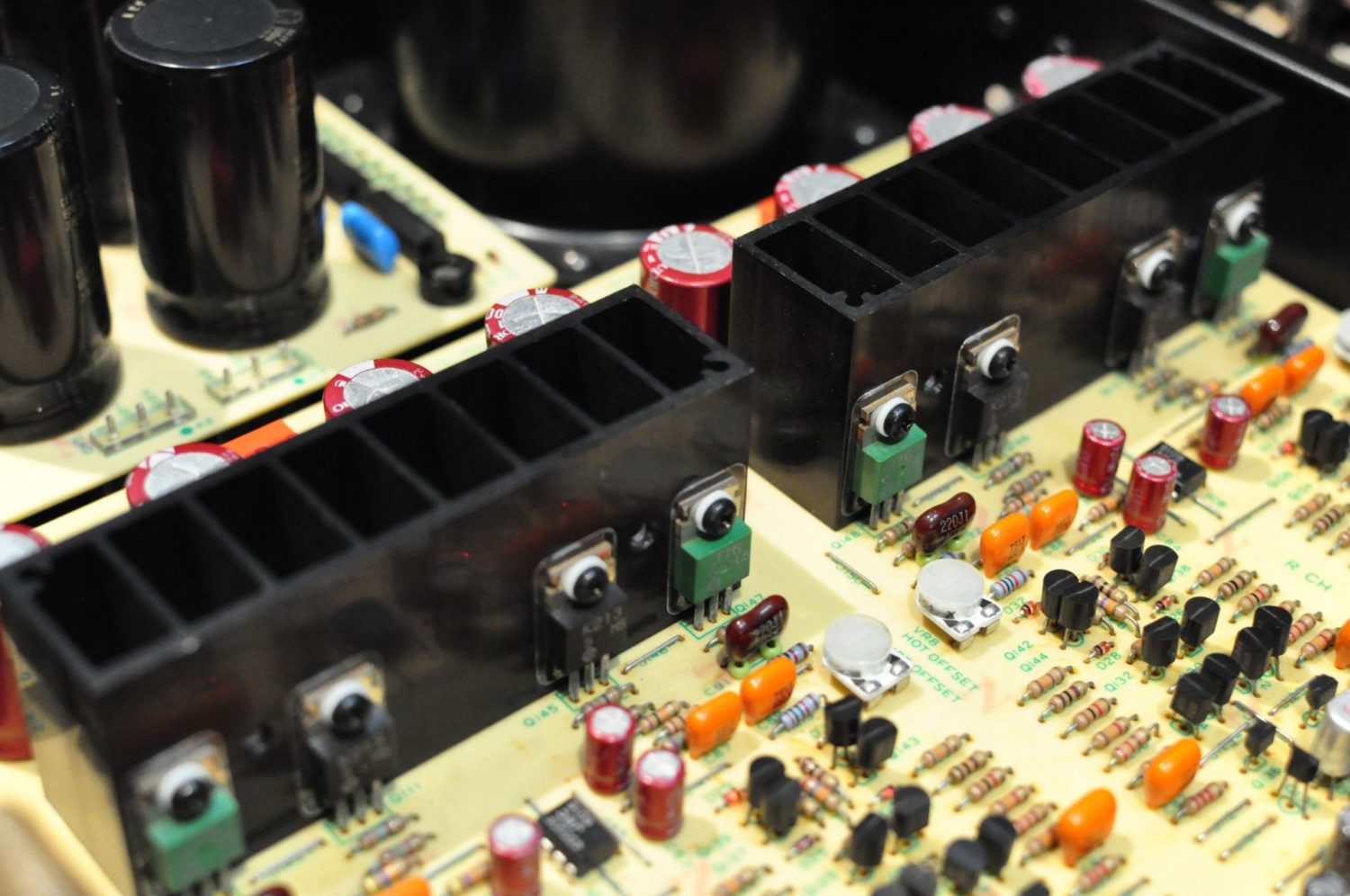
Make no mistake, there are lots of capacitors in the C-202. These are part of the local power supplies for each circuit block. Every circuit block has its own dedicated capacitor bank, lowering the source impedance of each power supply. Let’s take a look…
The C-202 draws 40 watts all the time, courtesy of class A operation. That’s more than most modern power amplifiers dissipate at idle. She gets warm, but not hot; the thermal design is excellent, and the chassis is well ventilated.
Features
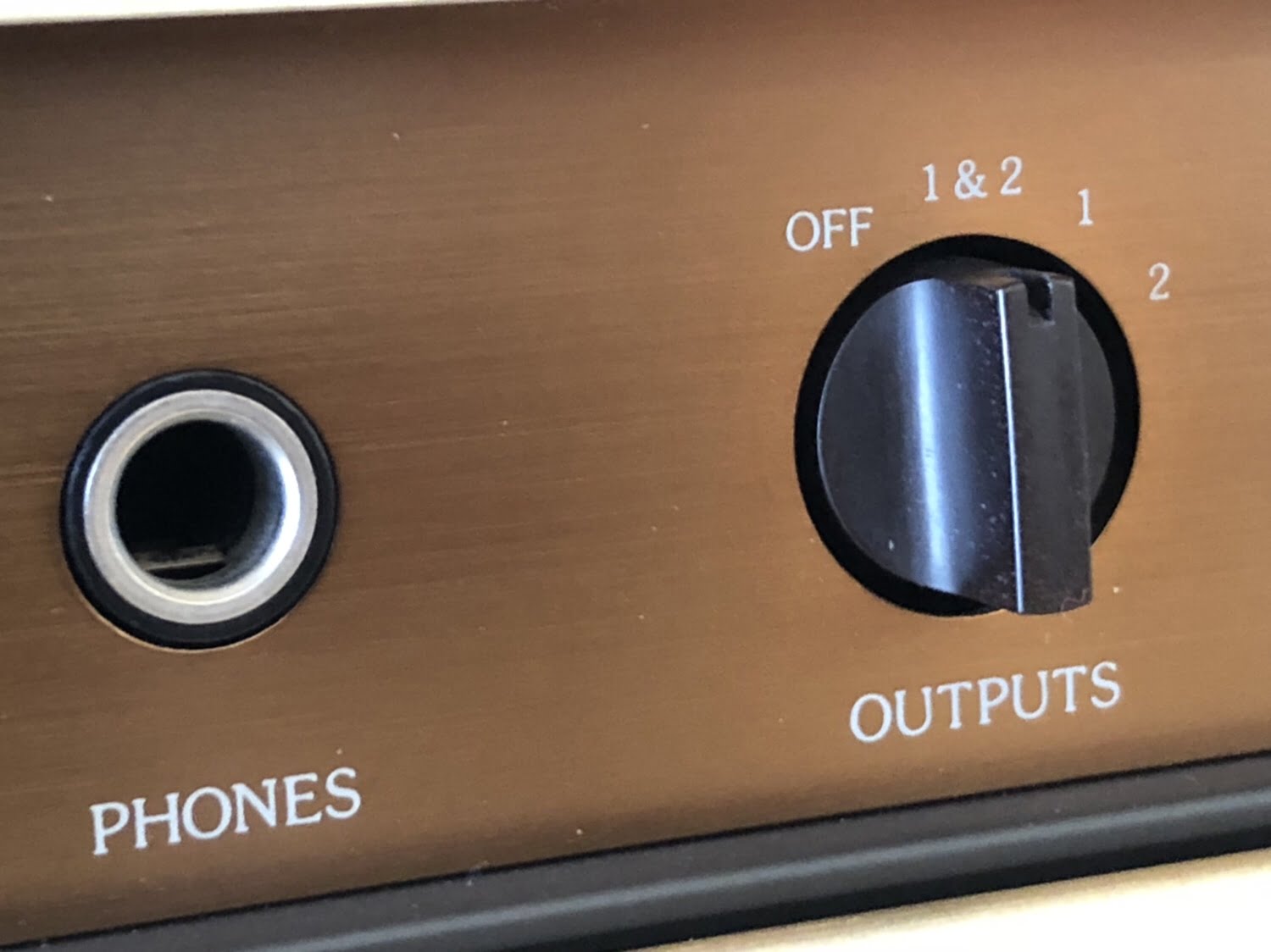
The C-202 has some useful features for those who like their preamps to actually have functionality. For example, there are three switchable outputs, two unbalanced, one balanced.
This is useful because you can feed high-end balanced amps, I use it to provide two separate feeds to my B&W subwoofer. In this way, I have two separate subwoofer set-ups, one for hi-fi, one for home cinema. I just switch the output selector according to what I’m doing.
There’s also a built-in headphone amplifier, capable of driving phones of up to 100 Ohms impedance. The C-202 will drive my HD580s, which are rated at 300 Ohms, but it isn’t totally happy doing so. Still, this is better than having no headphone amp at all.
Headphone socket and output switching. It’s only when you have these features on a preamp that you realise just how useful they are.
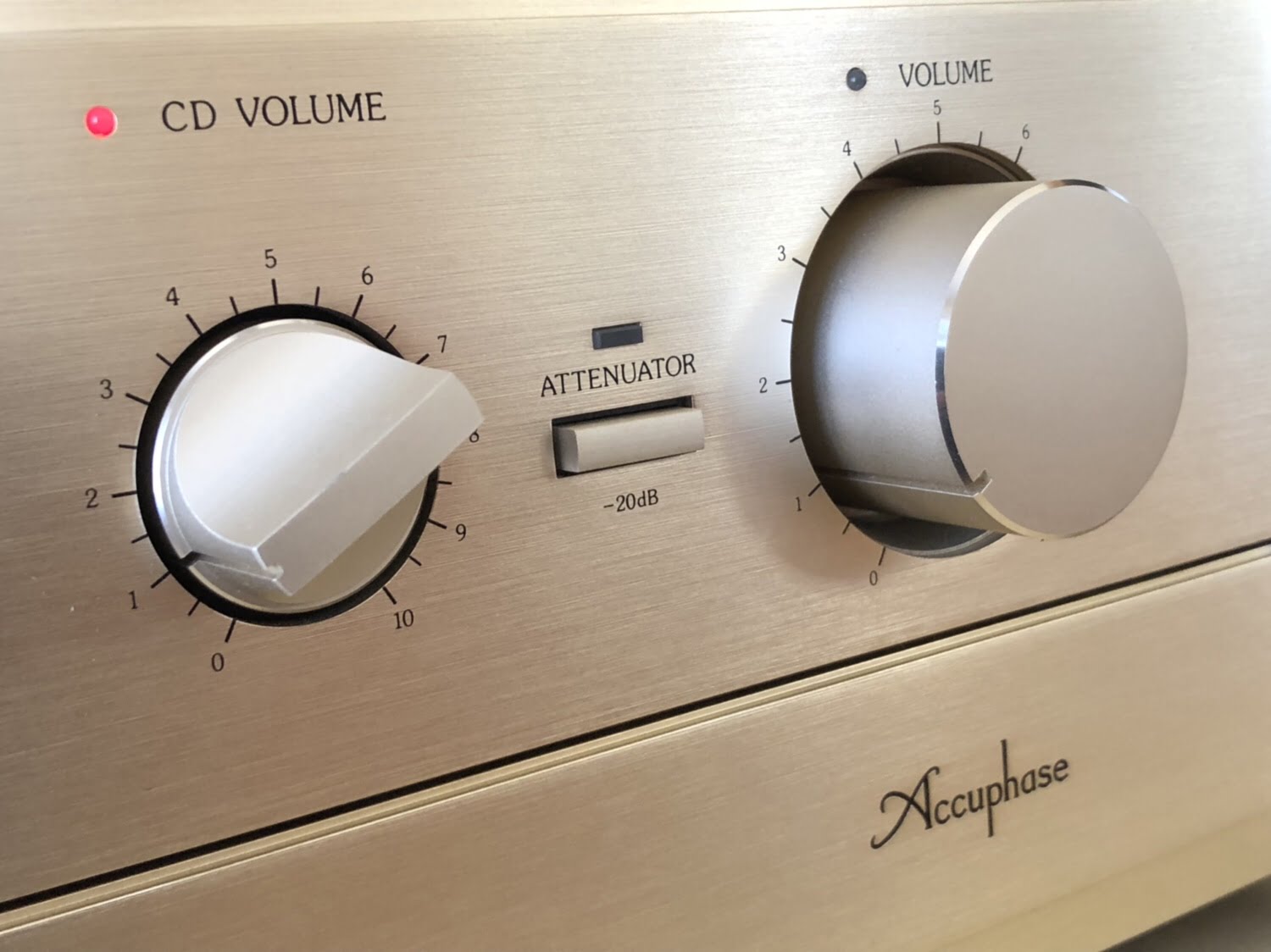
One of the most interesting features is the dedicated CD circuit, separate from the other line-level inputs. The CD circuit features dedicated volume control and bypasses the additional controls and switches under the flap, providing the most direct signal path possible. You can also select balanced or unbalanced inputs for this dedicated CD buffer.
Two volume controls, but why not? It guarantees the purest signal path for the CD input and this is how my DACs are connected.
There is full tape monitoring and switching provided, great if you are getting into cassette tape again, as I am right now. There’s even an attenuator button, which drops the volume by 20dB, useful if you get a phone call, have an overly hot source, or want to change something and return to precisely the same volume setting. I could go on, but let’s just say the C-202 is not short on features. About the only thing it doesn’t have is a built-in phono preamp.
The C-202 is a reliable and superbly constructed preamp as one would expect of Accuphase. The inputs are electronically switched via relays, so there isn’t much to go wrong there. There are some mechanical switches under the front panel flap though, these might need standard service, over time.
This unit was previously owned by a smoker. I removed the main circuit board to address some dry joints and clean the tobacco residue which was causing issues with some of the mechanical switches. I use a washing process, based on how test and measurement equipment is cleaned. This process effectively removes just about every last trace of residue and contamination from the board and other parts.
You easily can see the completely symmetrical arrangement of the hot and cold elements of each channel. It costs a lot to build something this way. This image shows the board after washing/drying.
After drying and reinstalling the main board, I left the C-202 to warm up for a couple of hours. Referring to the service manual, I adjusted all eight DC offset adjustments for each of the two balanced amplifier stages per channel and replaced a blown fuse.
The service manual is critically important here. I was finally able to locate a hard copy of my own and it’s now one of the most treasured manuals in my collection!
Why Aren’t All Preamps Made Like This?
Simple, it costs too much to build regular consumer equipment this way. Sure, zero capacitors in the signal path is the best way to go. But this requires DC servo circuitry for every stage, expensive to design and implement. It also requires eight adjustments per preamp on the production line, and this adds to the unit cost.
FETs are expensive and there are lots of them in this preamplifier. Add in the heat sinks for class-A operation, and other closely matched components needed for balanced operation, and the costs keep rising.
This is old-school design and build is what Accuphase is famous for and it makes a preamp like this such a pleasure to own and service. This unit remains the main preamplifier in my reference system to this day (2022)
Sound Quality and Use case
How does the Accuphase C-202 sound? In a word, sublime. You would expect this, given the design, premium parts and beautiful layout. Deep, clean bass, sparking, airy highs, grain-free, fluid mids. This preamp has all that you’d expect in a premium preamp and more. She is dead quiet and of course, produces her very best when fed with a balanced signal into the dedicated CD buffer.
I use my C-202 as part of a hi-fi stereo system fed by Redbook CD and vinyl. I run my turntable into a Fidelity Research XF-1 step-up transformer, that feeds a Cayin Phono 1 phono preamplifier and that feeds the minimalist line-level buffer of the C-202.
The Bottom Line
You get what you pay for with audio gear and this preamp is a good example of that. Having said that, the Accuphase C-202 is still one of the best-kept secrets in audio. Not many people know about them or how amazing they are, so prices are still sensible. If you need a line-level preamp, I can hardly imagine anything better.
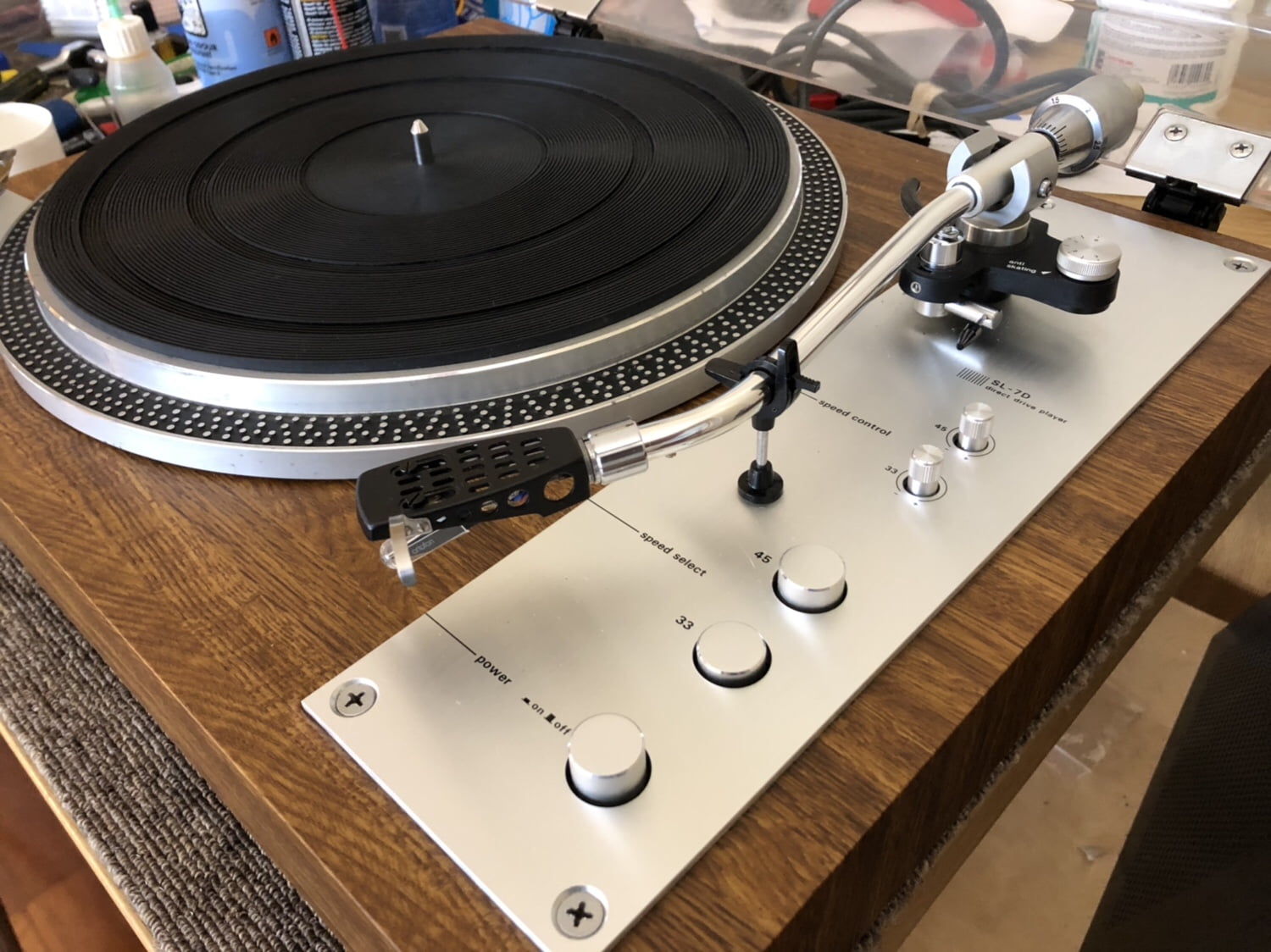
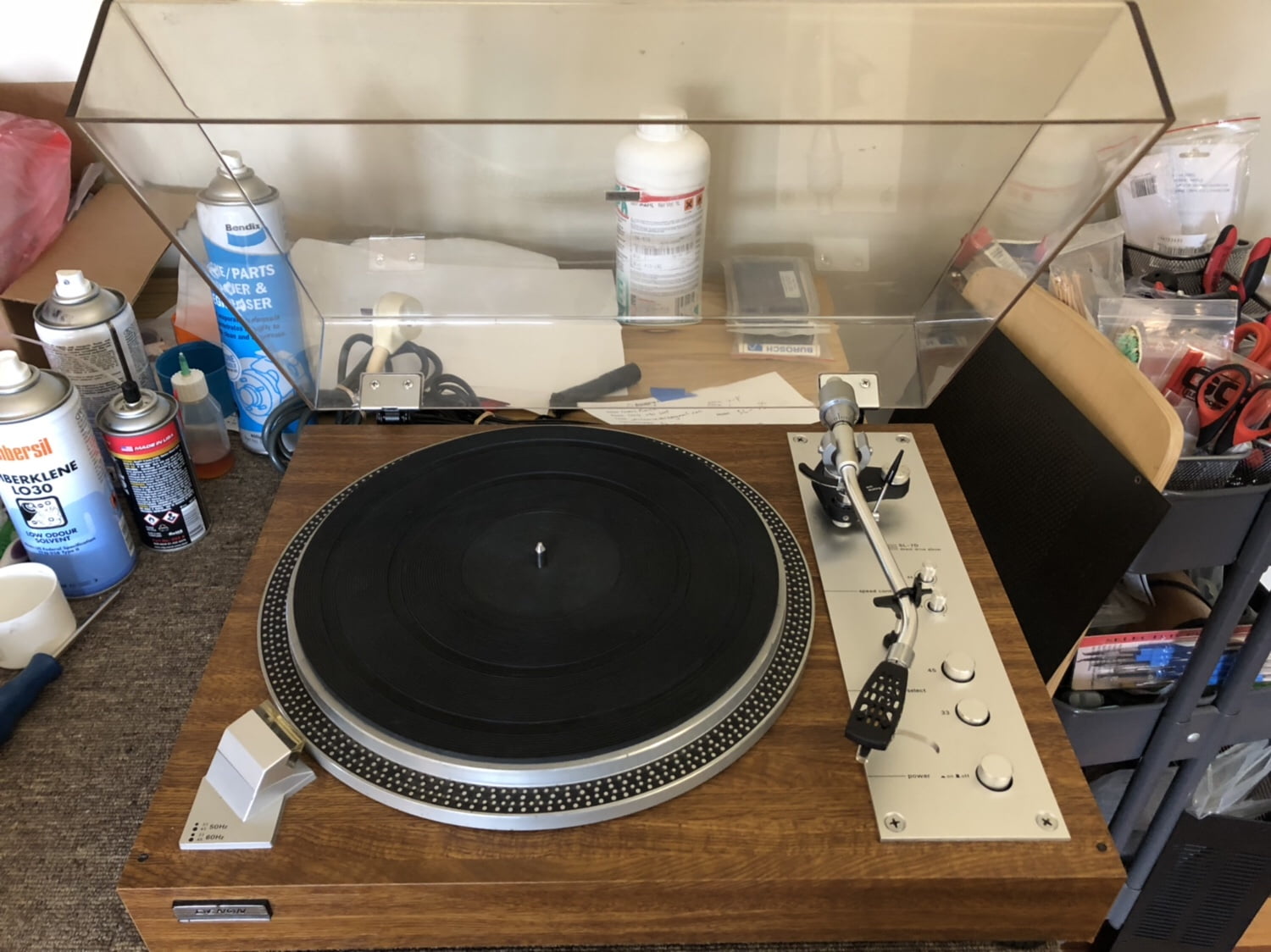
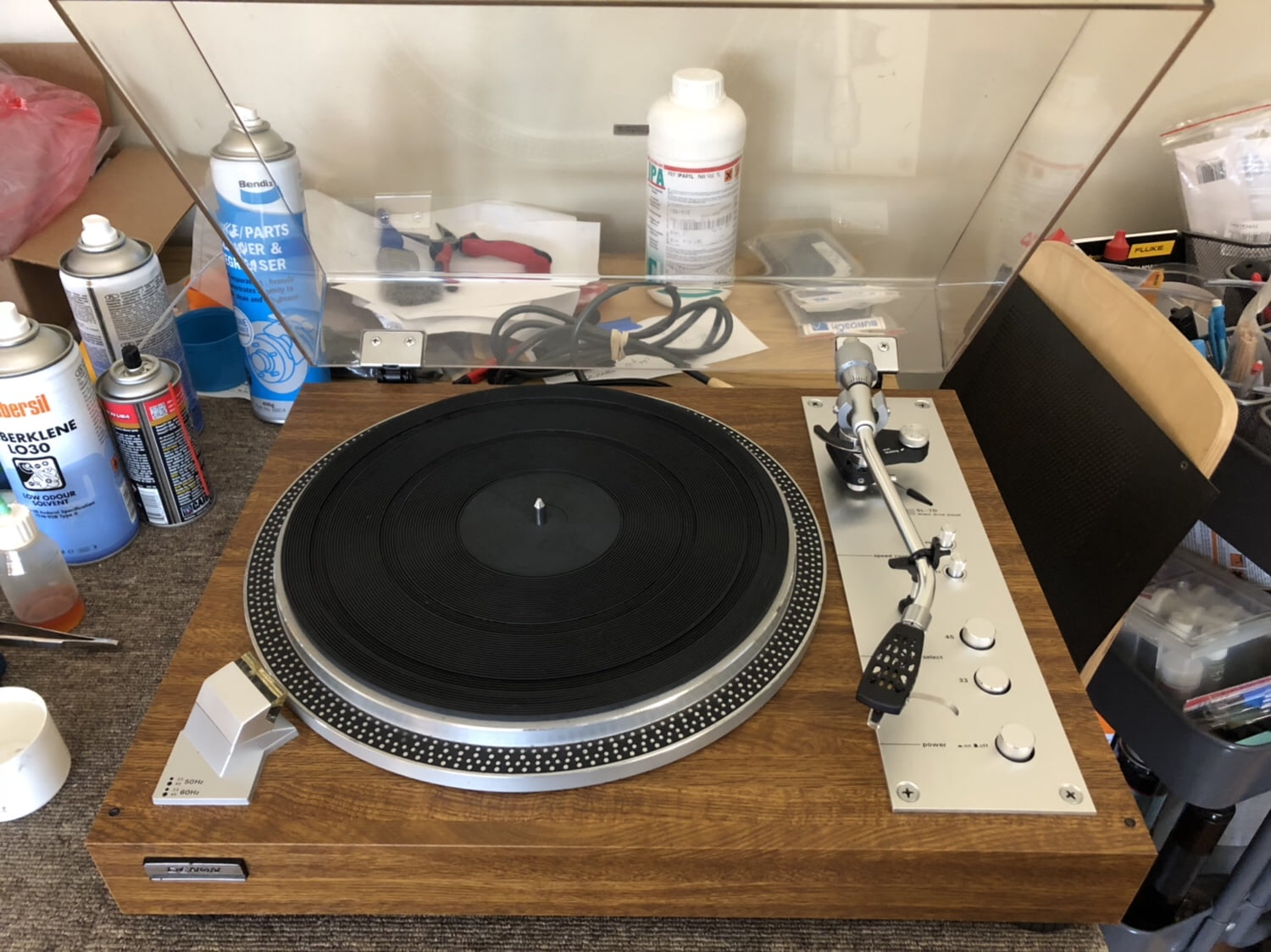
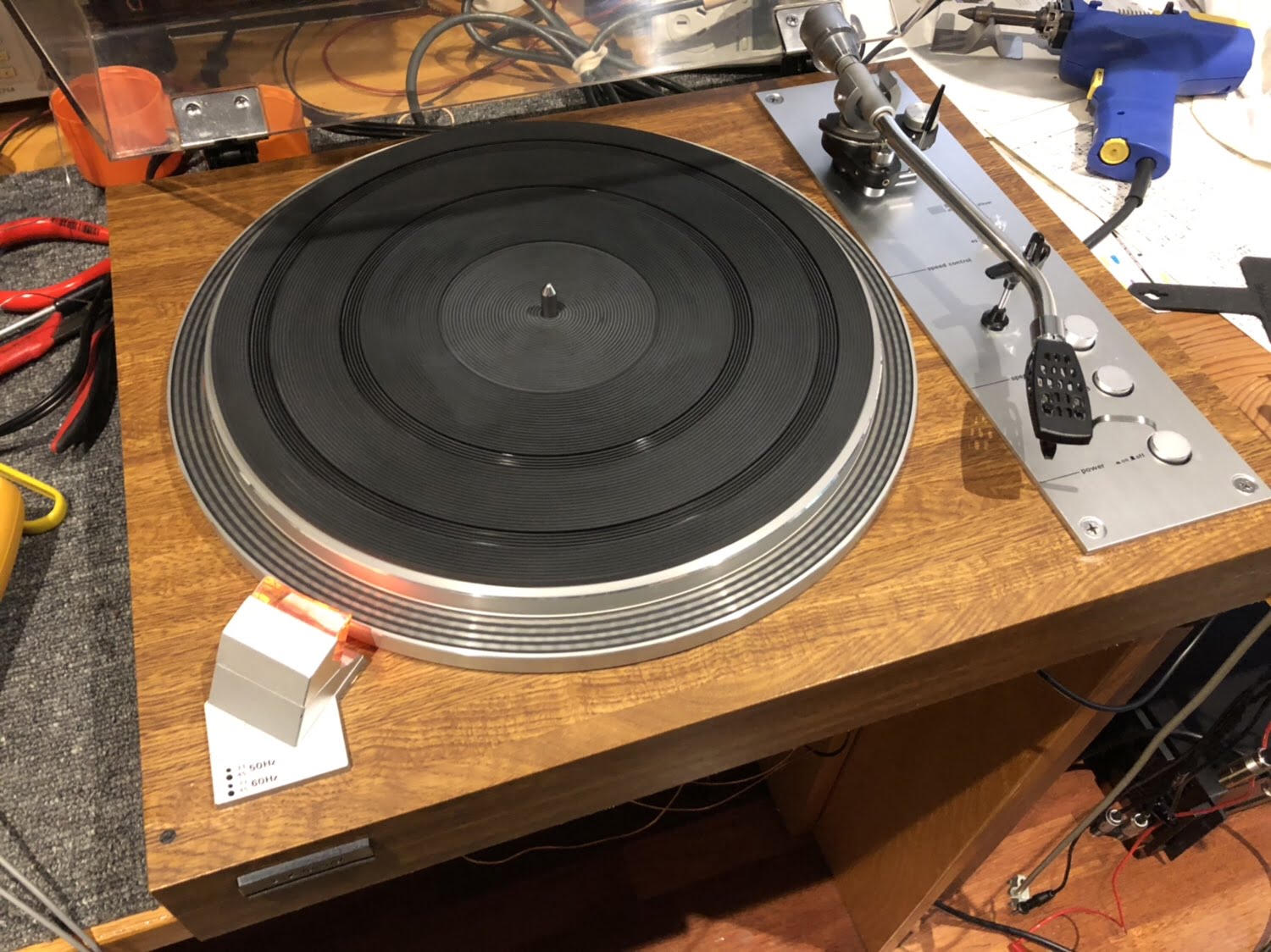
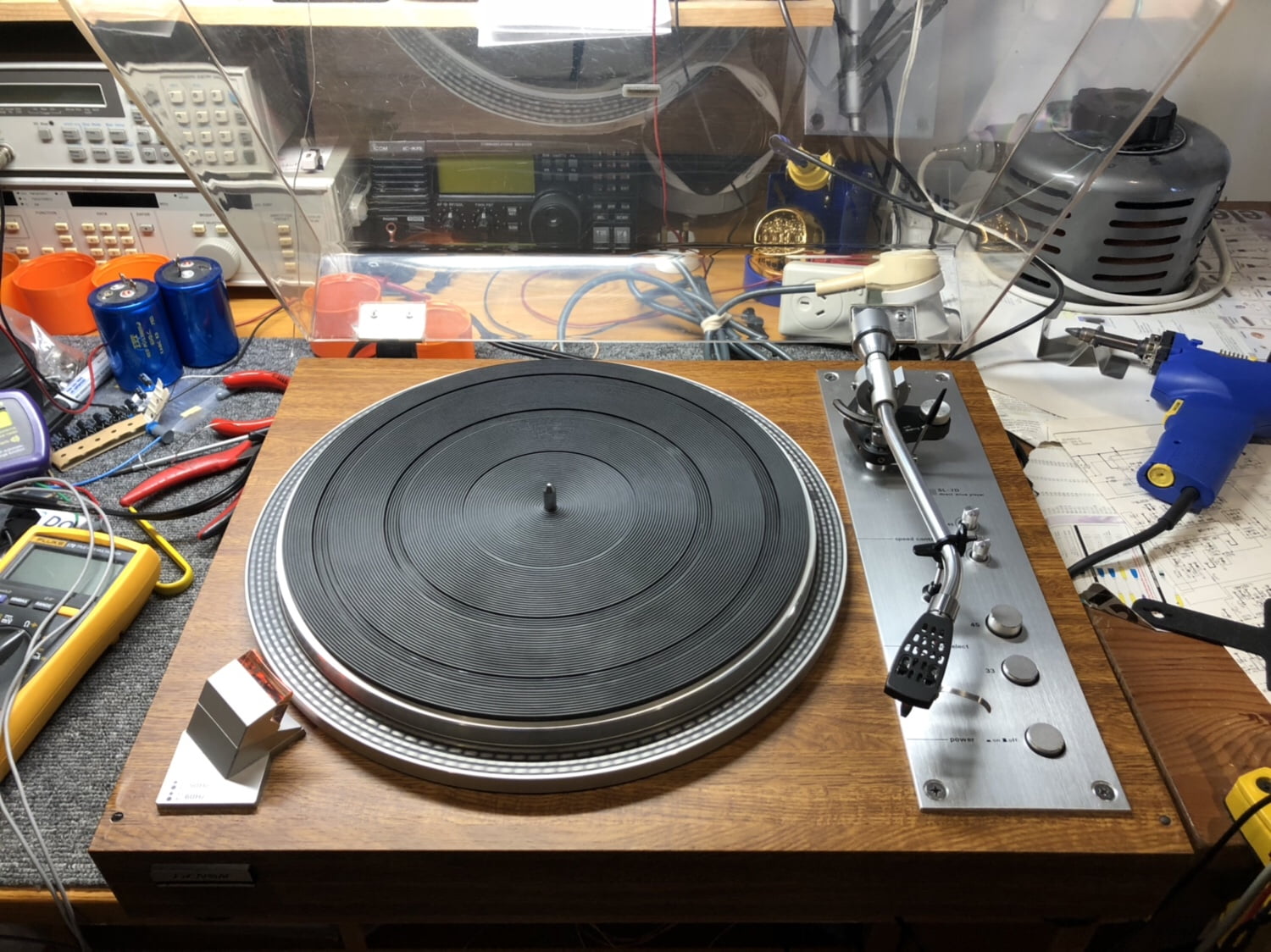
This lovely Denon SL-7D direct drive turntable needed a thorough service in order to play records nicely again. I figured it was a great opportunity to review this classic deck.
I’ve written about the Denon SL-7D previously, they are good, honest turntables and I enjoy working on them. The SL-7D definitely isn’t a super-deck, but they are well-engineered turntables, relatively affordable and, with regular service, should provide many years of listening pleasure.
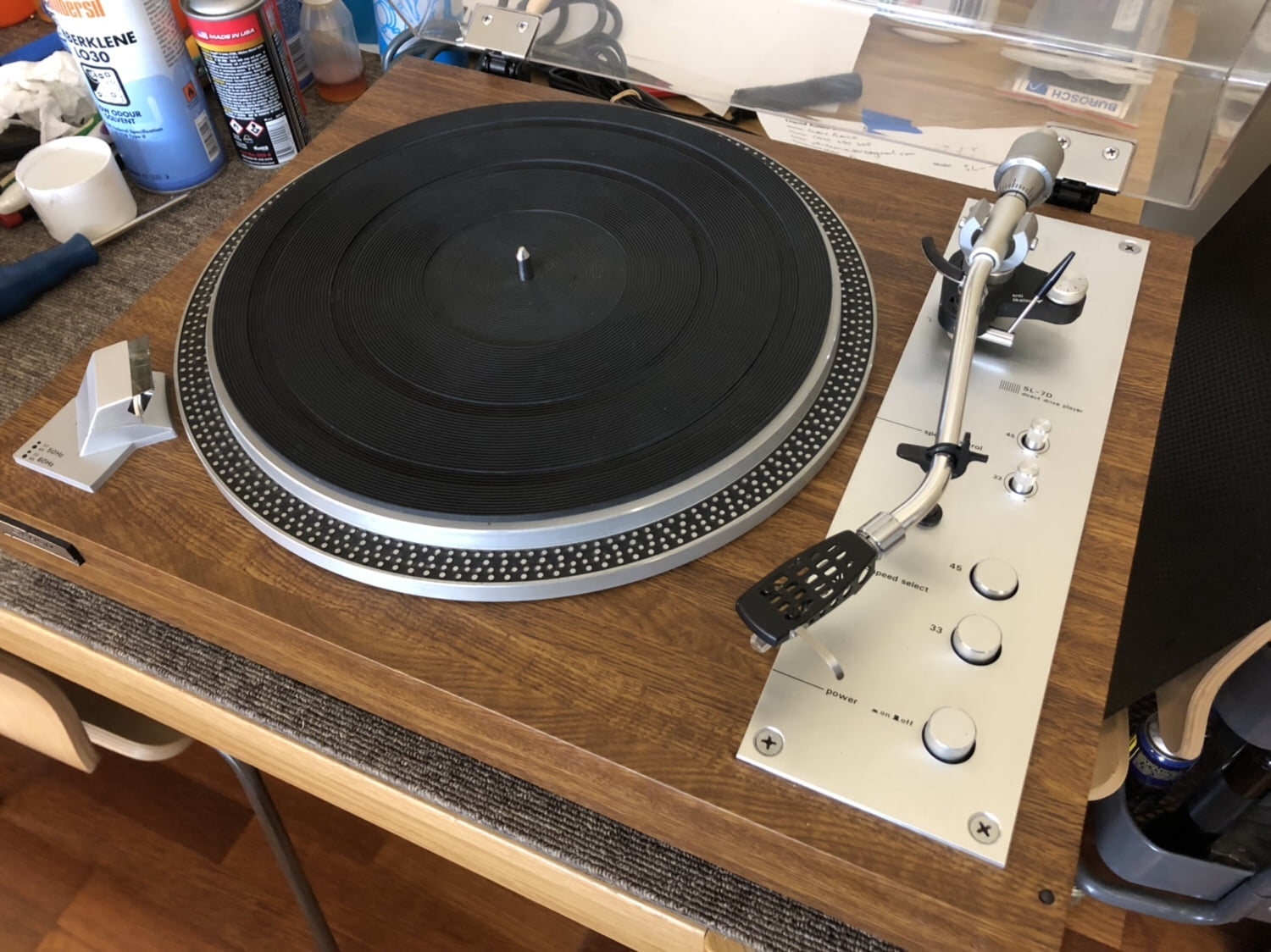
Typical of the era and price point, the Denon SL-7D comes with a basic vinyl wrap and fairly lightweight platter, not quite in keeping with the rest of the deck. It does have a nice tonearm however, and she’ll play a record very well, once properly set-up.
I’m aware of two finishes – the first is this light coloured vinyl wrap you see above. The second, and my preferred colour, is the darker wrap you see below, as featured on this SL-7D I worked on earlier in the year.
The deck is fully manual, meaning you set your speed, manually raise and lower the tonearm and return the arm to the resting position at the end of a record. Manual operation is usually best for sound quality, but many people prefer the push-button simplicity of an automatic machine, or the arm return benefits of a semi-automatic deck.
The SL-7D would make a great first direct drive deck for someone moving up in the turntable world. It would also be an ideal stepping stone into proper vintage turntabling and ideal if you want something a little nicer than plastic Pro-Ject, Rega and Thorens rubbish, but at a similar price-point.
I like the look of the brushed aluminium control panel and push-button controls. This definitely reminds me of the Marantz Model 6300 turntable…
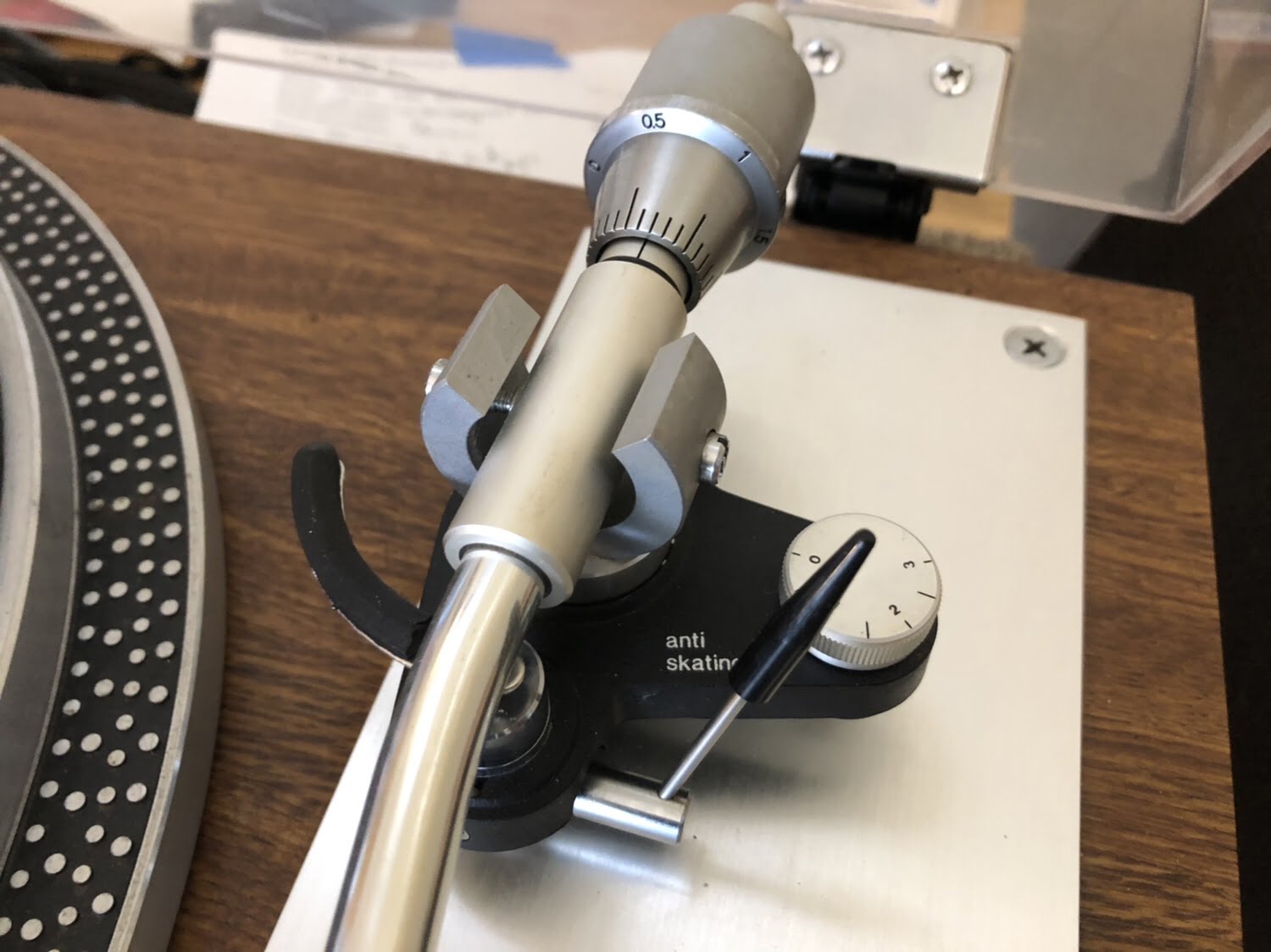
Drive method: direct drive Speed control: servo-controlled Motor: 6-pole outer rotor Platter: 338mm aluminium alloy diecast – light-weight, not great Speeds: 33 and 45rpm Wow and flutter: 0.04% wrms – pretty good spec Signal to noise ratio: 60dB Tonearm: static balanced, S-shaped pipe arm Effective length: 235mm Overhang: 14mm Cartridge weight range: 4.5 to 10.5g Dimensions: 484 x 405 x 163mm Weight: 9kg – moderate overall weight
As I received her, the arm set-up was all wrong, but the arm itself on the SL-7D is quite decent.
Issues and Faults
SL-7Ds are generally reliable machines, the most common problems being speed control issues. This unit came to me supposedly working. I’ve learned over the years that this rarely means working correctly or even playing a record. Often, it just means the platter turns and, sure enough, that was the case here. The unit produced no sound out of one channel, with high levels of noise. The speed controls were also at the end of their travel, indicating adjustments were needed.
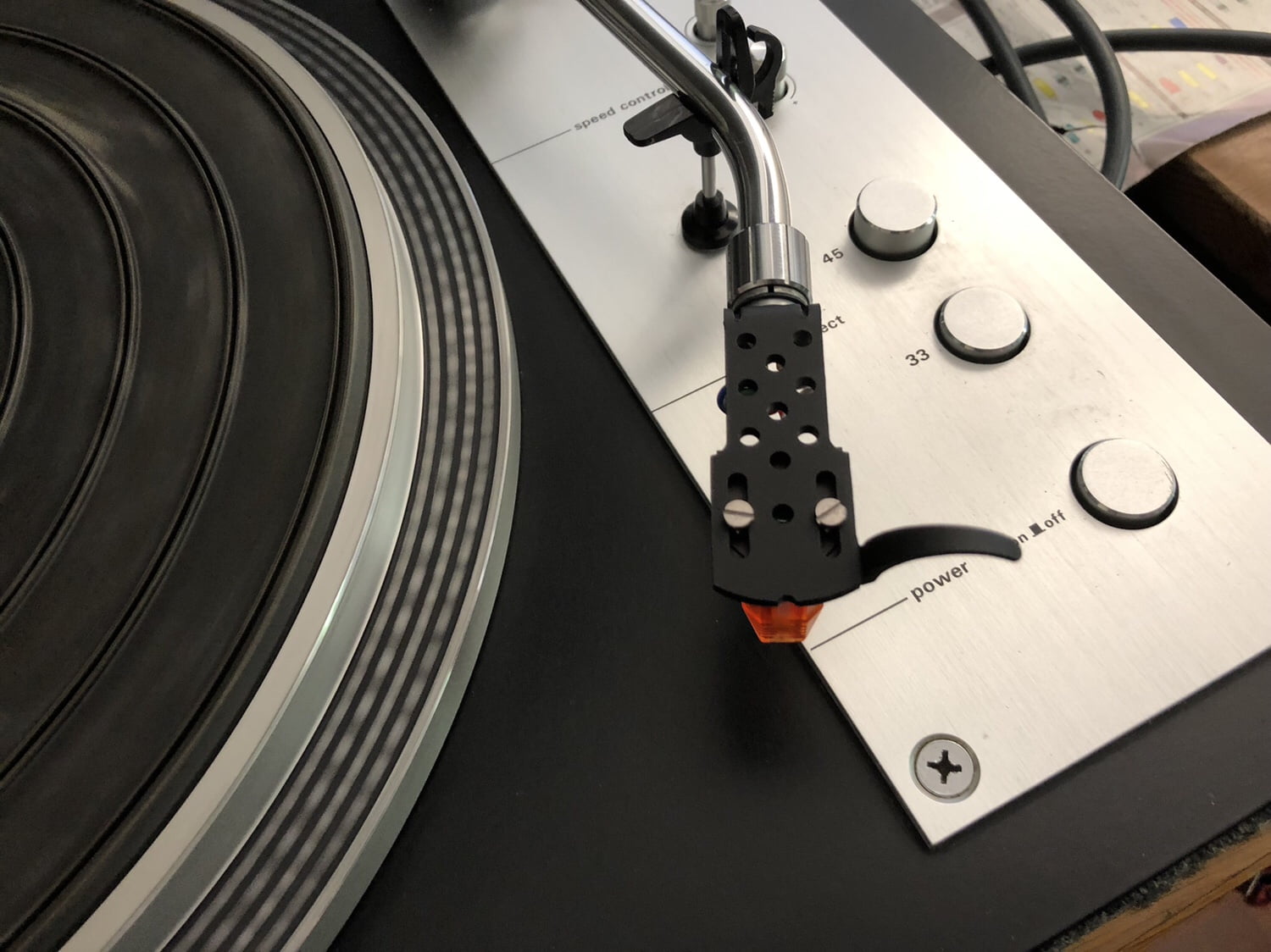
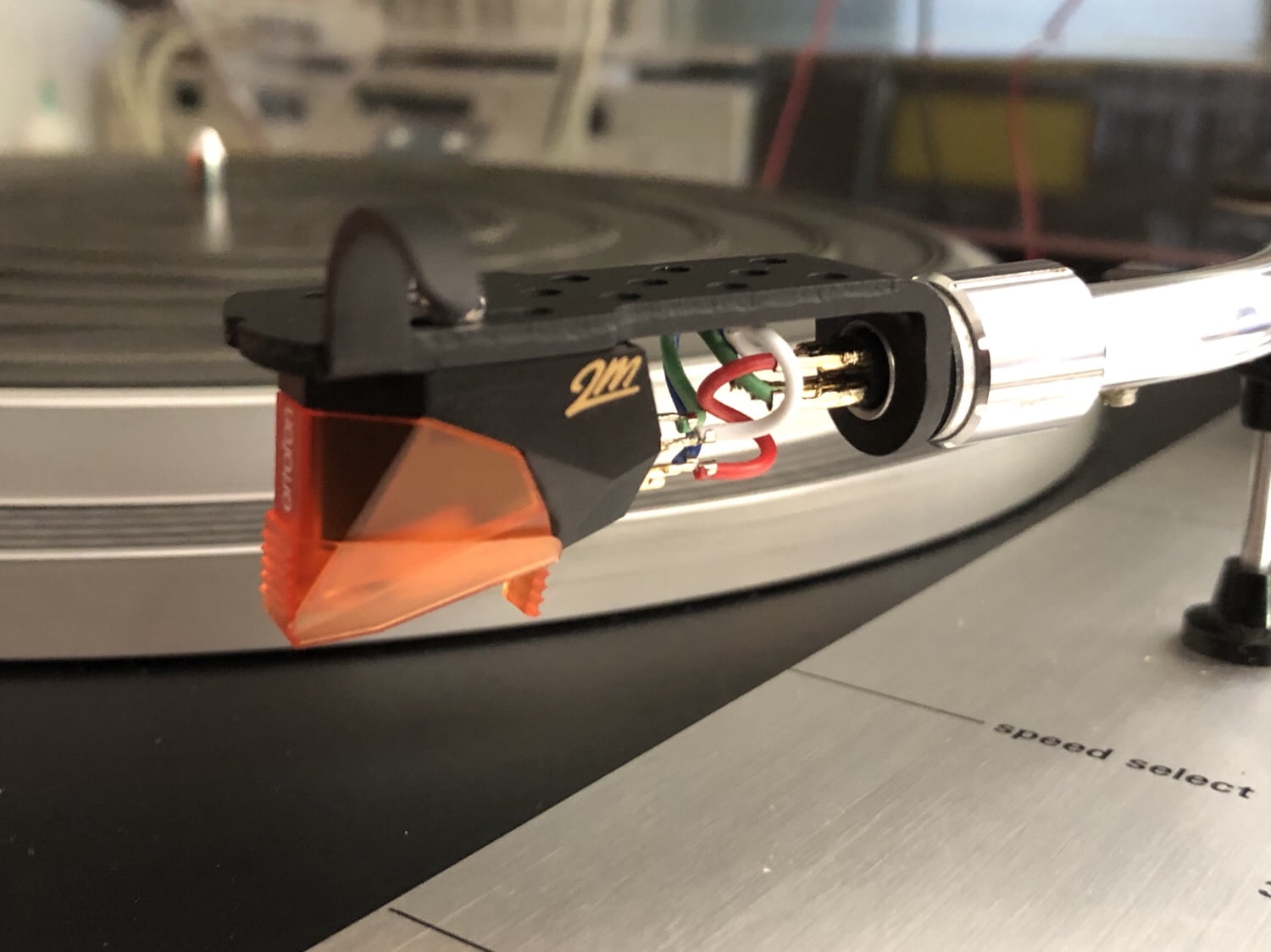
Testing and inspection showed that the Ortofon OM20 cartridge fitted to the deck was broken where the body meets the mounting flange. This wasn’t a problem, I have Ortofon OM series bodies in stock and (with a few exceptions) the bodies are common across the range. The upgrade path comes via the stylus assemblies, which improve as you go up through the range from the OM3 and 5, to the 30 and 40. The OM20 stylus was perfect. More on cartridges for the SL-7D later in this article.
Service
Right, let’s get started. All controls and switches needed the usual attention, as did the deck setup, chassis fasteners, bearing etc.
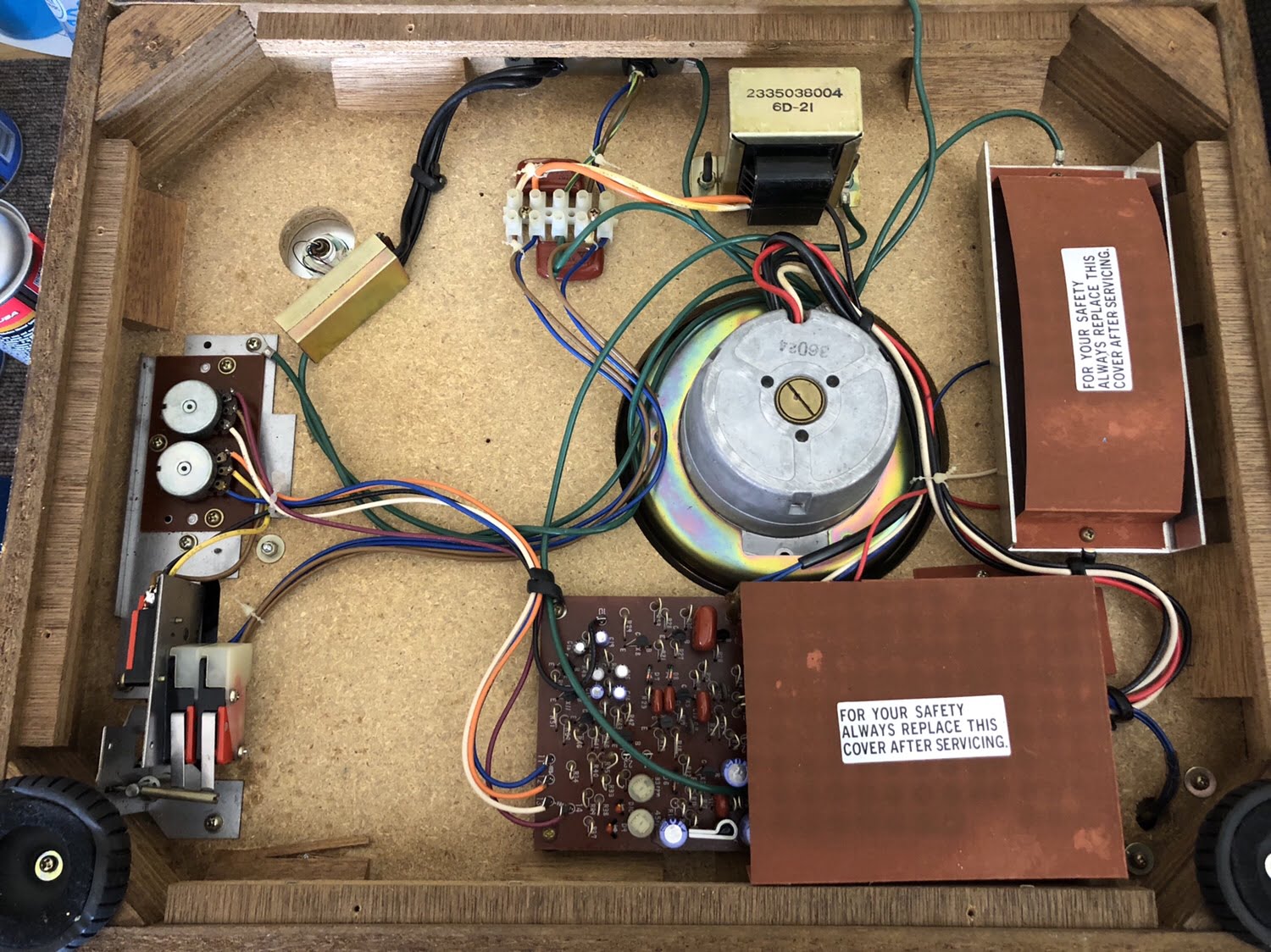
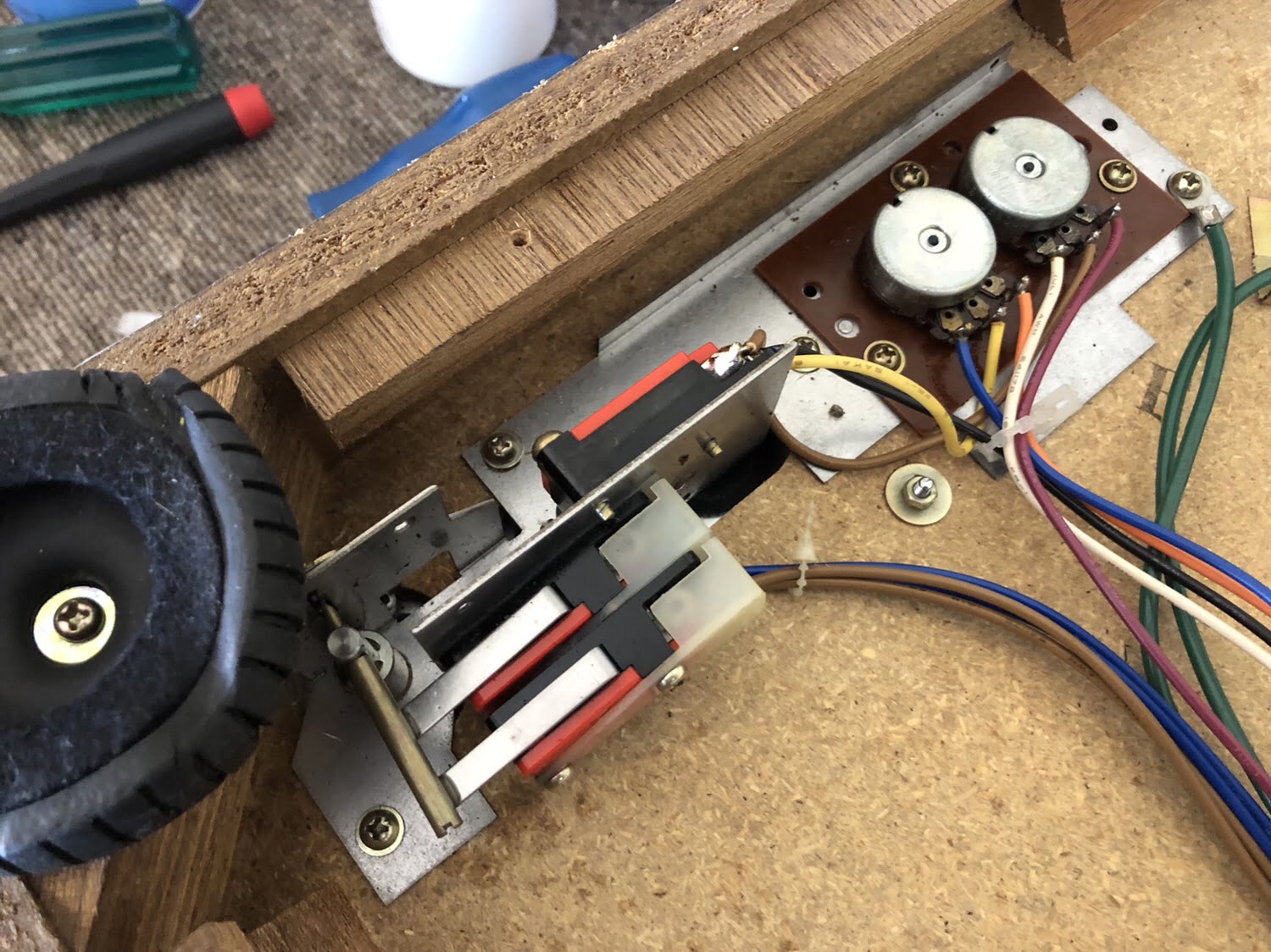
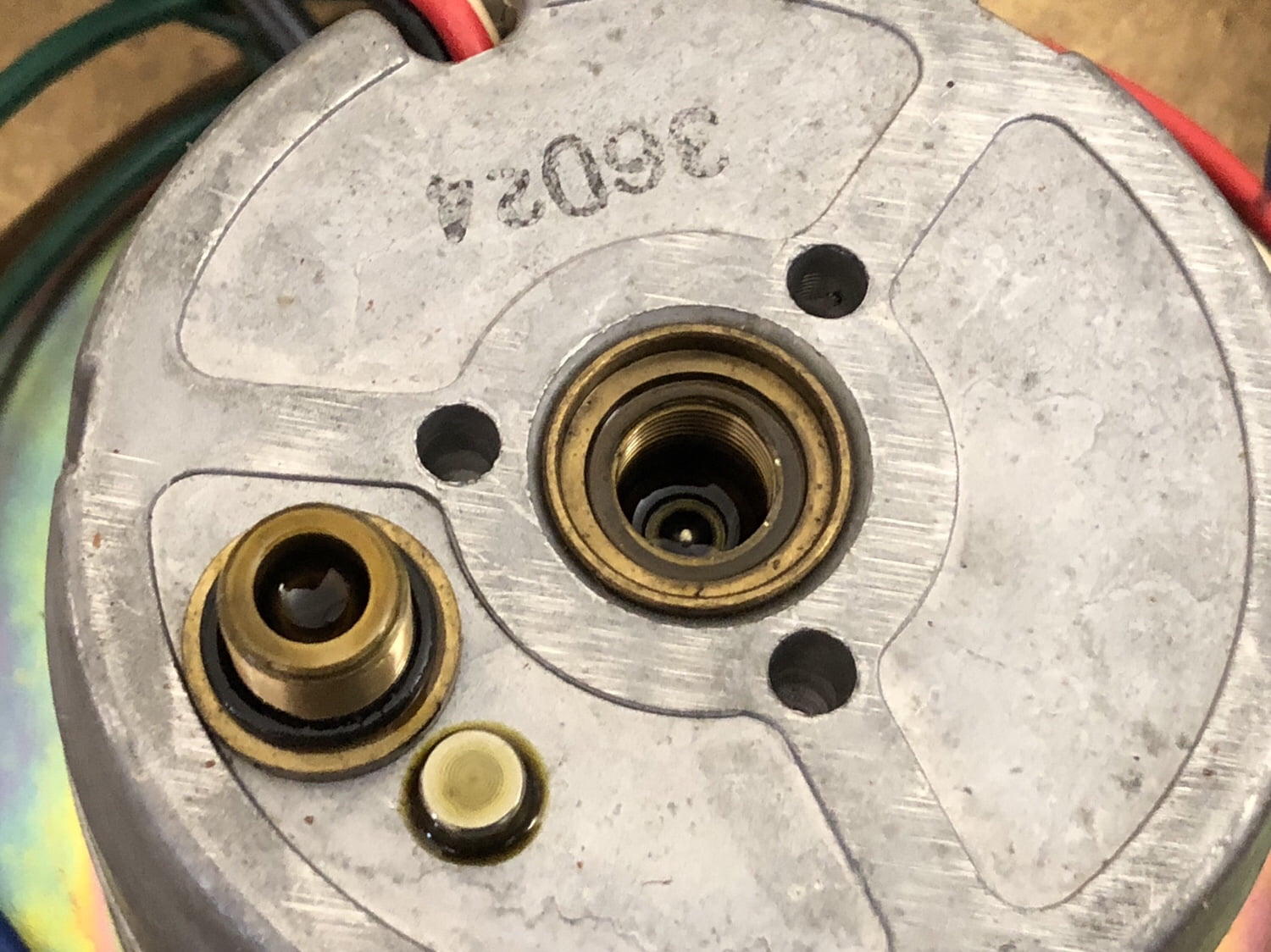
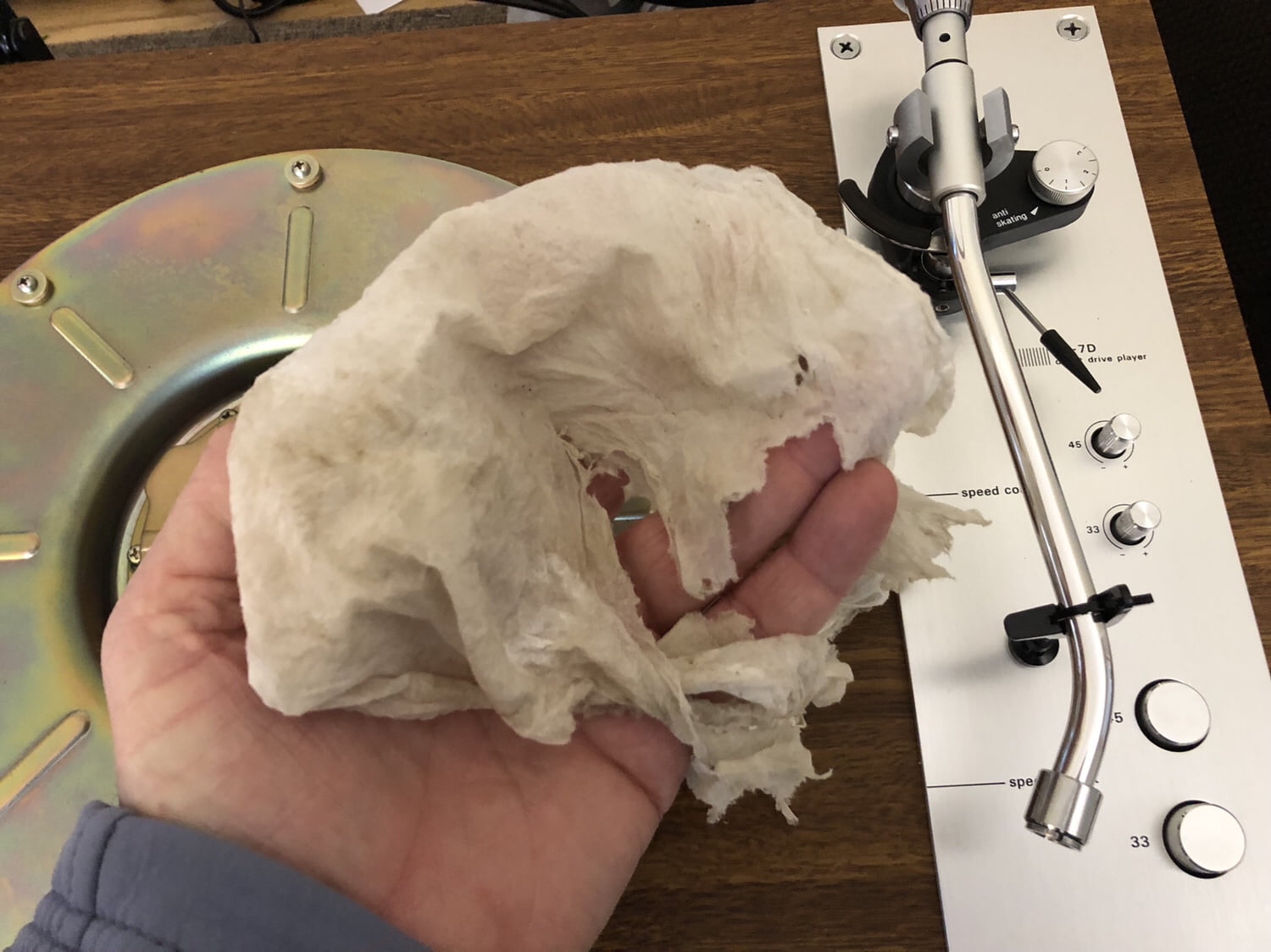
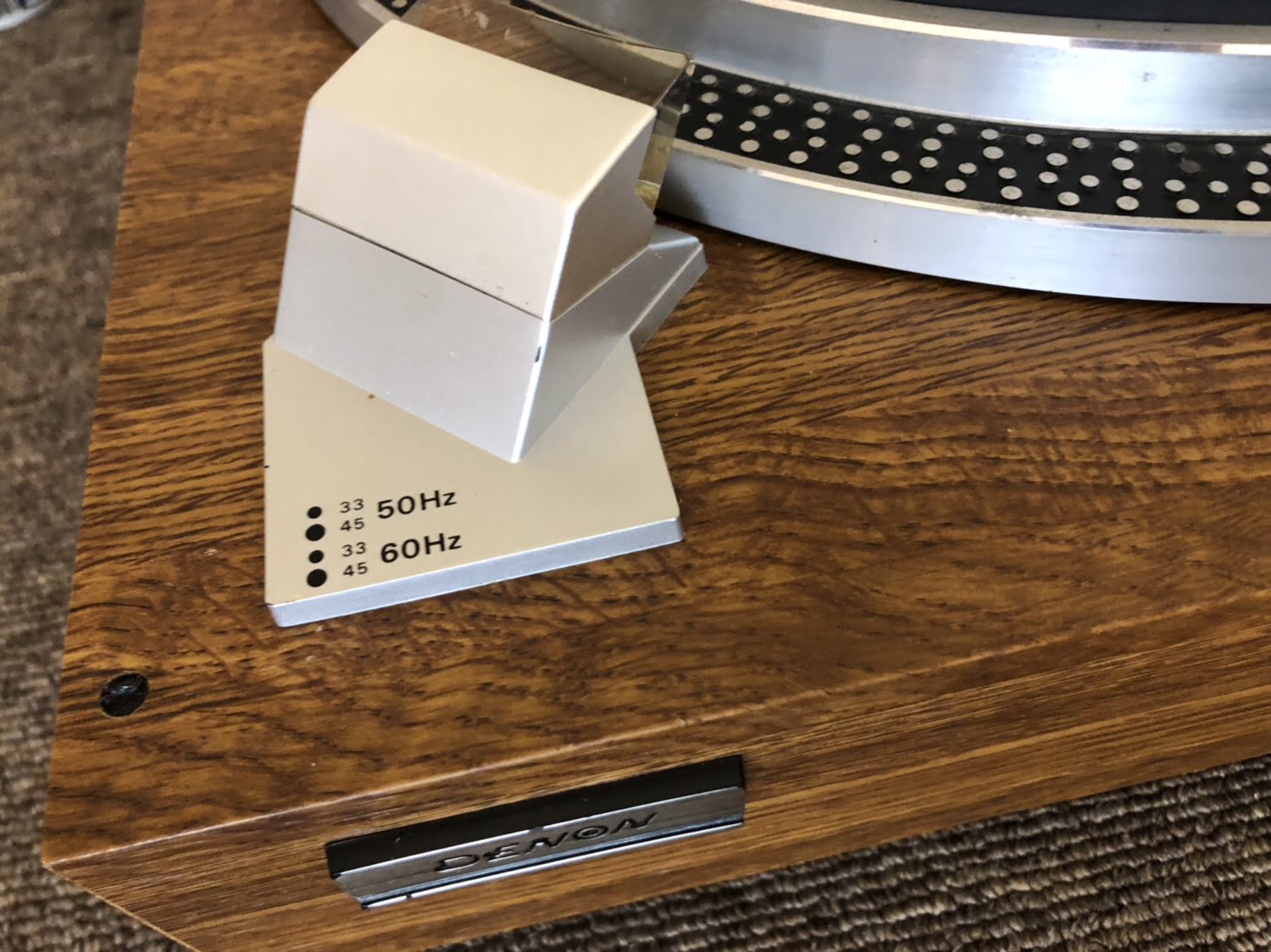
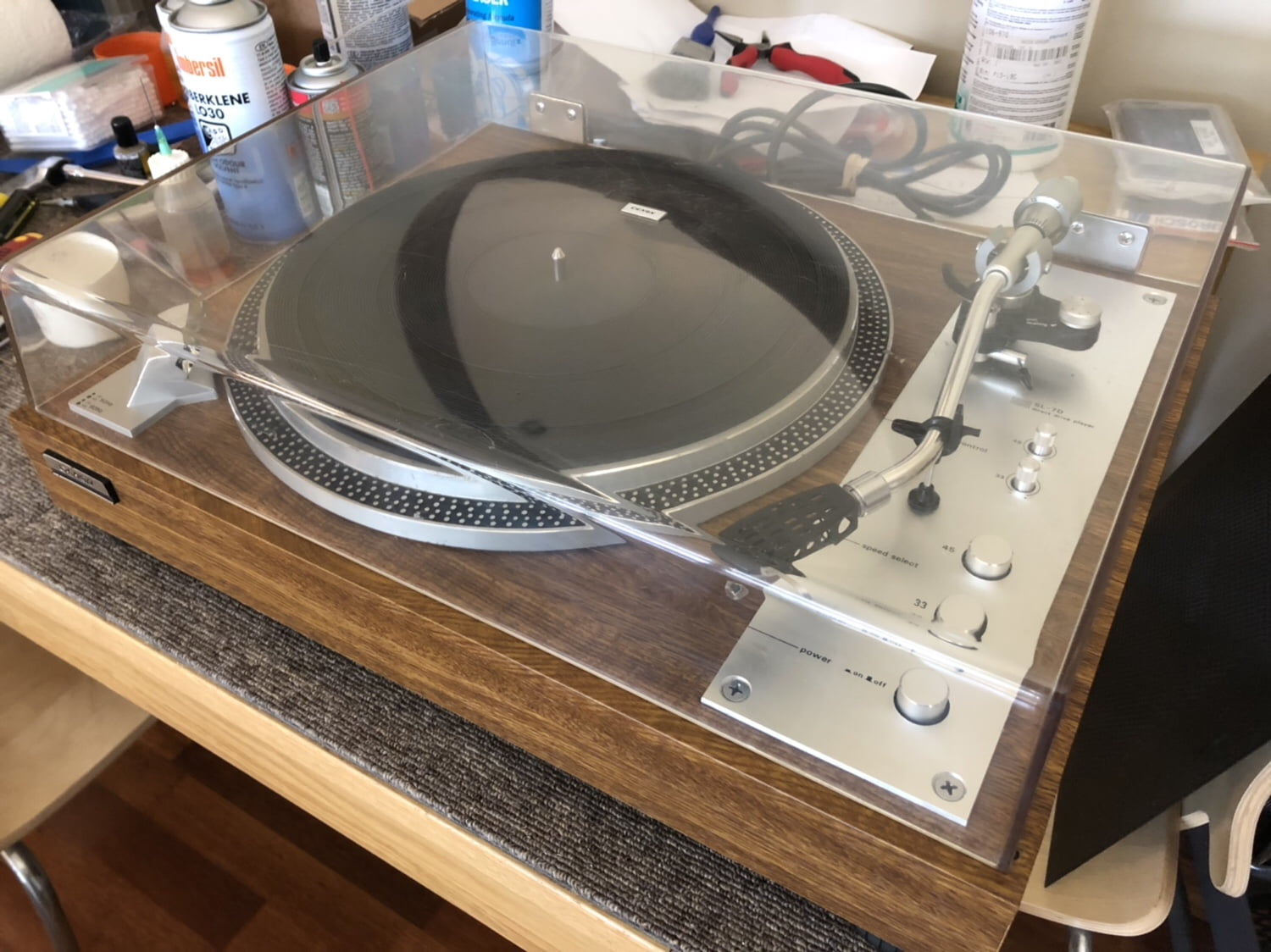
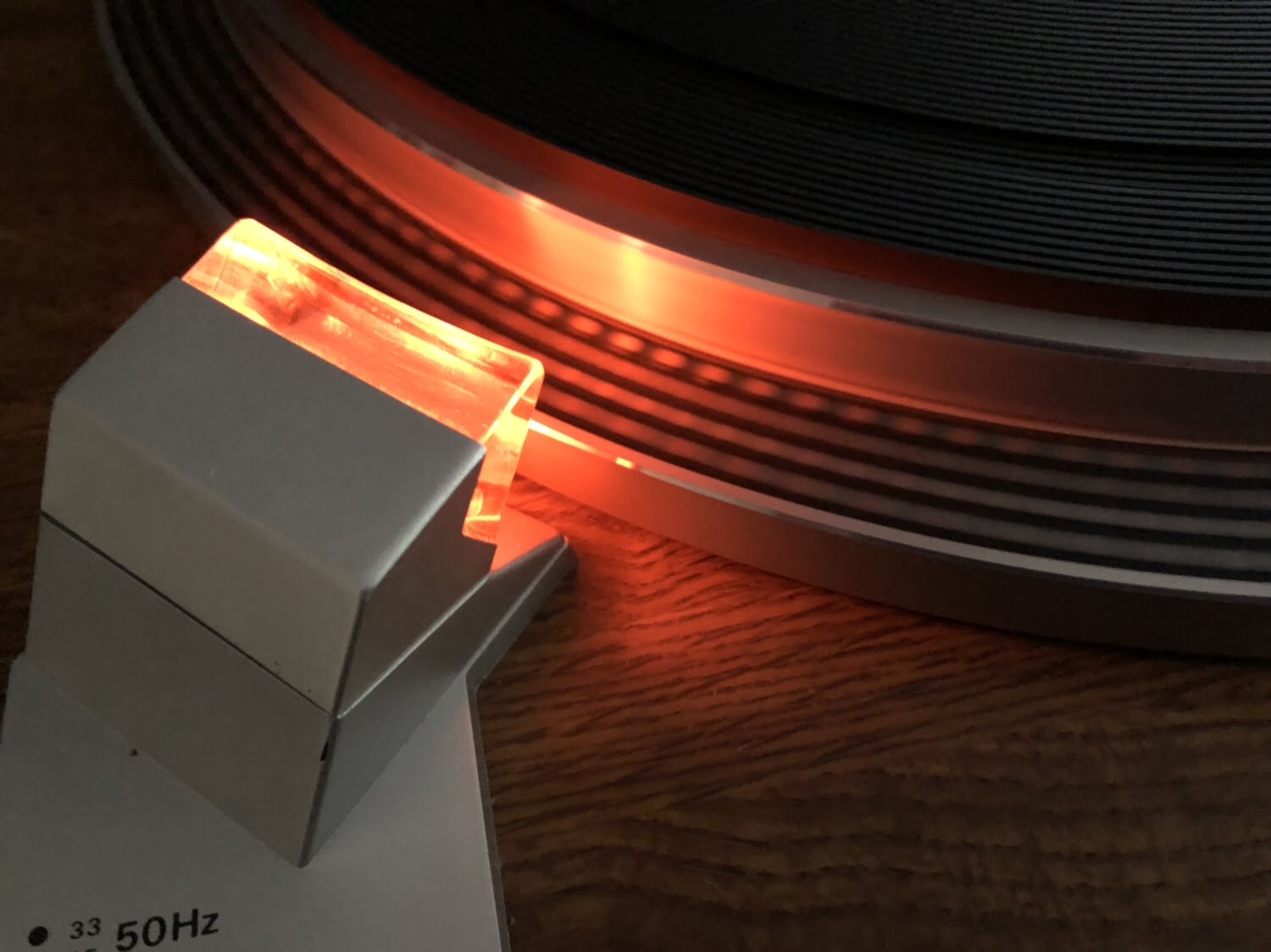
Bottom removed and we see the neat layout of this deck. It would never be made like this now, it would just be too expensive. The switches and motor used here are of high quality.I clean and lubricate switches and controls with a variety of different lubricants, according to purpose. It’s important never to use things like WD40 or cheap ‘sewing machine’ oils here.Denon actually made bearing service very easy, but the correct cleaning products and oils are essential. In this image, we see the open bearing, to the left of that the removed bearing cap, with O-ring seal, and the thrust pad just below it. Note the dirty oil. Lint-free materials that leave no fibres and suitable solvents are essential. Then a high-grade bearing oil of the correct viscosity is added before sealing her up!Back on the top-side of the deck, I removed years of oil and residue, probably much of it from smoking, or poor storage.This is what she looked like after a good clean, what a difference!The last step in this process is to zero the speed control verniers on the top panel, and set the master speed controls. This is technical, requires work jigs and I recommend you leave this part to me for example. What you get though is the full range of speed adjustment back, with correct speeds achieved midrange on the top panel verniers. Again, a little touch, but something most don’t even consider doing for their customers.The lid gets the same cleaning treatment and I always lubricate the hinges…You have to love a good strobe. This isn’t the best strobe, but hey, she’s got a strobe!
Cartridges for the SL-7D
This is pretty important and easy to get wrong. The height of the SL-7D tonearm is non-adjustable. Sadly, this is a shortfall that limits the number of cartridges usable with this deck.
Most cartridges are not tall enough to use on the SL-7D. Use the wrong cartridge and the back end will be too high. This compromises the vertical tracking angle, negatively impacting sound quality.
As it turns out, the Ortofon OM series of cartridges is one of a few that will work well and let you achieve the correct ride height when installed in the SL-7D.
Once I’d installed a new OM series body on the deck, I slipped on the supplied OM20 stylus and she was good to go. I used a spacer with this OM20 installation to get the vertical tracking angle spot on. This had the added benefit of creating a little more mass at the headshell, better suiting this light cartridge/headshell combination.
Final testing after resolving the cartridge issue.
Other good cartridge options for the SL-7D come from the Ortofon 2M series. Earlier this year I serviced another SL-7D and fitted an Ortofon 2M Bronze for that customer. The 2M Bronze is an excellent cartridge and worked well with the deck, albeit with a better headshell. The 2M series doesn’t have quite the height of the OM series, but again a spacer helps there.
We’ve only discussed moving magnet carts so far. In terms of moving coils, you have to keep in mind the fairly lightweight tonearm and smallish counterweight of the SL-7D. There aren’t many moving coil carts with high enough compliance to work with this deck, but the AT OC9 mk3 springs to mind as a good option.
I can of course supply and professionally fit any of these models to your deck.
Sound Quality & User Experience
“So how does she go, Captain..?” Good question. When properly serviced and set up, these decks sound really good and play a record nicely. Choose your cartridge and headshell carefully, get the deck serviced, the alignment spot-on and you’ll be rewarded with low distortion from the long-ish arm, low noise and lower wow & flutter than most belt-drive decks at this point in the market.
The SL-7D is definitely a step up from a more basic belt-driven deck like the Technics SL-23 for example, as much as I like those decks. The pitch and tone of piano, stringed instruments and singers is more solid and bass performance is better than with more basic machines.
You also have the generally high level of precision the Japanese manufacturers are famous for. All the switches and controls are silky smooth once serviced and everything here is built for the long haul, down to the O-ring seal in the brass bearing housing. Very nice and puts many others to shame.
The Bottom Line
The Denon SL-7D is a proper direct-drive deck for sensible money. I mean sensible though, occasionally you’ll see people trying to sell these for $1000+AUD, but that’s just being stupid. Get a sensibly priced one though, a nice one might go for say $750 with a cartridge, and you’ll be rewarded with a real old-skool player you can have some fun with. And don’t we all just want a player we can have some fun with..?!
Don’t forget to contact me for all your vinyl service and repair requirements if you live in Perth, WA. I love working on turntables, I think you’ll hear that when you get yours back from me and set-up again in your system!