
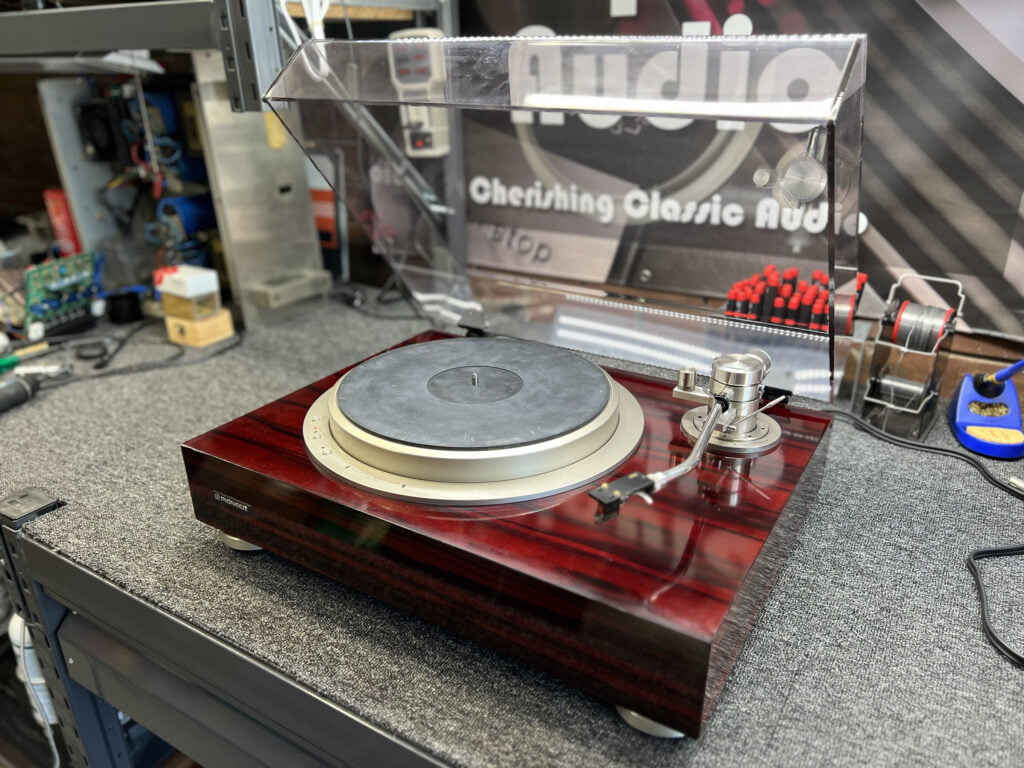
Join me as I service what I think is one of the most beautiful high-performance turntables of all time, the Yamaha GT-2000L.
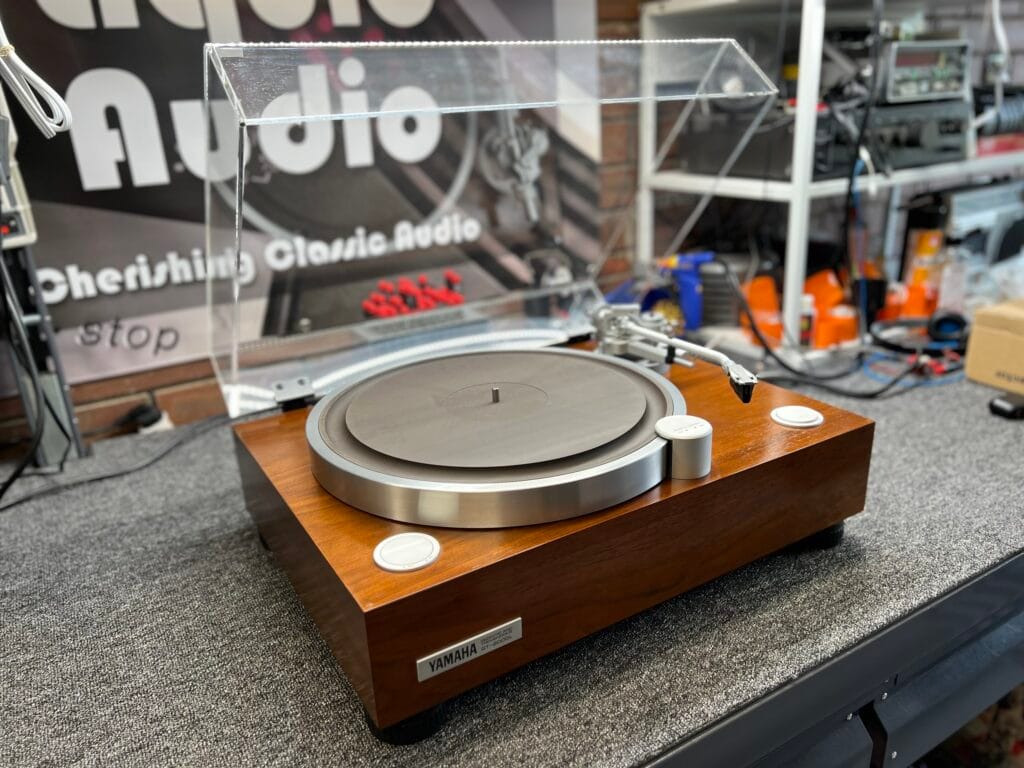
OK, so what is a Yamaha GT-2000L, I hear you ask. Well, it’s a regular near-30kg Yamaha GT-2000 direct drive turntable, a favourite I’ve written about many times, but with a light (maybe oak) real-wood veneer, as opposed to the classic black veneers we so commonly see from Japan, and Yamaha in particular. It also has a redesigned power supply, more on that later.

You get the same high performance that wobbly belt drive turntable owners can only dream about, the gigantic and tremendous build, high-mass, oversized platter, features we see in cutting lathes, and an elegantly simple, slightly ‘brutish’ design aesthetic, wrapped up in an even more beautiful real wood skin, yeilding this thing of beauty:

Yamaha GT-2000/L Specifications & Accessories
Courtesy of The Vintage Knob and adapted by Liquid Mike
| Turntable | |
| Motor: | DC 4-phase 8-pole Bi-directional servo |
| Platter: | 37,4cm / 5,8kg, Anodized |
| Inertia moment: | 1,2t / cm2 |
| Start-up: | 2kg / cm |
| Electronic braking: | With YOP-1 ext. power supply |
| Wow & flutter: | 0,005% (FG measured), i.e., not accurate! |
| S/N ratio: | 85dB (DIN-B) |
| Power consumption: | 7W (GT-2000), 12W (GT-2000L) |
| Dimensions: | 54,5 x 12,5 x 39,5cm |
| Total weight: | 28kg. |
| YA-39 Tonearm | |
| Type: | Static-balanced |
| Effective length: | 26,2cm |
| Overhang: | 14mm |
| Effective mass: | 22g |
| Cartridge weight: | 1 – 20g (not with the standard counterweight) |
| Wiring: | Neglex 2496 |
| Accessories | |
| YOP-1: | External power supply @ 32,000¥ |
| YDS-1: | Air-pump mat @ 60,000¥ |
| YDS-3: | 680g wood+metal puck @ 8,000¥ |
| YDS-9: | Metal puck |
| YSA-1: | Straight tonearm @ 40,000¥ |
| YSA-2: | Straight tonearm @ 60,000¥ |
| YAB-1: | Iron base @ 90,000¥ |
| YGT-1: | 18kg gun-metal platter @ 120,000¥ |
So which accessories should you get for a GT-2000 or GT-2000L? All of them, of course, but the YGT-1 gun metal platter above all others, the YAB-1 cast iron base would be a close second, and the YSA-2 straight arm, possibly third. I’d be scouring Japan for all of them if I owned a GT-2000/L.
The Yamaha GT-2000L does have some minor differences internally that account for the slightly increased power consumption. Despite working on many GT-2000s over the years, I’ve never had the two side by side for comparison purposes. I have, however, put together an image comparison of the electronics later in the article, for your gigantic and tremendous pleasure!
More information on the lovely Yahama GT-2000 and 2000L can be found at the inimitable The Vintage Knob.
Service
This Yamaha GT-2000L came to me in 2023, via a new customer who, as I recall, first purchased an advice consult where we discussed the GT-2000, pros, cons, how to get a good one, etc. That customer found this absolutely pristine example and booked her in for the standard inspection, service, and precision setup, which I was delighted to perform.
I’ve not heard from that customer since, but in my line of work, that usually means things are going well, and I imagine this turntable has been running flawlessly for him, as good Japanese equipment tends to. So, without further ado, let’s take a closer look at this beauty, and I’ll try to prepare a video at some point soon, so stay tuned for that.


Results
So, after what was a fairly modest amount of very careful work, and that’s the key, of course, we have a now perfectly running Yamaha GT-2000L, and an absolute bargain for her thrilled new owner. Not only was he a lovely gentleman, but he genuinely appreciated how great a thing this Yamaha GT-2000L is and what it represents. That makes him the perfect owner of such a beautiful piece.

So, should you seek out and buy a Yamaha GT-2000 or 2000L? Well, if you want to step up to what is basically a sensible end-game turntable and you are prepared to hunt one down, yes. I can’t recommend these highly enough.
Whilst not quite at the top of the tree, these decks offer outstanding value for money and bang-per-buck, especially when compared to overpriced new equipment. Let’s not forget that proper turntables like this sound very different from your standard lightweight stuff, kicking around new or second-hand.
If you’ve not heard a really good deck like this, that’s been carefully and correctly set up, you really need to. If you are under any illusion that newer = better in the world of turntables, listening to a piece of equipment like this GT-2000L will quickly dispel that myth for you. Or just speak to people who know about such things.

Thanks
As always, folks thank you for visiting, and I hope you enjoyed reading about another classic turntable. If you’d like me to look at your Yamaha GT-2000L or any other lovely Japanese turntable, you know where to find me.
Remember, you can support me, my efforts to tell the world about beautiful equipment and keep it performing at its best, by engaging our services, commenting, liking, sharing, subscribing, spreading the word and donating, using the button in the footer. There is a list of recent donors in the sidebar/footer.
Until next time!
Share this:

Discover more from LiQUiD AUDiO
Subscribe to get the latest posts sent to your email.
Gosh that’s beautiful in design and build.
It’s either phonographic pornography or pornographic phonography of the highest order… Well done Mike and the owner.
Ha ha, yes indeed Rob, these are truly beautiful!
Always nice to read about other GT2000L models in Perth like mine. It’s an incredible machine, definitely a mic drop when people ask what tt you have but that’s of course not why I have mine.
Mine has a very slight platter wobble, should probably book it in one day.
Great article as always.
Thanks Jason, glad you enjoyed this one, and it’s always great to hear about other GT-2000Ls in Perth that I’ve not yet worked on!
Very interesting reading yet again and priceless information, thank you Mike. Between Pioneer PL 70(L) and GT 2000(L) which one would be the one to choose?
Thanks Vladan, I’m glad you enjoyed this one. You know, that’s a tough choice. The Pioneer has a better tonearm, and I marginally prefer its aesthetics and the Pioneer ‘thing’; the Yamaha has a better platter and chassis. If I didn’t own two other/better turntables, I’d be happy with either of these beauties. If you are searching, I don’t think you can go wrong with a GT-2000, GT-2000L, PL-70 or PL-70L. All are a significant step up from your lovely KD-990.
The GT2000L is certainly beautiful! Especially once you gave the veneer a licking of oil, came up looking great!
If anybody reads this and is thinking about getting one of these, do it!
They are really great turntables and definitely on another level. I have a regular 2000 although modified (external power supply, custom stainless steel arm board, Groovemaster 2 10 inch tonearm) the inky black background and low surface noise you get off the record amazes me!
I have some modded Technics 1200mk5 tables that sit next to the GT2000 and they look tiny in comparison. The yammy really is Gigantic and Tremendous!
Comparing them sound wise there is also no comparison, the 2000 is next level.
Nice pics and work there Mike!
Long time reader/ watcher, love ya work man.
Cheers from NZ
J
Good on you mate, and great to have a few NZ readers and supporters out there! Great advice there, I agree with all of it, and nice setup you have there. Most people, unfortunately, don’t get to hear and use decks like the GT-2000, but turntables like this from the golden era are streets ahead of what most people can afford new and are 100% recommended.
Hello Mike
Another two great articles – the Class A article and this one on the Yamaha GT-2000L.
I miss my Luxman PD-441 but, at least I replaced it with a then new PD-350 (which I suspect is not in the same league as the Yamaha GT-2000L). Fortunately, I was also, at least, smart enough, to recognize how poor the European and American belt-drives are (even if I was influenced into replacing a superior direct-drive with a belt-drive). The PD-350 is a great turntable even though the vacuum does not work any more. The Micro Seiki belt drives always had real engineering in them as did the Technics SL-23 at the entry level (one that remains a better buy than any Rega, Project, Fluance, Music Hall, Linn, etc). I have given up trying to persuade the flat-earthers and they can cling to their Linns and Regas (although I do like to give them pause for thought by reminding them that pitch is essential to “musicality”).
Thank you for give real hifi and science alive and interesting.
Best regards
Marius
Good on you, Marius, and thanks for your support and sensible comments, always very much appreciated! The class A article is actually from 2016, but I pinned and updated it because of a recent conversation with a visitor. I’ve found the PD-350 to be a better deck than the GT-2000L, for several reasons. The platter is heavier and the chassis, denser; you can fit whatever arm you like – in my case, an FR-64S that kills the Yamaha arm; the TG arm bases are super-heavy duty and far surpass the Yammie in that regard; the vacuum is incredible when it works, and when it doesn’t, nice heavy clamps do the trick. Glad you still enjoy yours!
Apologies for the typographical error – Thank you for keeping real hifi and science alive and interesting.